Trump to ease mileage rules in bid to curb rising car prices
Published in Business News
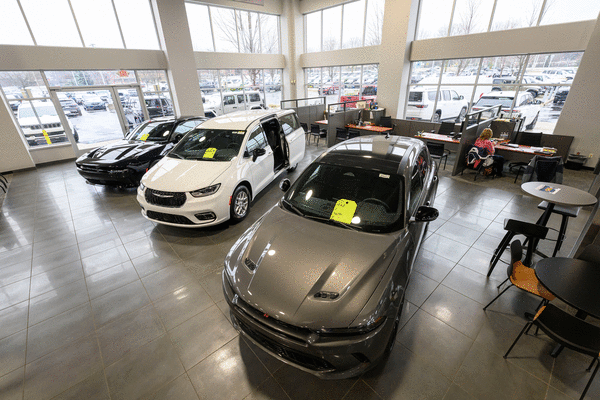
The Trump administration is poised to undo Biden-era fuel efficiency standards it blames for driving up the cost of new cars, according to people familiar with the matter.
Executives from Detroit’s major automakers, including Stellantis NV Chief Executive Officer Antonio Filosa, are slated to attend a White House announcement of proposed fuel economy standards Wednesday, said the people, who asked not to be identified discussing details that are not yet public.
Details of the plan weren’t immediately clear, but the administration is expected to propose standards that are less stringent than those finalized under former President Joe Biden.
The White House declined to comment. The Transportation Department did not immediately respond to requests for comment.
The move is the latest in President Donald Trump’s push to dismantle policies that he criticizes as an “EV mandate.” The Trump administration has argued that “artificially high” fuel economy requirements have pushed the price of a new car — which topped $50,000 on average for the first time in September — out of reach for many Americans.
Car prices have also been rising as domestic automakers increasingly prioritize profitable high-end, feature-laden models over lower-margin, entry-level cars. As they pull back on plug-in models, what’s left for consumers are vehicles that are less efficient and more expensive.
Easing fuel economy requirements is unlikely to swiftly lower prices for consumers. Carmakers plan their lineups years in advance, meaning changes stemming from policy shifts take time to appear in showrooms. Tariffs enacted by Trump have also raised automaker costs by billions of dollars.
The move also threatens a policy that would have reduced household fuel spending and slashed planet-warming carbon dioxide emissions. The Biden administration had said the standards would cut gasoline consumption by almost 70 billion gallons through 2050 and save US consumers more than $23 billion in fuel costs. That translates to about $600 in savings over an individual vehicle’s lifetime.
Stellantis’ shares rose as much as 3% after Bloomberg reported the planned announcement, touching a session high. General Motors Co.’s stock erased earlier declines to trade up 1.1% at 3:42 p.m. in New York.
Automakers for years have invested in new technologies to improve fuel efficiency to comply with stringent requirements enacted under Biden.
Framing the issue as a matter of affordability — that new technology to increase mileage and reduce emissions is adding unnecessary costs — represents an attempt to address the cost of living, which has strained Americans’ budgets and caused widespread dissatisfaction with the president’s stewardship of the economy.
Inflation fears
Trump has been seeking to calm fears over inflation as his own trade policies add costs to products as diverse as cars, avocados and children’s toys. Democrats won sweeping victories in off-year elections last month, portending risks for Trump’s Republicans in next year’s midterm contests that will determine control of Congress.
“We’re bringing back the automobile business,” Trump said during a Cabinet meeting Tuesday. “We’re bringing it all back. I think we’ll be bigger than we’ve ever been in the auto business.”
Trump also reiterated that despite his fondness for electric cars — and his belief that hybrid models “really are working really well” — it’s important to ensure consumers can buy the automobiles they want.
“I terminated the insane electric vehicle mandate and, look, some people that make electric cars weren’t happy with that,” Trump said. “But we have to do that, because you have to have a choice.”
Rule rewrite
Trump ordered the elimination of subsidies and other measures boosting electric vehicles during his first day back in the White House in January. His administration and the Republican-controlled Congress have heeded the directive by moving to ease tailpipe emissions standards, eliminate federal tax credits for EV purchasers and unwind California’s ability to set its own emissions limits.
At Trump’s request, Transportation Secretary Sean Duffy earlier this year ordered a rewrite of fuel economy rules that the administration portrayed as government overstep.
The National Highway Traffic Safety Administration in June laid out its legal rationale for replacing the Biden-era rules. It announced that standards finalized last year improperly considered alternative fuel vehicles such as battery-electric cars when determining future fleet requirements.
Those existing standards require automakers to achieve an average of about 50 miles per gallon across their 2031 model-year vehicles.
(With assistance from Keith Naughton and Justin Sink.)
©2025 Bloomberg L.P. Visit bloomberg.com. Distributed by Tribune Content Agency, LLC.








Comments