SpaceX to pursue 2026 IPO raising far above $30 billion
Published in Business News
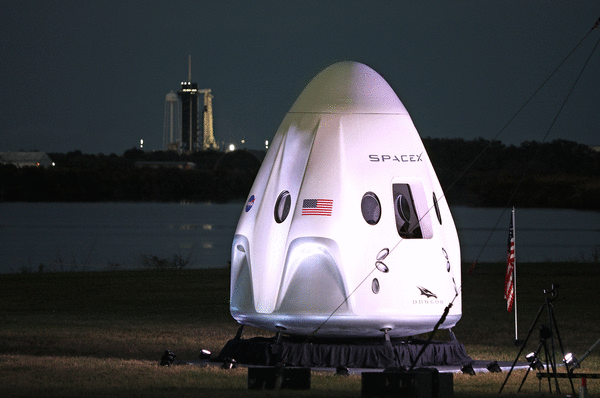
SpaceX is moving ahead with plans for an initial public offering that would seek to raise significantly more than $30 billion, people familiar with the matter said, in a transaction that would make it the biggest listing of all time.
The Elon Musk-led company is targeting a valuation of about $1.5 trillion for the entire company, which would leave SpaceX near the market value that Saudi Aramco established during its record 2019 listing. The oil major raised $29 billion at the time.
SpaceX’s management and advisers are pursuing a listing as soon as mid-to-late 2026, said some of the people, who declined to be identified because the matter is confidential. The timing of the IPO could change based on market conditions and other factors, and one of the people said it could slip into 2027.
A representative for SpaceX didn’t immediately respond to a request for comment.
SpaceX’s IPO plans sent shares in other space companies higher on Tuesday. EchoStar Corp., which has agreed to sell spectrum licenses to SpaceX, rose as much as as 12% in New York, hitting a fresh intraday record. Space transportation company Rocket Lab Corp. extended gains to as much as 4.3%.
Bloomberg and other media reported on Friday that SpaceX is exploring a possible IPO as soon as late next year. Musk and the company’s board of directors advanced plans for the listing and fundraising — including hiring for key roles and how it would spend the capital — in recent days as SpaceX firmed up its latest insider share sale, one of the people said.
SpaceX’s faster path to public markets is in parts fueled by the strength of its fast-growing Starlink satellite internet service, including the promise of a direct-to-mobile business, as well as the development of its Starship moon and Mars rocket.
The company is expected to produce around $15 billion in revenue in 2025, increasing to between $22 billion and $24 billion in 2026, one of the people said, with the majority of sales coming from Starlink.
SpaceX expects to use some of the funds raised in an IPO to develop space-based data centers, including purchasing the chips required to run them, two of the people said, an idea Musk expressed interest in during a recent event with Baron Capital.
In the current secondary offering, SpaceX has set a per-share price of around $420, putting its valuation above the $800 billion previously reported, people familiar with the discussions said. The company is allowing employees to sell around $2 billion worth of stock and SpaceX will participate in buying back some shares, two of the people said.
The valuation strategy is designed to level-set the company’s fair market valuation in a precursor to the IPO, one of the people added.
“SpaceX has been cash-flow positive for many years and does periodic stock buybacks twice a year to provide liquidity for employees and investors,” Musk said in a post Dec. 6 on his social media platform X.
“Valuation increments are a function of progress with Starship and Starlink and securing global direct-to-cell spectrum that greatly increases our addressable market,” he said.
SpaceX executives have repeatedly floated the idea of spinning off the Starlink business into a separate, publicly traded company — a concept President Gwynne Shotwell first suggested in 2020.
However, Musk cast doubt on the timing over the years and Chief Financial Officer Bret Johnsen said in 2024 that a Starlink IPO would be something that would take place more likely “in the years to come.”
The biggest long-term investors in SpaceX are venture firms like Peter Thiel’s Founder’s Fund, 137 Ventures led by Justin Fishner-Wolfson and Valor Equity Partners. Fidelity also is a significant investor, as is Alphabet Inc.’s Google.
If SpaceX sold 5% of the company at that valuation, it would have to sell $40 billion of stock — making it the biggest IPO of all time, well above Saudi Aramco’s roughly $29 billion listing in 2019. That company sold just 1.5% of ownership in that offering, a much smaller slice than the majority of publicly traded firms make available.
(With assistance from Loren Grush and Matthew Griffin.)
©2025 Bloomberg L.P. Visit bloomberg.com. Distributed by Tribune Content Agency, LLC.









Comments