ULA President and CEO Tory Bruno steps down
Published in Business News
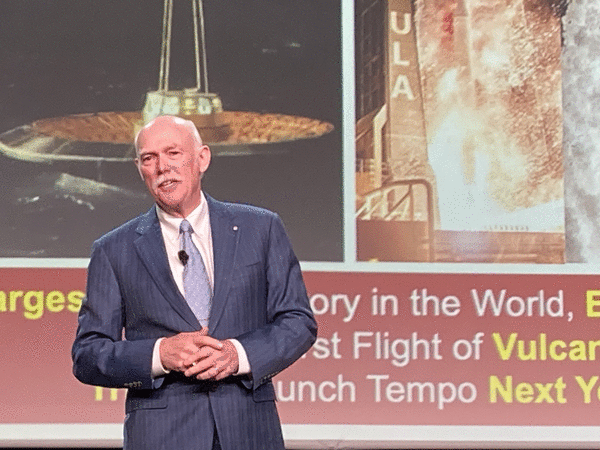
United Launch Alliance’s leader for the last 12 years has stepped down.
ULA President and CEO Tory Bruno has resigned as of Monday to “pursue another opportunity,” according to a shared statement from the board chairs from Lockheed Martin and Boeing, which share a 50% ownership of the rocket company.
“We are grateful for Tory’s service to ULA and the country, and we thank him for his leadership,” reads the statement from ULA Lockheed Martin Board Chair Robert Lightfoot and ULA Boeing Board Chair Kay Sears.
Taking his place in an interim role will be John Elbon.
“We have the greatest confidence in John to continue strengthening ULA’s momentum while the board proceeds with finding the next leader of ULA,” the statement reads.
Bruno came into the role in 2014 from Lockheed Martin, where he had worked as an engineer before moving into corporate leadership roles. He took the ULA job during a period where it saw increased competition from SpaceX and had to shepherd ULA through rounds of layoffs.
As SpaceX continued to see success and carve into what had been ULA’s lucrative national security mission manifest, Bruno was able to steer ULA through a long-delayed production campaign for its new Vulcan rocket, which saw its first launch in 2024 as the replacement for its dwindling supply of Atlas V rockets and already-retired Delta IV Heavy rockets.
“Thank you for the opportunity to lead this amazing team,” Bruno posted to X after the announcement. “They have put ULA in a great position to do important things for our customers and nation.”
Bruno was at the helm when Amazon announced what some considered a lifeline to the company with a guaranteed launch future. ULA would be tapped to be the main provider of dozens of launches through the end of the decade to support what is now referred to as the Amazon LEO, but was previously dubbed the Project Kuiper constellation of satellites.
ULA has flown its first four Amazon missions this year, and has another 42 launches lined up to help grow the constellation to its eventual total of more than 3,200 satellites in Amazon’s efforts to compete with SpaceX’s Starlink.
And while ULA’s Vulcan delays have meant a backlog of more than 20 national security missions, it’s still winning new contracts under the Department of Defense’s new rounds of mission orders. Vulcan was only certified for national security missions this past spring, and flew its first mission, USSF-106, in August, nearly three years behind schedule.
While ULA didn’t hit Bruno’s forecast total of 12 missions in 2025, it did end up besting its output from the previous two years with six successful flights, with the most recent earlier this month. It had only five launches in 2024 and three in 2023.
The company was first formed as a partnership between Boeing and Lockheed Martin in 2006. The most missions the company has flown in a single year has been 16 in 2009.
ULA, though, has lined up some of its 10 remaining Atlas V rockets as well as a steady supply of the new Vulcan rockets for missions it looks to fly in early 2026.
“I can fly more if satellites show up, and obviously, if there aren’t any satellites, we’ll fly less,” Bruno said earlier this year. “I literally have a stockpile. … I would like to be hitting our baseline tempo before the end of the year. So that would be two a month, and then next year it’ll be more like 20.”
_____
©2025 Orlando Sentinel. Visit at orlandosentinel.com. Distributed by Tribune Content Agency, LLC.









Comments