Starbucks sued over alleged chemicals in decaf coffee, farm violations
Published in Business News
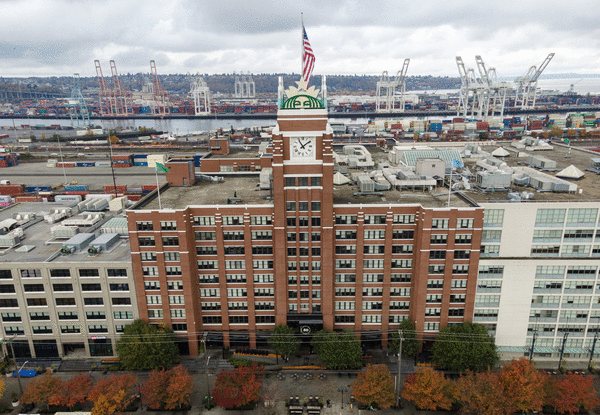
A Seattle-based law firm is accusing Starbucks of having an unethical supply chain and alleging that its decaffeinated coffee contains harmful chemicals.
Hagens Berman filed the proposed class-action lawsuit Tuesday in the U.S. District Court for the Western District of Washington on behalf of plaintiffs Jennifer Williams, of Washington, and David Strauss, of New York.
The legal team argues that some coffee farms overseas — while deemed ethical by Starbucks — are engaging in labor law violations.
The firm also claims that the company's Decaf House Blend medium roast coffee contains levels of volatile organic compounds, including methylene chloride, benzene and toluene. All three compounds are dangerous for human consumption.
The Seattle-based coffee giant defended itself against the claims.
We take the allegations raised in the Williams and Strauss lawsuit seriously, but we firmly believe they are inaccurate and misrepresent both our sourcing practices and the integrity of our Coffee and Farmer Equity (C.A.F.E.) Practices program," Starbucks spokesperson Leandro Cavinato Herrera said in a statement on Wednesday.
Hagens Berman declined a request for an interview.
"Starbucks has been linked to farms that mistreat workers, do not provide proper housing and sanitary bathrooms, and from which workers — including minors — were found to be working in extreme conditions and in violation of local labor laws," Steve W. Berman, managing partner and co-founder of Hagens Berman, said in a news release.
The plaintiffs are seeking to represent Washington and New York consumers who bought Starbucks coffee products on and after Jan. 1, 2016. Williams, who lives in Ferndale, Whatcom County, has purchased Starbucks coffee, including its decaf products, as has Strauss in New York.
Among their demands, they are asking for a jury trial and restitution. The plaintiffs also want an order that prevents Starbucks from continuing "unfair business practices," per the complaint.
Ethical sourcing
The lawsuit first scrutinizes Starbucks' commitment to ethical sourcing.
The company says on its website that it purchases 3% of the world's coffee from more than 400,000 farmers across 30 countries.
Since 2004, it has utilized Coffee and Farmer Equity, or C.A.F.E., Practices, which Starbucks defined as "one of the coffee industry’s first set of ethical sourcing standards." The company says the verification program and its economic, social and environmental criteria ensure the protection of coffee farmers and workers.
According to guidance provided by Starbucks, some criteria to receive C.A.F.E. certification are zero tolerance, so they must be followed and require "immediate corrective action." Other criteria — deemed major or minor — must be followed within one year's time if noncompliance is found.
Starbucks developed the practices with Conservation International, a global organization that works with businesses, including Adobe, Apple and PepsiCo, on issues like climate and biodiversity.
An assessment by Conservation International said that, from 2017 to 2021, 99.9% of participating farms didn't rely on child labor, and at least 98.4% "ensured a minimum wage for permanent workers."
The program's farms and mills hired 2.5 million workers — both permanent and temporary — in 2021, per the assessment. Compliance with human rights, working conditions, medical care and more are verified by a third party.
In this week's complaint, lawyers alleged that Starbucks is deceiving its customers on the issue, pointing to "documented accounts of forced labor, child labor, unsafe working conditions, wage theft, and other serious labor law violations on C.A.F.E. certified farms."
The lawsuit details alleged violations at Brazilian coffee farms. Those claims included citations for unsafe working conditions in 2015, reports of moldy and pest-infested employee housing in 2018, complaints about 17-hour shifts in 2018, and evidence of illegal underage workers in 2022.
Several of these allegations were exposed by journalists, including outlets Mongabay, Repórter Brasil and Channel 4.
The attorneys argue that these farms were certified under the Starbucks program. In several cases, they claimed that the implicated farms retained their certification status for a year or longer.
Human rights violations have also been traced elsewhere, per the complaint. It said in Guatemala, five certified farms allegedly employed children under the age of 13, and Chinese farms were investigated for claims of child labor, low wages, excessive hours and an absence of medical equipment.
Just south of the U.S., "Mexican coffee farmers find themselves 'trapped in abusive labor practices, a cycle of debt and systemic marginalization,' a harm that disproportionately falls on Indigenous people," according to the lawsuit.
"How a company can do business with farms like that and still tout a record of a commitment to 100% ethical sourcing is confounding," Berman said. "If consumers knew the truth about Starbucks’ practices, we believe they would not support this."
The coffee giant told The Seattle Times that it maintains visibility into its supply chain, audits farms regularly and takes swift action when violations are reported, including by terminating supplier relationships when necessary.
'Chemical contamination'
The complaint has a second focus area: Starbucks' decaf coffee bean roasts allegedly contain traces of volatile organic compounds.
The lawyers said benzene, toluene and methylene chloride were detected in January 2025 through independent testing, but customers haven't been informed.
The lawsuit called it "avoidable chemical contamination introduced during processing."
Benzene is used as a solvent, and humans are typically exposed to it through cigarette smoke and gasoline fumes. Toluene is a chemical in paints and metal cleaners. Methylene chloride, also known as dichloromethane, is a chemical that helps strip paint and manufacture pharmaceuticals.
According to the complaint, these compounds "are not typically associated with food production."
"Starbucks has gone to great lengths to attempt to conceal the reality behind its label," Berman said. "Starbucks continues to profit by hiding the true nature of its supply chains and chemical processing practices.
The company told The Times that the safety and quality of its coffee is its highest priority, and it can confirm its products meet or exceed applicable safety standards.
©2026 The Seattle Times. Visit seattletimes.com. Distributed by Tribune Content Agency, LLC.







Comments