'Time to do better': Las Vegas public housing complex to be torn down, redeveloped
Published in Business News
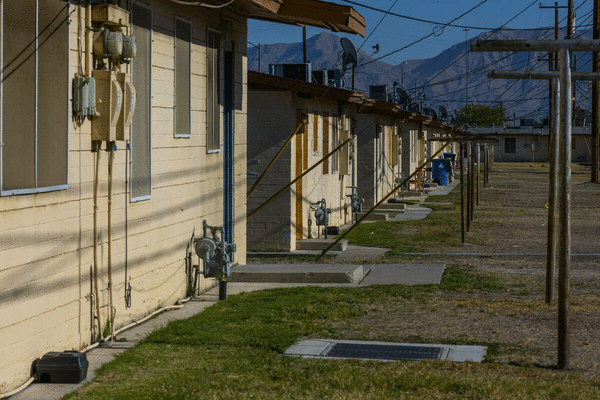
When Marble Manor opened in the early 1950s, the Las Vegas public housing complex offered modern homes with up-to-date kitchens, bathrooms, heating and cooling.
It had everything needed for “comfort and clean living,” a newspaper columnist wrote, noting it served people who had been living, or just existing, in “paper-box or cardboard hovels of almost unbelievable bareness and filth.”
All told, you’d have to be “pretty hard-hearted” not to be thrilled by the new units and what they meant for the residents, the author wrote in the Las Vegas Review-Journal.
More than 70 years later, the low-income housing complex in the Historic Westside is being redeveloped, with the high-priced venture set to completely remake a pocket of a neighborhood once defined by segregation.
Work crews have demolished a portion of Marble Manor as part of a years-long project to transform the 235-unit property along Washington Avenue just east of Martin Luther King Boulevard. Owned by the Southern Nevada Regional Housing Authority, the 35.7-acre complex of single-story concrete block homes, many of them duplexes, will be torn down and redeveloped in five phases.
Plans call for 627 newly built units — including townhomes and apartment buildings — as well as a community center, retail space, parks and other features, according to housing authority officials and city records.
It will also include a mix of low-income and market-rate units.
The project is slated to be finished in 2032 and cost an estimated $350 million to $400 million, said Frank Stafford, director of development and modernization for the housing authority.
According to a Las Vegas city staff report last year, the Marble Manor site was in “serious disrepair,” with several recent code-enforcement cases reported for “unsafe building conditions.”
‘It’s time to do better’
DeVona Johnson-Biggs, who has lived in Marble Manor for almost three years, said her four-bedroom unit has only one bathroom and that she has a washer but no dryer.
Her heating was recently fixed because it was out for a week, she said, adding she has seen repairmen at several other homes, too.
As she sees it, the property needs to be updated.
“It’s time,” she said.
Claytee White, former director of UNLV’s Oral History Research Center, said the opening of Marble Manor had “monumental” significance.
Las Vegas was once known as the Mississippi of the West, with Black residents all but confined to the west side of the city.
White said that many people in the area lived in shacks and tents — even if they were fully employed — amid housing and mortgage-lending discrimination against Blacks.
Marble Manor gave people the chance to live in real homes. But overall, residents were given the “bare minimum, and it’s time to do better,” White said.
‘They feel like army barracks’
Marble Manor was built in phases between the early 1950s and early 1960s and is a “typical example of concentrated poverty, functionally obsolete housing, and underutilized land,” according to a project fact sheet included with a City Council agenda item last spring.
The regional housing authority, formed in 2010 through a merger of public housing agencies in Southern Nevada, teamed with Brinshore Development on the Marble Manor overhaul.
Construction of the first units is scheduled to start in March, said Bryce Clutts, president and CEO of contractor Metcalf Builders.
Kathi Thomas, the housing authority’s chief housing officer, has said that Marble Manor’s existing residents have the right to come back to the property once newly built units are finished.
Given the demolition, they can move to another public housing complex or receive vouchers to rent from a private landlord. The tenants don’t have to pay their moving expenses, as federal grant dollars cover the relocation costs, she said.
According to Thomas, the cost of maintenance at Marble Manor was rising, and the homes are not energy efficient and don’t serve modern families’ needs. As she described it, the units are “constrained” inside.
“They feel like army barracks rather than homes,” she said.
‘Mass slum clearance’
As recently as the 1940s, housing conditions were often inhumane in the Westside, with families living in cardboard shacks that lacked running water or sewer service, according to a 2015 report released by the city of Las Vegas.
As World War II came to an end, the living conditions there “could no longer be excused by the lack of building materials and wartime housing shortages,” so the city decided the best way to deal with this “public embarrassment was through mass slum clearance,” the report stated.
Between September 1944 and April 1945, hundreds of shacks and cabins were “demolished or razed with no plans by the city for replacement.”
It wasn’t until the construction of Marble Manor that “strides were made” to improve the living conditions for Black residents of Las Vegas, the report said.
In spring 1951, the former Las Vegas Housing Authority announced it was taking bids to build the low-income complex. Named for the late Las Vegas Mayor H.P. Marble, it initially featured 100 units.
Marble Manor opened in 1952, with the Review-Journal reporting that a “barren desert wasteland amid squalor” had been cleared and converted into a clean plot of “sparkling” homes.
The report noted that Marble Manor was “open to all races” and that more than half of the families living there were white.
‘They could only live on this side of town’
Marble Manor was expanded over the next decade or so. And by late 1962, as the Review-Journal reported, 95 percent of the residents were Black.
According to White, the local historian, the vast majority of Black residents in Las Vegas used to live in the Westside. Many people moved in, but they couldn’t get loans to buy or build a house.
“The restrictions were very severe at this point,” she said.
Former Las Vegas Councilman Cedric Crear, who is Black, told the Review-Journal in 2021 that his parents moved to Las Vegas in the mid-1960s after his father, a family practice doctor, was recruited by the city’s first Black physician, Charles West, to join his medical practice.
They rented an apartment in the Westside.
“They knew they could only live on this side of town,” Crear said.
‘It helps the entire area’
Evan Wilson, who has lived in Marble Manor for about three years, said that both his mom and dad stayed in the complex when they were kids and that he has seen the broader neighborhood in good times and bad.
The 1980s and ‘90s were especially tough, given the drugs and gangs. But now, he explained, Marble Manor is a regular housing complex and a pretty quiet place to live.
He wants to see the new homes first before he decides whether to rent one, but it makes sense that Marble Manor is being redeveloped, Wilson said.
“I feel good,” he said.
Sapphire Banks, who has lived in Marble Manor for about two years, also said that it’s a quiet place to live and that she would want to move to a new unit in the community.
Marble Manor is walking distance from her son’s elementary school and is centrally located for her job with an inventory-management company.
She said it’s been pretty good living there but still views the redevelopment as a good thing.
“These have been here a long time,” she said of the buildings.
White, meanwhile, said the expansive project would usher in a larger, vibrant community with recreation, commercial space and more.
“If they really do this … it helps the entire area, it helps the city,” she said.
___
©2026 Las Vegas Review-Journal. Visit reviewjournal.com.. Distributed by Tribune Content Agency, LLC.










Comments