$7.25 billion settlement pitched in Bayer Roundup case. St. Louis court to review
Published in Business News
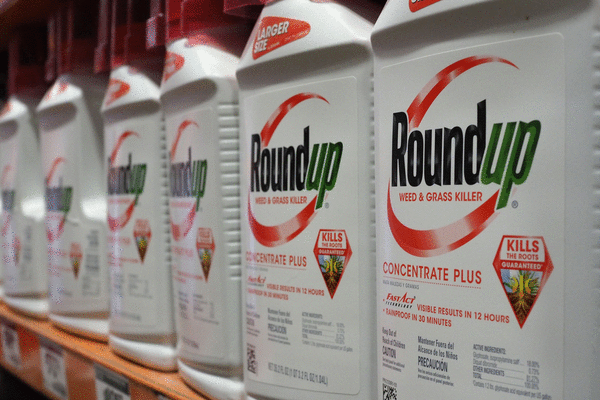
ST. LOUIS — Agri-chemical giant Bayer has agreed to a proposed $7.25 billion class-action settlement, a big step toward resolving thousands of lawsuits claiming that exposure to the weedkiller Roundup caused non-Hodgkin lymphoma.
Tuesday's proposed settlement would pay people across the United States exposed to Roundup and diagnosed with the cancer, and also those exposed and diagnosed in the future. The settlement would have the company make annual payments for up to 21 years.
“This resolution follows more than two years of intense negotiations shaped by the complex and evolving course of this litigation,” class-action attorney Eric D. Holland said Tuesday at a press conference. “Compensation is to be determined through a transparent, objective set of criteria that considers type of exposure, age at diagnosis, and type of (non-Hodgkin lymphoma).”
The individual awards will mostly max out at $198,000, though additional compensation is available “under extraordinary circumstances,” Holland said.
The announcement is the latest in the yearslong legal saga surrounding the company’s bestselling weedkiller, Roundup, which has sparked tens of thousands of personal injury claims alleging that its active ingredient, glyphosate, caused various types of non-Hodgkin lymphoma.
Bayer bought the weedkiller’s manufacturer, Monsanto, in June 2018. That acquisition came just in time for the avalanche of lawsuits — crippling Bayer by cratering its stock price and fueling investors' calls for the company to split off its besieged agriculture arm that features Monsanto's legacy products.
On Tuesday, Bayer CEO Bill Anderson again insisted that glyphosate is safe.
“To be clear, today’s announcement does not take away from the truth,” he said during an online address. “A truth that scientists and regulators around the planet continue to uphold: That glyphosate is a safe and essential tool for farmers in the U.S. and around the world.”
He also said today’s settlement comes at a cost beyond its dollar amount.
“It’s cost employees their jobs,” Anderson said. “It’s diverted funding away from new medicines and new seeds and towards litigation.”
He said the proposed settlement was necessary for Bayer’s financial survival, but he and other company leaders maintain their significant objections to the “broken tort system that makes it necessary.”
Tuesday’s proposed settlement is one part of a plan the company hopes will keep it from bankruptcy.
In January, the Supreme Court agreed to hear Bayer’s appeal asserting that federal law trumps state law when it comes to failure-to-warn claims involving the Roundup label.
The Environmental Protection Agency does not require product warning labels for non-Hodgkin lymphoma.
If the Supreme Court sides with Bayer, the proposed settlement will not be affected. But those who have opted out of the settlement may no longer have legal grounds to sue the company.
“The funding is locked in, and if the Supreme Court finds that state law claims are preempted, people who are in this settlement are still going to get compensated,” said attorney Christopher A. Seeger, another lawyer representing claimants in the proposed settlement.
A favorable ruling for Bayer would help limit claims against the company to just those in the settlement, providing the company a way out of this legal pit.
The company has already paid out $11 billion in glyphosate settlements.
In 2020, it settled thousands of claims for nearly $10 billion. Two years later, it reached a settlement for another spate of claims, just before trial started in St. Louis.
In September, the Missouri Supreme Court rejected Bayer’s request to appeal a $611 million jury verdict in favor of four plaintiffs who originally sued in Cole County in 2022.
And in a December lawsuit against its insurer, Bayer said 56,000 lawsuits have been filed against the company by more than 149,000 plaintiffs. Approximately 50,000 of those lawsuits remain pending.
"Thousands of additional lawsuits may be filed against Monsanto in the future," the company wrote.
Attorneys on Tuesday said it was hard to provide an accurate timeline for the settlement to be approved. The case will be assigned a judge and preliminary approval could come a few weeks after that.
Then claimants would be notified, eventually followed by a final hearing.
©2026 STLtoday.com. Distributed by Tribune Content Agency, LLC.






Comments