Health care unions to end historic strike at Kaiser Permanente
Published in Business News
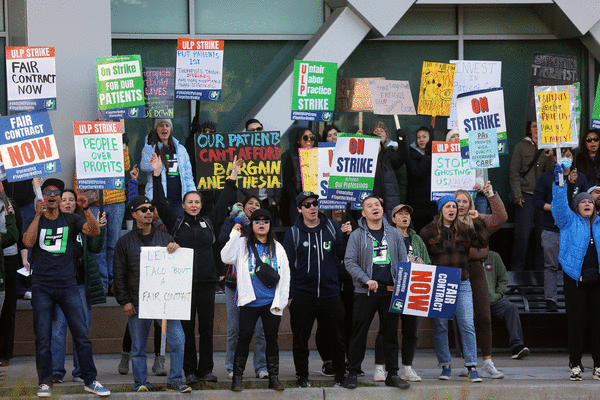
The largest open-ended strike of health care professionals in U.S. history will end Tuesday, without workers winning on a key wage demand.
Spokespersons for the United Nurses Associations of California/Union of Health Care Professionals said Monday it had notified Kaiser of plans to formally end the major work stoppage, which stretched over four weeks across California and Hawaii. More than 31,000 health professionals will return to work across the West, including 2,800 nurse anesthetists, physical therapists and others at the Bay Area’s largest care provider.
Workers had not taken to picket lines on Monday as they had for much of the last month. At the direction of union leaders, they will return to work Tuesday and begin finalizing contracts that do not include the significant wage increase they’d sought since the fall, in favor of a smaller pay bump long proposed by Kaiser.
The striking workers were not paid from a “strike fund” and went completely without wages for the month-long stoppage.
Union officials said ending the strike was in the best interest of workers and cast the historic work stoppage as a success. Elissa Harrington, a spokesperson for Kaiser in the Bay Area, said the strike was “entirely unnecessary” in an email.
The strike forced the health care giant to delay some surgeries and other appointments, frustrating patients. It’s unclear if there is a backlog of appointments to clear when workers return. Harrington did not respond to specific questions.
“We are working with our teams to schedule returning employees over the coming days, in an orderly way that protects patient safety and minimizes any disruption,” Harrington said.
Patients may still see picket lines at Kaiser facilities: separately, mental health therapists in the Bay Area and Central Valley said Monday they’re planning to strike for one day, although a date isn’t set.
Any delays in care sparked by the strike didn’t result in an increase in complaints to the California Department of Managed Health Care, according to data obtained by this news organization. There was also no sizable increase in requests for an independent medical review, in which an independent board of doctors can order a health provider, such as Kaiser, to perform medically necessary procedures.
For employees returning to work Tuesday, union officials said the strike successfully forced Kaiser back to the bargaining table after talks broke down.
The health professionals ultimately accepted the offer Kaiser had made for months leading up to the strike: a 21.5% wage increase over four years, rather than the 25% increase demanded by the union, said Peter Sidhu, the union’s executive vice president.
Management at Kaiser, a nonprofit health giant that is both California’s largest health provider and its biggest private-sector employer, maintained the union’s sought-after raise would increase costs to patients. The 21.5% raise would cost nearly $2 billion over the life of the contract, and the union’s plan would have cost another $1 billion, a Kaiser spokesperson claimed last year.
Kaiser patients already faced increased health premiums this year. The nonprofit enjoyed a series of profitable years. During the strike, workers cast their wage demand as necessary to catch up with post-pandemic inflation.
Sidhu said some of the union’s members were frustrated Monday because the strike had not achieved a bigger pay increase. Still, he said, the decision to walk off picket lines and return to work was in the best interest of the union’s members. Returning to work “protected” the workers’ ability to receive the 21.5% pay increase, he said, as Kaiser shifted its demands. He did not elaborate, citing the confidentiality of negotiations.
“I think that we accomplished our goal of getting them back to the table,” he said of Kaiser’s management.
The tens of thousands of nurses and other health professionals had walked off the job and onto picket lines on Jan. 26. The union launched the strike after negotiations stalled in the fall, and relations between its negotiators and Kaiser’s had deteriorated by the holidays, with allegations of blackmail and bad faith.
In the Bay Area, hundreds of workers picketed in front of Kaiser’s sprawling hospitals in Santa Clara and in Oakland, not far from the giant’s headquarters. Drivers enthusiastically honked in solidarity while the workers marched or danced to loud music.
When the work stoppage disrupted operations, some patients were frustrated – or furious– after receiving word that a planned doctor’s visit or procedure was postponed. During the height of the strike, Kaiser’s pharmacies and labs in Oakland were crowded with lines of patients.
Health providers hire temporary workers during strikes, and initially, some of Kaiser’s postings appeared lucrative for physical therapists. The temporary help may have staved off a worse staffing crisis.
Behind the scenes, workers may have crossed the picket line — Kaiser spokesperson Elissa Harrington said last week that 42% of striking employees had returned to work in Northern California, including the Bay Area.
Sidhu said union leaders weren’t privy to that data, but he added that Kaiser has released incorrect information elsewhere.
“The members remained committed to getting bargaining done,” he said.
The union’s thousands of workers are split into many separate units, each negotiating some contract elements. Sidhu said those negotiations will continue this week.
©2026 MediaNews Group, Inc. Visit at mercurynews.com. Distributed by Tribune Content Agency, LLC.




Comments