What another sales decline for Target says about consumers
Published in Business News
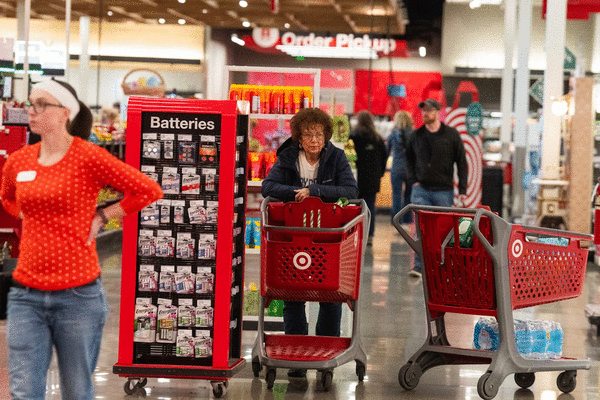
Target customers continue to be cautious — and a bit frugal, sticking to essentials and increasingly turning to discount chains.
During the holiday season, they bought toys and kept spending on essentials such as food and beauty products. But they pulled back elsewhere to stretch their budgets.
Other retailers reported similar trends. However, Target has lost ground to Walmart and off-price retailers like TJ Maxx and Marshalls as shoppers traded down amid persistent economic uncertainty.
Target reported March 3 a 2.5% decline in same-store sales during the November-to-January period and quarterly profits that slid more than 5%.
CEO Michael Fiddelke, who has been at the helm for a month, has a long road ahead of him. Full-year same-store sales fell by a similar margin, and annual profit declined 9.4%. The company expects earnings per share to range from $7.50 to $8.50 in 2026.
That’s a modest increase, and officials expect a 2% increase in sales as well.
“Target saw a healthy, positive sales increase in February, serving as an important milestone on our path back to growth this year, and reinforcing my confidence in the momentum we’re building and the future we’re creating together,” Fiddelke said in the earnings release.
Best Buy said on March 3 that comparable sales slid less than 1% in the November-to-January quarter, as revenue just missed analyst estimates.
The steady quarter gives momentum to the business, said Chief Financial Officer Matt Bilunas in the earnings release.
Consumers showed a willingness to spend on higher ticket items to fit a need or for technology innovation. While hot holiday items such as health rings and gaming handhelds as well as AI products and 3-D printers were strong sellers, appliance and home theater sales lagged.
CEO Corie Barry said in a news release that Best Buy’s market share was at least flat for the quarter, and the holiday season saw “slightly softer customer demand for our industry.”
However, she pointed to “better-than-expected profitability” for the quarter.
Net profit increased from $117 million to $541 million, and adjusted earnings per share of $2.61 handily beat estimates.
Like Target, Best Buy also plans to continue investments in stores this year from refreshing layouts in partnership with key vendors to adding six new locations, adding to its store count for the first time in more than a decade.
Overall retail sales were flat in December compared with November, according to federal data, a sign that many shoppers hunted for discounts and skipped more extravagant holiday spending.
Economists were hoping for a boost despite tightening jobs data. Surveys by the University of Michigan showed consumer sentiment improved in December from November and again in January.
But a Bank of America analysis found the income gap in spending is the widest since mid-2022. Higher- and middle-income households have adjusted by trading down, while lower-income shoppers have less room to maneuver.
“While consumers have in part managed to navigate affordability challenges … many of these choices may not have been ‘comfortable,’” analysts at the Bank of America Institute wrote. “This partly explains why some measures of consumer sentiment have not kept pace with faster spending growth.”
The latest results from leading retailers reflect that “K-shaped” divide. Off-price retailer TJX, parent of T.J. Maxx and Marshalls, also saw comparable sales increase 5% as higher-income households sought bargains.
Target’s sales fell in apparel and home furnishings, as well as sporting goods and appliances. The retailer saw modest gains in beauty and food and beverage.
Shoppers made fewer trips to Target in the most recent quarter, with traffic down 2.9%. Weekend visits, when the retailer is more likely to capture browsing-driven discretionary purchases, fell more sharply, according to Placer.ai.
Walmart, which saw same-store sales rise 4.6% in the quarter, still saw a pullback on general merchandise purchases. Grocery sales and Walmart+ membership fees drove most of the growth.
Higher-income households, defined by Walmart as those earning more than $100,000, accounted for much of the company’s share gains, suggesting even affluent shoppers are hunting for bargains, a trend the Arkansas-based retailer has noted in several recent quarters.
Despite its growth, executives cited signs of economic unease, including a softening job market and rising student loan delinquencies.
Historically, consumers have funneled refunds into big-ticket purchases such as appliances and furniture.
Refunds are expected to be about 20% larger this year, according to Morgan Stanley, reflecting expanded deductions and credits under the federal budget act passed this summer. Gains are likely to skew toward middle- and higher-income households.
Yet consumer surveys indicate plans to spend more on everyday purchases, vacations, clothing and home improvement — categories many households have delayed.
“The most common use of tax refunds are saving and paying off debts, neither of which count as consumption,” Morgan Stanley economist Heather Berger said in a release.
U.S. credit card debt climbed to $1.28 trillion, up 5.5% from a year earlier, according to the Federal Reserve Bank of New York.
Researchers say younger and lower-income households saw some of the biggest spending bumps from refunds in 2025, and some analysts suggest the increased refunds could spur spending similar to the pandemic-era stimulus checks that boosted Target. The retailer reported a positive sales increase in February, marking the start of the first quarter. Refunds began arriving as early as Feb. 6.
But others caution that while middle-income households may narrow the gap with wealthier peers, refunds alone won’t ease the financial strains facing lower-income families.
(Includes reporting by Star Tribune staff writer Patrick Kennedy.)
©2026 The Minnesota Star Tribune. Visit at startribune.com. Distributed by Tribune Content Agency, LLC.









Comments