War knocks global economy with dual shock to growth, prices
Published in Business News
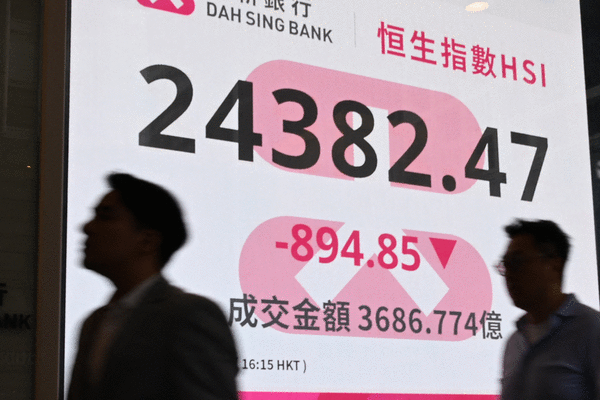
The world economy’s first signs of a synchronized shock emerged in business surveys revealing how the Iran war’s fallout is crippling growth momentum and stoking prices.
Multiple purchasing manager indexes compiled by S&P Global for March showed declines. Among the releases on Tuesday, composite measures for the U.S. and the euro zone were lower than economists predicted. Australia’s equivalent gauge slumped to indicate a sudden contraction, and Indian factory activity slowed to the weakest since 2021.
Several price readings surged meanwhile, with input cost inflation in Germany, Europe’s biggest economy, quickening to the fastest pace in more than three years. A similar gauge for UK manufacturing jumped the most since 1992.
The provisional results were gathered in the second half of March, capturing the mounting gloom among global businesses at the persistence of the Iran war and its mushrooming fallout.
Collectively, the indexes offer an initial illustration of the reverberations on prosperity of a conflict that has taken an immediate and crushing toll on energy supplies crucial to the functioning of some of the world’s biggest economies.
Alarm at the consequences has already gripped policymakers, with European Central Bank chief Christine Lagarde declaring last week that the hostilities sparked by President Donald Trump’s attack on Iran have stoked “upside risks for inflation and downside risks for economic growth.”
Monetary officials both in Frankfurt and London have pivoted toward hawkish vigilance, with a euro-zone hike in interest rates possible as soon as next month. Peers in Japan are priming another move as soon as April and those in Australia already delivered a second consecutive increase.
“Before the Iran war erupted, our global growth tracker suggested the world economy was gathering momentum,” said Jamie Rush, director of global economics at Bloomberg Economics. “The PMI figures emerging from advanced economies suggest that nascent recovery is in danger of being choked off by a combination of higher oil costs, tighter financial conditions and faltering sentiment.”
Every composite index of activity published on Tuesday, combining both manufacturing and services, showed declines. The list in chronological order encompassed Australia, Japan, India, France, Germany, the overall euro zone, the UK and then finally the U.S.
The American report showed business activity expanded in March at the slowest pace in almost a year, reflecting cooling growth at service providers. A measure of prices paid for materials and other inputs, meanwhile, jumped to the highest since May. Manufacturers, however, showed further signs of stabilization.
Euro-area factory activity also unexpectedly improved, though S&P Global’s analysis cautioned that frontloading of stock-building by clients wary of supply disruptions may account for some of that.
Combined with a near-stalling of services activity in the region, and a 10-month low for the composite measure, the overall picture was bleak, not least given a notable uptick in price indicators.
“The flash euro-zone PMI is ringing stagflation alarm bells as the war in the Middle East drives prices sharply higher while stifling growth,” Chris Williamson, chief business economist at S&P Global Market Intelligence, said in accompanying commentary.
Black Wednesday
In the UK, manufacturing also proved more resilient than services, though the composite gauge still ended up far lower than anticipated. The dramatic surge in prices for factories was the most since the impact of the pound’s slump after the Black Wednesday crisis of 1992.
“The Bank of England faces a challenging period where it will need to balance these growth and inflation risks when setting policy, seeking to dampen the potential for the inflation spike to become more ingrained while ensuring a hawkish interest rate outlook does not exacerbate downturn risks,” Williamson said.
For Japan, where data on Tuesday showed an unexpected slowdown in inflation, the indexes of business activity also revealed an impact of the war, even if the economy remains robust. A gauge of confidence for the coming 12 months fell to the lowest in almost a year.
India’s measures meanwhile pointed to the weakest economic growth since 2022, accompanied by a four-year high for cost inflation.
Australia’s shift in fortunes appeared the most dramatic. The overall output index dropped more than 5 points to 47, crashing through the 50 mark that separates growth and contraction. Services showed marked weakness, but combined with a significant deterioration in factory momentum, private-sector activity in the economy was indeed shrinking at the end of the first quarter, according to S&P Global.
Inflation for Australian businesses meanwhile, as measured by the S&P Global indexes, is at a more than three-year high, underscoring the challenge for the Reserve Bank at present.
Peace talks in the Middle East are claimed by Trump to be under way, despite unabated fighting between the U.S.-Israeli alliance and Iran.
But even if hostilities do cease, global policymakers will need to assess how the damage inflicted on growth and inflation prospects has already derailed their economies. Despite their geographical scope, the S&P Global indexes offer only limited indications of that for now.
“Key questions shaping the outlook remain how long the Strait of Hormuz will be shut and how central banks will respond to the shock,” BE’s Rush said.
____
—With assistance from Alexander Weber, Andrew Langley, Andrew Atkinson, Tom Rees, Anup Roy, Jana Randow and Reade Pickert.
©2026 Bloomberg L.P. Visit bloomberg.com. Distributed by Tribune Content Agency, LLC.









Comments