Policy adjustments likely needed to lower inflation, Fed governor says
Published in Business News
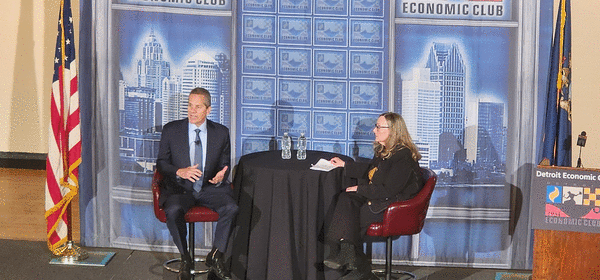
DETROIT — The U.S. economy is facing persistent inflation, geopolitical uncertainty and a surge in investment tied to artificial intelligence, Federal Reserve Governor Michael Barr said Tuesday.
Speaking to the Detroit Economic Club at The Masonic, Barr said the U.S. economy has shown resilience through a series of disruptions, with real gross domestic product growing at roughly a 2% rate in the first half of 2026. He expects growth to pick up somewhat in the second half.
Inflation remains above the Federal Reserve's 2% target, with the U.S.-Israel war with Iran pushing energy prices and inflation higher while the surge in AI investment and related demand is having a measurable effect on prices, Barr said.
“The combined effect has meant we've been knocked off course on our progress towards a 2% goal,” he said.
With economic growth strong and the labor market solid, Barr said the Fed needs to better balance the risks to achieving its inflation target. On Sept. 16, the central bank raised a key interest rate by a quarter-point.
“In my base case, further policy adjustments are likely to be needed to ensure inflation comes down to target in a timely fashion,” he said.
Barr outlined the factors that have shaped inflation in recent years, from the pandemic and war in Ukraine to tariffs, the conflict in the Middle East and the surge in AI investment.
Inflation, as measured by the personal consumption expenditures price index, surged in the wake of the pandemic and, with the start of Russia's war in Ukraine, peaked at a 12-month rate of 7% in 2022, Barr said. Significant monetary policy tightening and easing supply constraints brought inflation closer to the Fed's 2% goal by early 2025, he said. Tariff increases in April 2025 pushed up goods prices, while the conflict in the Middle East that started in late February drove energy prices and inflation higher. The rapid build-out of AI is adding another source of demand.
Strong business investment and resilient consumer spending are supporting a solid labor market, Barr said. Lower net immigration has reduced the number of new jobs needed to keep pace with growth in the labor market. Job creation has averaged about 80,000 a month this year, close to estimates of its sustainable pace, while the unemployment rate of 4.1% is close to estimates of maximum sustainable employment, he said.
Asked about the impact of higher interest rates on Michigan's economy, Barr said bringing inflation back to the Fed's 2% target is the best way to eventually lower mortgage rates, auto loans and other borrowing costs.
"People can go on with their lives without having to think about inflation," he said. "You can run your business without having to think about inflation. You can buy a house without having to think about inflation."
Barr said the rapid development of AI is creating a new source of demand in the economy, adding to the supply shocks from tariffs and the conflict in the Middle East. He said strong demand for computer chips is pushing up prices for computers and other goods that require chips.
The longer-term effects of AI are less certain, Barr said. He said there is little evidence of significant job displacement across the economy so far, although there are indications AI may already be limiting opportunities for entry-level workers in some sectors.
“That said, we should be prepared for the possibility that there might be short-term disruptions in the labor market that need to be managed effectively if the long-term benefits of AI are to be realized,” Barr said.
Over the longer term, Barr said he is optimistic AI could improve productivity and raise living standards, allowing the economy and real incomes to grow faster without fueling inflation. But he said the greatest uncertainty for monetary policy is how AI will affect the economy over the next two to five years because companies may need time to reorganize their business processes.
“Penciling in a projection for a productivity boost from AI in the medium term makes a lot of sense to me,” Barr said. “But it is difficult to project how and when those productivity gains can take hold.”
©2026 www.detroitnews.com. Visit at detroitnews.com. Distributed by Tribune Content Agency, LLC.









Comments