Rising yields are wreaking havoc on stocks outside the AI trade
Published in Business News
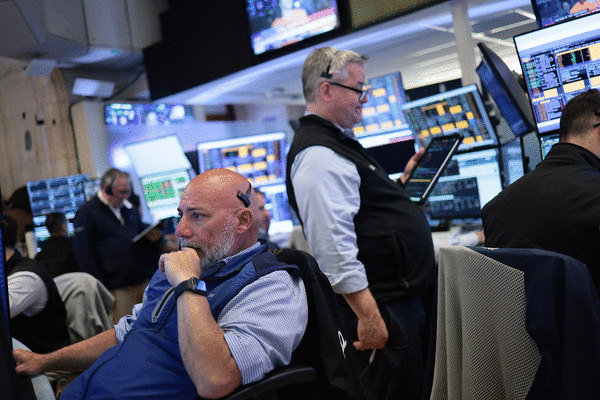
After the 10-year Treasury yield rose as high as 5.34% for the first time since 2002, stock traders are fiercely debating when the selloff in bonds will start to trigger pain for a resilient U.S. stock market.
Under the surface, however, the spike in rates is already wreaking havoc.
While the S&P 500 Index is less than 2% from a record, everything from interest-rate sensitive small-cap stocks to banks and utility companies are getting battered. And many of the most speculative corners of the market — like unprofitable technology companies and those with the weakest balance sheets — trail the equity benchmark since the Federal Reserve hiked interest rates last month for the first time in three years to cool inflation.
“Most parts of the market are at least 5% off their highs, let alone segments of the market that are down 15-plus percent,” Dan Suzuki, global investment strategist at iCapital, told Bloomberg TV. “A lot of that has to do with the higher interest rates and the tightening of financial conditions that comes along with that.”
It’s a unique moment for the U.S. stock market, which is being held aloft at the index level by the artificial-intelligence trade while at the same time staring down the type of circumstances — from mounting geopolitical risks to rising interest rates and U.S. midterm election uncertainty — that historically have led to turbulent markets.
“The stock market can handle higher yields — for now — as long as the economy and profit growth remain strong,” said Eric Diton, president and managing director at The Wealth Alliance, who’s cautious on equities and is snapping up energy shares as a hedge for elevated bond yields and crude prices. “But the biggest risk to stocks is if something goes wrong with AI buildout. If profit outlooks get slashed, it’ll spur wider pain across equities.”
Here’s a look at five charts that reveal the pain hiding under the stock market’s surface:
Equal weight slump
The S&P 500 Equal Weighted Index, which gives an equal share to each constituent, is eyeing its seventh consecutive week of losses — reviving worries that market breadth is too narrow, with just a handful of megacap stocks driving the bull run.
If the weakness persists through Friday, it would be only the third time in history that the equal-weight version of the S&P 500 has declined for seven weeks in a row, behind the aftermath of the dot-com bubble bursting in 2002 and the bear-market rout in 2022, according to data compiled by Bloomberg.
But not everyone sees this as an end to the bull run in stocks.
“We do not look at today’s distorted breadth as reason to be bearish on the SPX, but rather a reflection of a strong bull market underscored in part by substantial technology disruption,” Michael Purves, chief executive officer at Tallbacken Capital Advisors LLC, wrote in a note Thursday. His year-end target of 8,500 for the S&P 500 implies a gain of almost 11% from current levels.
Big pain for small caps
Higher rates and yields also pressure shares of small companies, which are typically more heavily indebted and tend to have less-diversified business lines. Take the Russell 2000 Index, which is coming off its second-worst quarter relative to the S&P 500 since 1999, under-performing its larger counterpart by nearly 10 percentage points, Bloomberg data show.
That’s left the small-cap equities benchmark teetering on the brink of a correction, sinking 8.5% from its Aug. 14 record. Of course, the Russell 2000 is more speculative than its larger peers. Economically sensitive sectors like financials and industrials make up more of the index than they do of the S&P 500, which is weighted more heavily toward this year’s winning technology stocks that have been fueled by the AI frenzy.
And the number of so‑called zombie stocks in the Russell 2000 — companies that struggle or are unable to cover interest payments on their debt — include more than one-third of the index, Bloomberg data show.
Banks tank
Even as Americans continue to spend and companies borrow — all good for banks’ business — their stocks have slumped in recent weeks, dragging the KBW Nasdaq Bank Index, which comprises 24 big banks, into a correction — down more than 12% from its mid-August peak. It’s gained 3.3% so far this year, trailing the broader S&P 500’s 12% advance.
Higher borrowing costs, rising bond yields and credit worries have squeezed near-term profitability expectations for banks. And Meta’s Muse AI Agent has also triggered a selloff in financial shares by threatening an end to “consumer inertia” — the habit of leaving cash in low-yielding checking accounts.
Capital One Financial Corp., Wells Fargo & Co. and Huntington Bancshares Inc. are the worst KBW performers this year, respectively down 20%, 14% and 12% in 2026. Citigroup Inc. fell as much as 4.6% on Thursday, the most since July.
A safe haven disrupted
One of the hardest hit corners of the market: utilities. That’s because higher yields typically make bonds a more appealing option when compared with utility stocks famous for generous and dependable dividends that historically have made them an equity safe haven.
The S&P 500 Utilities Sector is flirting with a bear market after tumbling about 17% since its February record amid projections of a U.S. natural gas inventories buildup while yields climb to fresh highs. The 10-year hit a fresh 24-year high after rising by nearly a full percentage point last quarter, when the utilities sector shed 13%, and only two companies among the 31 members in the group notched gains — Constellation Energy Corp. and AES Corp.
In the third quarter, the power-company industry group and electric utilities both tumbled more than 10%, worse than any other cohort in the sector as rising fuel costs threaten profits. At the same time, the sharp jump in rates is making the shift to renewable energy more costly and sapping demand from investors — since payouts on short-term Treasuries are dwarfing the dividends that usually make the companies a draw.
Risky stocks are risk-off
At the same time, the most speculative corners of the market are struggling. A Goldman Sachs Group Inc. basket of unprofitable tech companies, which includes firms like Roku Inc. and Peloton Interactive Inc., dropped 11% in the third quarter — its second-worst July to September stretch ever, according to Bloomberg data going back to 2014.
Companies with the most fragile balance sheets and higher debt loads rose just 1.9% in the three months ended in September, their smallest quarterly gain since early 2022, when the Fed began its most aggressive hiking cycle in a generation, according to data compiled by Goldman Sachs and Bloomberg.
Still, some are betting that the Fed may not raise rates much more from here.
“We don’t see the spike in bond yields getting out of hand, and think investors are just dumping rate-sensitive shares and rotating back to tech after a deep selloff earlier this year,” said Jimmy Lee, chief executive of the Wealth Consulting Group, who’s snapping up financial and industrial shares on cheaper valuations. “But the biggest risk for the S&P 500 is if the AI trade unwinds unexpectedly.”
©2026 Bloomberg L.P. Visit bloomberg.com. Distributed by Tribune Content Agency, LLC.









Comments