Maduro defiant as Trump weighs escalation. Venezuela abuzz with rumors
Published in News & Features
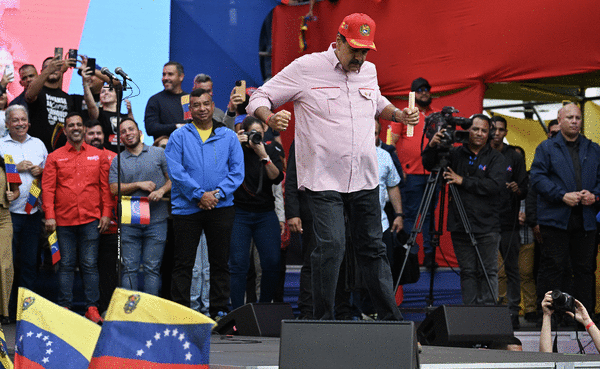
As the Trump White House weighs its next steps in an expanding military offensive against Venezuela’s main drug-trafficking network, strongman Nicolás Maduro is taking to the streets to project an image of national unity — insisting that Venezuelans stand ready to take up arms to defend his regime.
Maduro, indicted in the United States for allegedly leading the Cartel de los Soles, was warned in a phone call late last month with President Donald Trump and Secretary of State Marco Rubio that he had only a narrow window to leave the country safely with his immediate family.
Publicly, he has shown no sign that he is preparing a hurried escape from Caracas, though rumors of an imminent departure have consumed the capital in the past few days.
On Monday evening, Trump convened senior national security officials and top aides for a high-stakes Oval Office meeting to chart the next phase of the administration’s campaign against the cartel — an operation the president has already said will extend onto Venezuelan territory.
Hours before the meeting, Maduro appeared dancing at a public event in a show of defiance toward Washington.
“We have lived through 22 weeks of aggression that can be described as psychological terrorism,” he said outside the Miraflores presidential palace. “These are 22 weeks that have put us to the test, and the people of Venezuela have proven their love for the homeland.”
Claiming overwhelming support, he added: “Today, Venezuelans of different ideological persuasions, with one voice, more than 94% of public opinion rejects and repudiates the imperialist military threat.”
Independent polling paints a far different picture. A survey released in late September by London-based Panterra found that 70% of Venezuelans no longer identify with the socialist movement founded by Hugo Chávez, and a majority supported a U.S. intervention to remove Maduro from power.
For months, Maduro’s representatives and U.S. officials have held quiet talks over a possible exit deal for the president, who has ruled Venezuela for more than 12 years. In many of the discussions, regime negotiators floated proposals under which Maduro would step down in exchange for amnesty, while one of his lieutenants would assume the presidency and oversee a transition.
A similar proposal emerged in the 15-minute call between Caracas and Washington 10 days ago. The long-awaited conversation, meant to defuse a rapidly escalating crisis, collapsed almost immediately, according to sources familiar with the exchange.
Washington demanded that Maduro and his top allies leave the country at once to allow a restoration of democratic rule. Regime officials countered with an offer to hand political control to the opposition but retain command of the armed forces.
Sources told the Miami Herald the U.S. message to Maduro was blunt: safe passage would be guaranteed for him, his wife Cilia Flores and his son only if he resigned immediately.
The United States has long accused Maduro and his inner circle of running the Cartel de los Soles. In 2020, the Justice Department indicted the Venezuelan leader and more than a dozen senior officials, labeling the regime a “narco-terrorist enterprise.” Washington has since offered a $50 million reward for Maduro — the highest bounty ever placed on a sitting head of state — and $25 million for ruling-party heavyweight Diosdado Cabello.
Trump announced last week that U.S. counter-narcotics operations, until now focused on blowing up speedboats suspected of ferrying drugs through the Caribbean, would soon extend onto Venezuelan soil. Speaking to service members during a Thanksgiving call, he said the military would “very soon” launch land-based efforts to disrupt what he called Venezuelan trafficking networks.
One source said the call — viewed by both sides as a last chance to avoid a direct confrontation — broke down over three main issues.
“First, Maduro asked for global amnesty for any crimes he and his group had committed, and that was rejected,” the source said, speaking on condition of anonymity. “Second, they asked to retain control of the armed forces — similar to what happened in Nicaragua in ’91 with Violeta Chamorro. In return, they would allow free elections.”
The proposal, the source said, mirrored a “Cuban model,” in which formal political power shifted but real authority remained in the hands of an entrenched inner circle. The administration flatly rejected it.
The third point of dispute was timing: Washington insisted Maduro resign immediately. Caracas refused.
©2025 Miami Herald. Visit at miamiherald.com. Distributed by Tribune Content Agency, LLC.

Comments