Chicago Mayor Brandon Johnson says attacks against his proposed head tax 'would make Donald Trump blush'
Published in News & Features
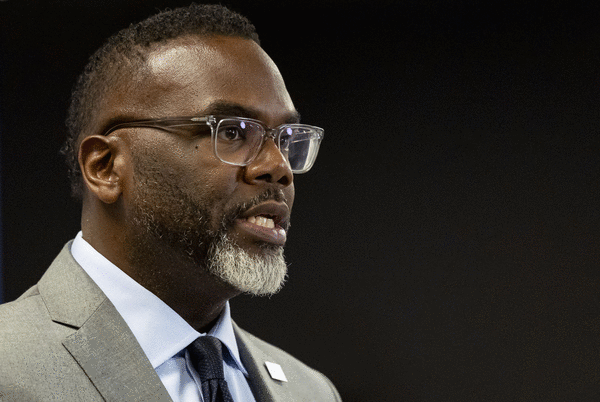
CHICAGO — Mayor Brandon Johnson delivered a stinging rebuke to opponents of his 2026 budget plan on Tuesday, signaling he will continue digging his heels in on his controversial head tax proposal rather than seek to reconcile with a rebellious City Council.
At a City Hall news conference, Johnson called out political organizations that have launched campaigns against his monthly $21-per-employee surcharge on businesses — which a council committee summarily rejected last month. The mayor said the dark money Common Ground Collective and One Future Illinois PAC, both formed by business leaders, were spreading misinformation about the tax that would go toward a Community Safety Fund in his spending proposal for next year.
“It has been brought to my attention that there is a number of entities that are relaying information that would make Donald Trump blush,” Johnson said. “Frankly, I think it’s beneath these so-called business leaders to lie to the public. … There’s no need to treat the people of Chicago like they’re stupid just because they may not have as much money as you do.”
Johnson proposed a $16.6 billion budget plan in mid-October that he framed as Chicago’s greatest chance to stand up to an antagonistic White House, though the city’s fiscal woes long predated the second Trump administration. Reinstating the head tax was part of $438 million in new levies and fees that would close a projected $1.19 billion deficit without hiking property taxes. An aldermanic panel voted down his revenue package, a serious setback for the mayor as the end-of-year budget deadline approaches.
Since then, Johnson has shown no willingness to scrap the head tax component and vowed to veto any budget that raised property taxes or garbage pickup fees. His Tuesday salvo showed that his standoff with the council goes on.
One Future Illinois, the PAC invoked by Johnson, is running an attack campaign saying Johnson’s “so-called Community Safety Fund, paid for with $100 million in new taxes, doesn’t make any new investments in public safety or youth programs.” In response, the mayor argued “no resident will be impacted by this tax,” only a tiny share of large corporations, and that the revenue would indeed go toward those programs.
Johnson’s head tax proposal applies to companies with over 100 employees, but some aldermen and business owners say that size is hardly the threshold for a large corporation. And while the new $100 million fund would go toward safety priorities, it would only serve to maintain existing programs currently supported by the Corporate Fund or expiring federal COVID-19 relief dollars. Some line-items are seeing marginal increases, and others decreases, but spending levels from this year’s budget would largely stay the same.
“The mayor seems to be having a hard time accepting that an overwhelming majority of Chicagoans not only reject his leadership of the city, but his budget,” Mike Ruemmler, head of One Future Illinois, said in a statement after Johnson’s news conference. “It’s a hard reality to face and I’d be upset too.”
Johnson also shrugged off complaints that his closest ally, the Chicago Teachers Union, was the entity being misleading in its ads decrying aldermen who opposed his budget plan. The influential labor group, Johnson’s biggest backer in his 2023 election, posted a video after his head tax defeat that claimed aldermen against the levy want to raise property taxes.
Johnson and his budget team countered that those are indeed the only two options, barring major layoffs in the police and fire departments.
“They’re not coming out saying it out loud because, for whatever reason, they don’t have the fortitude or the gall to actually state their position out loud,” Johnson said about unspecified aldermen who he said privately indicated they want to raise property taxes. “So no, it’s not misleading.”
Johnson pledged not to raise property taxes in his 2023 mayoral campaign, but tried to break that promise a year ago when he proposed a whopping $300 million hike in his 2025 budget plan. Aldermen resoundingly shot the idea down.
Now, with the next municipal election looming in early 2027 and the latest property assessments hitting South and West siders the hardest, most council members agree it’s politically impossible to go that route this time.
But an exasperated Johnson hasn’t found a way to win them over on the head tax, either.
____
©2025 Chicago Tribune. Visit at chicagotribune.com. Distributed by Tribune Content Agency, LLC.


Comments