Bipartisan Senate duo seeks corporate support for 'Trump accounts'
Published in News & Features
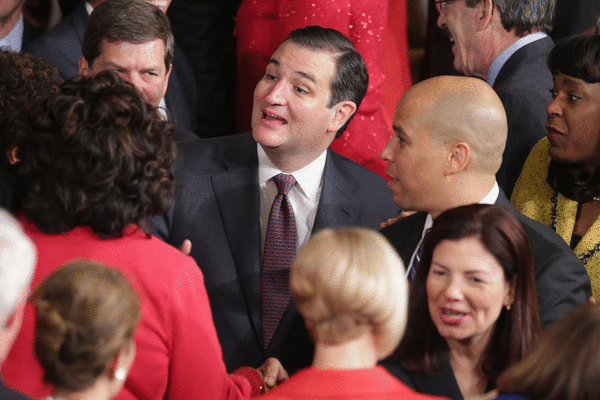
An unlikely bipartisan Senate duo is spearheading a push for employers to donate to the new “Trump accounts” created under the GOP’s “big, beautiful” reconciliation package last summer.
Sens. Ted Cruz, R-Texas, and Cory Booker, D-N.J., teamed up on a letter sent to Fortune 1000 CEOs on Monday encouraging their companies to contribute to the new investment accounts created for young children. Dell CEO Michael Dell and his wife, Susan, pledged a $6.25 billion donation to the accounts Tuesday that earned them a White House appearance with President Donald Trump.
The savings accounts, which are funded with after-tax contributions, were dubbed “Trump accounts” under the budget reconciliation law. The government will contribute $1,000 to the accounts for babies born this year through the end of Trump’s term.
The Congressional Budget Office estimated that the provision would cost $15 billion over 10 years. The Dell donation would expand the program to reach children who wouldn’t qualify for the federal contribution.
“These tax-advantaged accounts ensure that every American child is an immediate shareholder in America’s largest companies and will experience the miracle of compound growth through their lifetime,” Cruz and Booker wrote in their letter seeking corporate contributions.
The bipartisan letter stood in contrast to the strictly partisan House and Senate votes that produced the budget reconciliation package that drew united Democratic opposition. And Cruz and Booker are hardly ideological soulmates or allies on most issues. Just six months ago, the two drew headlines for a fiery exchange at a Senate Judiciary subcommittee hearing as they accused each other of hypocrisy and lying about attacks on federal judges.
But Booker said Tuesday that as a longtime supporter of individual savings accounts for children, he was excited by what he described as a growing bipartisan interest in such a provision.
“What happened with these accounts is not the version I would have done,” Booker said in a brief interview. “I think there’s a lot of things we can do to improve it, but for every child in America to have an individual investment account could be game-changing, especially if we can get the number of that initial investment up as much as possible.”
Cruz said in an interview Tuesday that he sees employer contributions as a “powerful accelerant” for the growth of the accounts. Those employer efforts, combined with donations like the one made by the Dells, could have a “transformational effect” on the future of the country, he said.
“Today, trillions of dollars are invested in 401(k) accounts,” Cruz said. “I believe ‘Trump accounts’ will be the same thing – that within a decade, we will see trillions of dollars invested in Trump accounts and the legacy of this provision will be profound.”
Cruz added that in time, he believes employer contributions to the accounts will become a “routine benefit,” similar to 401(k) contributions.
Dell donation
At a White House ceremony announcing the Dells’ donation on Tuesday, Trump said he expects “hundreds of major companies” to announce plans to contribute to the accounts in the coming months.
“This is truly one of the most generous acts in the history of our country,” Trump said. “I mean, you don’t hear about things like that.”
The Dells’ $6.25 billion donation wouldn’t offset the federal costs of the program; rather, it is intended to expand the program’s reach to a greater number of children through an additional incentive.
The gift is designed to give $250 to 25 million children who won’t receive the federal contribution and who live in ZIP codes where the median income is $150,000 or less.
Families will be able to open the accounts beginning in early 2026 and can start contributing on July 4, 2026.
The accounts are available to American children with a Social Security number. Families can contribute until the child turns 18, at which point the beneficiaries can take distributions from the account.
“I got to see the power of compound interest early in my life, and that has brought me here to this moment,” Dell said at the White House. “And hopefully we’ll inspire that kind of opportunity for many more young people in this country.”
©2025 CQ-Roll Call, Inc., All Rights Reserved. Visit cqrollcall.com. Distributed by Tribune Content Agency, LLC.





Comments