Virginia lost 10% of community pharmacies over 5 years, study finds
Published in News & Features
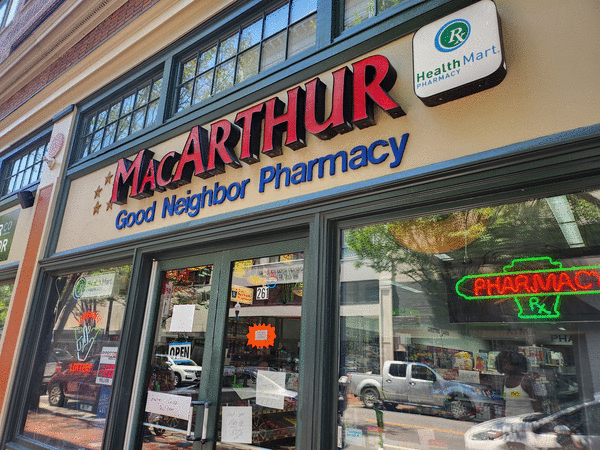
The number of community pharmacies in Virginia — including chains — has declined by nearly 10% since 2019.
That’s according to a new report from the Joint Commission on Health Care, which was tasked with studying access to pharmacy services in Virginia. Legislative staff presented the findings to the commission Wednesday in Richmond.
“Community pharmacies are a critical access point for healthcare services,” said Jen Piver-Renna, deputy director of the commission. “They dispense medications and provide health services such as vaccinations to all members of the public. They are open longer than other health care offices and provide opportunities for face-to-face medication, counseling, and education.”
But the total number of community pharmacies in Virginia has declined each year for the past five years, dropping from 1,600 in 2018 to 1,444 in 2024. In Hampton Roads, independent pharmacies including MacArthur Pharmacy, Colley Pharmacy, Barr’s Pharmacy have all shuttered in recent years. The area has also lost numerous chain pharmacies — Rite Aid has closed more than 20 locations in the region.
Statewide, 22 localities have just one or no community pharmacies at all. Six of those localities have not had any operating pharmacy in the last decade. King William County lost it’s only pharmacy, King William Pharmacy, in 2020.
Most of the closures are driven primarily by revenue not keeping pace with the increasing costs of operation. Drug costs are on the rise, often outpacing inflation. The median pharmacy technician salary has also gone up over the last 10 years, from $25,000 to $40,000 in Virginia.
Pharmacies primarily make money through reimbursement fees, which are meant to cover ingredient costs and a professional dispensing fee, from insurance companies or pharmacy benefit managers (PBMs). PBMs function as middlemen in the drug supply chain and are contracted to manage prescription drug benefits of a health plan for employers and insurance companies.
“The ingredient cost portion of a reimbursement fee should cover the cost to the pharmacy of purchasing the drug product from a wholesaler,” Piver-Renna said. “The professional dispensing fee portion of a reimbursement fee should compensate pharmacies for operational costs associated with filling prescriptions, including labor supplies and administrative overhead.”
But that’s not what’s happening.
“We heard nearly unanimously from stakeholders that revenue generated by pharmacies through reimbursement fees is not keeping pace with the cost pharmacy operations,” she said.
And that leads to tough decisions. Pharmacies might not purchase more costly drugs, or they might have to layoff staff or reduce hours, if they can stay open at all.
In an effort to reduce pharmacy deserts, the General Assembly passed legislation last session that directs the Department of Medical Assistance Services to choose one PBM to administer pharmacy benefits for all Medicaid recipients in the state. That law is designed to reduce the influence of PBMs, but it does not specifically require increased reimbursement fees.
The commission ultimately voted Wednesday to recommend several policies meant to stem the loss. They include directing DMAS to make available the 2024 cost-of-dispensing report and propose a minimum reimbursement for medications dispersed through Medicaid accordingly; establishing a pilot program to provide funding for pharmacies operating in areas of low access; proposing a budget amendment to increase funding to free and charitable clinics and community health centers to help fill the pharmacy gap; and examining a minimum amount of reimbursement fees paid by all PBMs, not just through Medicaid.
Some of those asks could be cost-prohibitive.
“We have a $3.2 billion Medicaid bill in front of us,” said Del. Mark Sickles, D-Fairfax, who abstained from voting on the policy block. “Can we afford (the budget amendments)? We don’t know that.”
_____
©2025 The Virginian-Pilot. Visit pilotonline.com. Distributed by Tribune Content Agency, LLC.





Comments