Expected loss of federal funds could push thousands of LA County households into homelessness
Published in News & Features
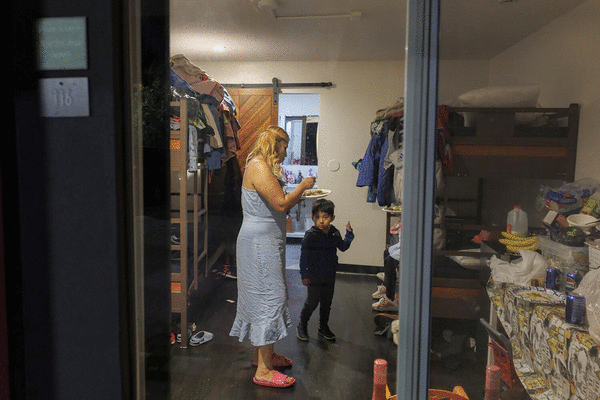
LOS ANGELES — Local officials are warning that more than 14,500 L.A. County formerly homeless households in subsidized, permanent housing could be forced back onto the streets or into shelters over the next year, mostly because of a loss of federal funding.
The predicted displacement would wipe away the slight reduction in the local homeless population since 2023 and is setting off a scramble by nonprofits and local government officials to try to blunt the potential effects.
"This is not a normal moment and we cannot treat it like it's a normal moment," said Los Angeles City Councilwoman Nithya Raman, who chairs the council's housing and homelessness committee. "There is a potential for the entire homeless services system that we have built up here to fall apart."
The estimate that more than 14,500 households are now at risk of becoming homeless comes from the Los Angeles Homeless Services Authority, which did not say how many individuals could be affected.
About 3,500 of those households are at risk mostly because of state funding cuts, LAHSA said, and an additional 6,000 households could lose housing because a federal emergency housing voucher program, launched during the pandemic, is set to expire next year, four years ahead of schedule.
Between 5,000 and 7,000 additional households could become homeless because their rent in permanent homes is paid by a separate federal program known as continuum of care, LAHSA said.
Last month, the Trump administration announced it was slashing the amount that program would distribute for permanent housing and shift dollars to temporary housing options that mandate people enroll in services such as job training and mental health treatment.
It also is putting more of the continuum of care money up for competitive bidding and making it harder for localities to get funds if they don't adhere to policies the administration wants to see, such as enforcement of camping bans.
Last week, more than 15 states, including California, sued to stop that policy change.
If the lawsuit fails and the cuts go through, LAHSA and nonprofit service providers say they expect many people to return to homelessness because they can't simply use the additional transitional housing money and turn those people's permanent apartments into temporary ones.
Permanent housing projects are usually built using other government funding sources, including state and local dollars, that bar permanent housing from converting into transitional. Furthermore, LAHSA said someone must be homeless to move into transitional housing, so people would first have to lose their permanent housing to qualify anyway.
"I cannot fathom a universe where we will not see people falling into homelessness and see our streets explode with folks who today are housed," said Stephanie Klasky-Gamer, president of L.A. Family Housing, a nonprofit that runs permanent housing as well as shelters.
In all, LAHSA said it would take at least $323 million to backfill all the money expected to be lost and keep the 14,500 households housed.
In response to the combination of cuts, the Los Angeles City Council recently ordered city staff to work with the county to make sure dollars both governments do have are efficiently used to limit the possibility of budget cuts pushing people into the streets. The council also asked staff to craft a plan to lobby federal and state officials to "limit potential funding reductions."
Getting more money could be tough. The Republican-controlled Congress has been seeking to shrink the size of government and both state and local governments face their own fiscal challenges, forcing them in recent years to make cuts to balance their budgets, including to programs that fight homelessness.
"I don't think I've ever experienced in my years in homeless services where every level had a shortfall like this," said Amber Sheikh, chair of the LAHSA Commission.
Los Angeles County Supervisor Lindsey Horvath said "there is absolutely no way" the county can backfill all the money lost, but it might be possible to keep housed a small number of at-risk people by shifting them into different programs managed by the county.
But to "come up with a clear plan," Horvath said county officials first need more clarity from the federal government on its new requirements for funding and what sort of "tools I will and will no longer have."
If thousands are forced back onto the streets, Horvath said, it could ruin the trust those people have in the government to help, making it harder to get them off the streets again.
It could also wreck trust with the broader L.A. County voting population, which last November approved Measure A, a half-cent tax to fight homelessness, which was an increase from the quarter-cent levy known as Measure H.
Though Measure A is raising more money than its predecessor, the county is proposing to slash homeless outreach programs in the coming fiscal year.
Officials say that's needed because much of the additional tax hike flows to a newly established county agency to build affordable housing, which takes time, while the sales tax percentage flowing to the county for core homeless services has remained largely the same, leading to less money available for those services as the economy slows and consumers spend less.
In a statement, Los Angeles Mayor Karen Bass said that despite the "attacks from D.C." and the county's financial situation, "going backwards is not an option for L.A." She pledged to keep working to get people off the streets and keep them housed.
One potential avenue to lessen the pain from federal cuts could still be Measure A, said Raman, who in addition to her seat on the L.A. City Council also is on the board of the L.A. County Affordable Housing Solutions Agency, the new county agency that receives much of the additional revenue from Measure A.
Under the ballot measure, though a plurality of the money LACAHSA receives must fund the construction of new affordable housing, some can go toward homelessness prevention programs.
Raman said she is exploring whether those dollars could be used to keep at least some of the 14,500 households at risk housed, something other officials said they are looking at as well.
"We have to get creative about meeting this crisis moment," Raman said.
©2025 Los Angeles Times. Visit at latimes.com. Distributed by Tribune Content Agency, LLC.






Comments