N.C. scientists fight EPA firings over petition criticizing Trump, Zeldin policies
Published in News & Features
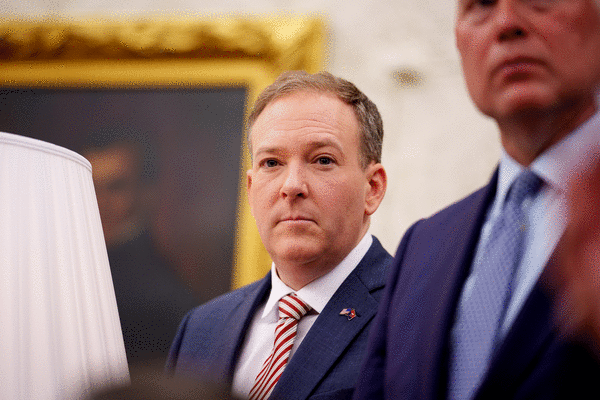
A group of Environmental Protection Agency workers fired for signing a letter criticizing EPA Administrator Lee Zeldin have formally challenged their dismissals to a federal oversight board. Among them are two North Carolina scientists who worked at the agency’s large campus in Research Triangle Park.
“Beyond the legal reasons, I still maintain a deep commitment to the mission of the EPA,” Tom Luben of Durham told The News & Observer in a phone interview Thursday.
The previous day, Luben was one of six former EPA employees to appeal their firings to the U.S. Merit Systems Protection Board, an independent agency designed to safeguard hirings, terminations and promotions in the federal Merit system. The workers accuse the EPA of violating their First Amendment right to free speech, dismissing without cause, retaliating based on politics, and disciplining inconsistently.
“Signing a petition should not be a punishable offense at all, period, let alone fireable,” said Joanna Citron Day, a lawyer for the nonprofit Public Employees for Environmental Responsibility who is representing two non-North Carolina employees in their challenges.
Luben, a senior health scientist, joined the RTP office in 2007. He was one of approximately 140 EPA employees placed on administrative leave this summer for signing an online petition that denounced agency policies under Zeldin, an appointee of President Donald Trump.
“Under your leadership, Administrator Zeldin, this administration is recklessly undermining the EPA mission,” the letter said.
The petition was hosted on the website of Stand Up For Science, a nonprofit advocacy group launched last winter to protest federal funding cuts under the Trump administration. Some EPA employees signed the dissent anonymously, but others entered their names.
“The Environmental Protection Agency has a zero-tolerance policy for career bureaucrats unlawfully undermining, sabotaging, and undercutting the administration’s agenda as voted for by the great people of this country last November,” the EPA said in a statement to The N&O in July.
While the agency later allowed most of the workers placed on administrative leave to return to work — following a short suspension or letter of reprimand — it fired a smaller number of employees.
“The ones who were fired were senior folks,” said Holly Wilson, president of the American Federation of Government Employees Local 3347, which represents EPA workers in the Triangle. She estimated around 17 RTP-based employees were initially put on leave over the petition.
The second RTP scientist fighting his firing is John Darling, a senior research biologist who focused on invasive species in the Great Lakes. He started at the EPA in 2006, a year before Luben, and now seeks reinstatement.
“I have issued the challenge first of all because I was wrongfully terminated, and I think that needs to be corrected,” Darling said in a statement provided to The N&O through his lawyer Josh Klinger. “I deserve to be reinstated so that I can continue to serve the American public as I have faithfully for the past 20+ years.”
Both men were dismissed on Oct. 2.
More than a month earlier, on Aug. 29, Luben had received an email from EPA associate deputy administrator Travis Voyles informing him of his proposed dismissal for “Conduct Unbecoming of a Federal Employee.” The lone charge Voyles made pertained to the petition.
Voyles acknowledged that Luben had received a “distinguished” rating on his most recent performance review, but he then wrote “your public criticism of EPA leadership and policies is incompatible with your duties to represent the Agency nationally and internationally through presentations, publications, and workgroups. This has eroded my confidence in your ability to represent the Agency’s interests credibly and objectively, particularly in external engagements.”
In a video call response 10 days later, Luben told EPA chief financial officer Paige Hansen he had been “compelled to exercise my First Amendment rights.”
His main motivation for signing the letter, he said, was the dismantling of the Office of Research and Development, the agency’s scientific research division. Under Zeldin, ORD scientists could apply for positions across other EPA offices, including a newly formed Office of Applied Science and Environmental Solutions that was to be housed within the Office of the Administrator.
“I fear that such a change will make EPA science more vulnerable to political interference, result in an inability to meet the needs of the EPA and its partners, and will be detrimental to the health of all Americans,” Luben told Hansen, a Trump appointee.
On Oct. 2, Hansen finalized Luben’s firing, effective the next day. “As an EPA employee, you are required to maintain proper discipline and refrain from conduct that can adversely affect morale in the workplace, foster disharmony, and ultimately impede the efficiency of the agency,” she wrote.
Prior to the final ruling, Luben’s attorney asserted in a written response that the EPA had violated the terms of its collective bargaining agreement between the EPA and the American Federation of Government Employees, the biggest U.S. federal worker union. However, this summer, President Trump signed an executive order that stripped most EPA workers of their union rights.
In her ruling, Hansen stated the EPA does not recognize the AFGE.
EPA officials declined to comment on the ex-employees’ challenges this week, citing a policy not to answer questions about pending litigation.
The U.S. Merit Systems Protection Board can order reinstatement, back pay, coverage of attorney fees and the correction of personnel records. The agency is divided among regional offices that assign administrative law judges to make initial decisions.
Luben and Darling filed their challenges to the Washington, D.C., regional office. Luben has since started a job with the University of Michigan and seeks back pay and a correction to his EPA record.
Whichever side loses at the regional MSPB can then appeal to the full U.S. Merit Systems Protection Board, a three-member body made up of presidential appointees. By law, the members can never all be from the same party.
The full MSPB currently only has two members — one appointee each of Trump and President Joe Biden. If the board is divided, the challenge is held in limbo until a third member is appointed.
“If Trump doesn’t appoint anyone, and the two board members are a split decision, it might be four years before they rule,” Klinger, Darling’s attorney, said.
_____
© 2025 The Herald-Sun (Durham, N.C.). Visit www.heraldsun.com. Distributed by Tribune Content Agency, LLC.





Comments