4-year-old evacuated from Gaza finds sense of normalcy in Chicago area while being treated for amputation
Published in News & Features
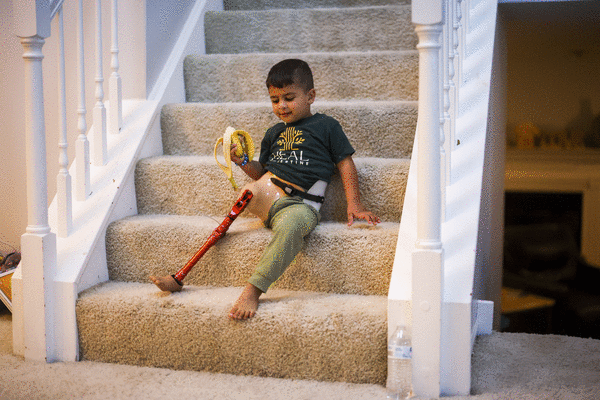
A typical late afternoon for 4-year-old Adam is much like a typical late afternoon for any child his age: snacks, “Cocomelon” on YouTube, blocks, jumping off the stairs, resisting a bath.
But unlike most toddlers, Adam lives with a host family thousands of miles away from his hometown in Rafah, in the southern Gaza Strip. His parents were killed, his siblings, too. He also jumps off the stairs with just one leg, not two.
Adam is one of six children temporarily living in the Chicago area after being medically evacuated by Heal Palestine, an organization founded in response to the destruction caused in Gaza by Israel’s response to the Oct. 7, 2023, attacks by militant group Hamas. All of the children are amputees, with most of them staying in the southwest suburbs. Heal Palestine asked the Tribune not to disclose Adam’s full name for security reasons.
Steve Sosebee, the founder of Heal Palestine, who has worked to medically evacuate children from war-torn countries for over 30 years, said his organization helps patients in Gaza who have had an amputation and require specialized care. Heal Palestine also facilitates evacuations to other countries such as Mexico, Spain, Portugal and Italy.
“There’s such a need that it’s not a challenge to identify the patients — the challenge is to place them in care and to get them out,” Sosebee told the Tribune.
The U.S. State Department halted visitor visas to the U.S. in August for individuals from Gaza — including for medical treatment — while it reviewed its visa-issuing procedures. But Heal Palestine made it clear that the program is not for refugee resettlement. After their treatment is complete, these children and any accompanying family members will go to a location in the Middle East yet to be determined, Sosebee said.
When that time comes, it will be a bittersweet goodbye, said Tinley Park resident Tujan Almasri, who has been hosting Adam and his paternal grandmother since they arrived in April. Almasri and her family have grown attached to both visitors.
Adam’s grandma, Alia Fojo, who is now more of a mother figure to Adam, has felt at home in Tinley Park, but the memories of Gaza and a yearning to go back are constant. Fojo said the Gaza she left was a nightmare, but the Gaza she dreams of is home.
“No one is in Rafah anymore. Like you see in the pictures, it’s completely flat — it’s ruined,” Fojo said in Arabic. “We were forced to leave and live in tents … and even though you are in war, you build your own tent with whatever resources you have.”
Sitting in Almasri’s living room, the 54-year-old Fojo said that although it’s been more than a year since Adam’s parents were killed in an Israeli airstrike on July 7, 2024, the image is as clear as if it happened yesterday.
At the time, the families were living in shelter tents, she said. That night, a rocket launched by Israeli forces exploded a few feet away from the tent where Adam and his family were sleeping. Fojo hadn’t been able to sleep that night and heard four rockets drop near her tent, not far from her son Ahmed’s tent, but none went off. The fifth shook her core, she recounted.
Fojo ran outside barefoot, bracing for the worst possible scenario. The car outside Ahmed’s tent was on fire. The tent was clouded in smoke and debris. Fojo’s husband and daughter came out of their tent and all three of them darted toward the flames.
Fojo said she searched for the faces of her son, her daughter-in-law and her three grandkids. She spotted Ahmed on the ground and reached for his arm: “It was detached,” she said. Next to Ahmed was his wife — and in between them was Adam, still wrapped in the bedsheet he was sharing with his parents.
“Adam’s mom was still wearing earrings,” Fojo said. Adam’s siblings, Yusuf, 5, and Nada, 7, were a few steps away — lifeless and still. “They were killed while sleeping,” Fojo said, tears slowly sliding down her sunken cheeks. At that moment, she thought even Adam had died, but “God wanted him to live,” she said.
Following the airstrike, their neighbors — also in tents — ran through the rubble to help, or at least to figure out who was killed. Fojo said her daughter took Adam to a hospital nearby. Adam never saw his parents or his brother and sister again.
While Fojo told the story in Almasri’s Tinley Park home, Adam hopped into the living room and playfully wiped his grandma’s feet with a baby wipe. He did the same to Almasri.“You’re such a goofball,” Almasri said to him, while tucking his right pant leg inside his back left pocket so he wouldn’t trip over it. He laughed and scooted away on one leg.
Adam was fitted for a prosthetic for his right leg in May, about a month after he got here. The terms of the visa require a hospital visit almost immediately after a child arrives in the country. His first appointment was the day after he landed at O’Hare International Airport.
Sosebee said Adam’s prosthetic leg will need to be refitted as he grows, and his physical therapy will continue when he goes back to the Middle East. It’s just not clear when he will leave the U.S. or where he will end up.
But he’s come a long way, Almasri said, noting that it took time for Adam to relearn how to walk, first with a trial plastic leg, and now with a prosthetic designed for a nimble toddler. But because he wears it for six consecutive hours at a local private preschool, he sometimes prefers playing without the added weight once at home.
Almasri enrolled Adam at the same preschool as her daughter Dua, 3. A few days a week, Adam goes to jujitsu classes and swim school, activities that have boosted both his verbal and physical skills. Most days, he also plays with another classmate at the library.
At home, about an hour and a half before their 8 p.m. bedtime, Dua and Adam were playing with a dry-erase board that flips into a chalkboard. The set came with one marker that Adam claimed quickly, though Dua attempted to bargain several times.
“Oh, stop it, Dua!” Adam said in impressive English. Dua quickly ratted him out: “He’s not sharing!”
They have a real sibling-like rivalry, Almasri said, smiling. While waiting for Adam to give her the blue marker, Dua pointed out that “his leg is missing.”
“He’s here to fix it,” she said. Adam, fully immersed in his scribbles, responded to her in Arabic, something about the eraser being his. “He said he loves me,” Dua added.
Adam’s mom’s name was also Dua. “Isn’t that something,” Almasri said.
When the Israeli airstrike hit the family’s tent, Adam was only 2½ years old. He turned 4 this month. Fojo said he does mention Mama Dua and Baba Ahmed every now and then, but the thing he talks about most is that they died. The trauma has become his entire memory of his parents, she said.
He often tells the story of a flame and of losing his leg and how he was in the hospital. Early on, when he was still hospitalized, he’d always ask his grandma where his parents were, having not seen them for months. She’d say, ‘They are with Allah.” Other times, she’d say, “They are in jannah, heaven.” Adam would tell her he wants to go there, too.
The journey to the Chicago area was arduous for both Adam and Fojo, but it’s an opportunity few are given. Medical evacuations from Gaza are not easy to secure, said Sosebee, and there are thousands upon thousands of children waiting to be rescued.
Nisreen Malley, the director of advocacy for Rebuilding Alliance, who started the agency’s task force for medical evacuations, said for a Gazan child to get on the list for a medical evacuation, the patient would need to see a treating physician at a government hospital and the physician would need to give a medical referral, which is extremely difficult to obtain.
“Part of it is that the doctors themselves are starving,” Malley said. “They’re fainting in the middle of procedures … so the idea of ‘OK, I’m going to pause everything to do some paperwork,’ that’s a little bit of an ask.”
Malley said so far children are the only ones being approved for medical evacuation out of Gaza, and there is a list gathered by the World Health Organization that attempts to keep track of the total number of wounded or critically injured children using a classification system to prioritize who gets evacuated.
According to the WHO, 8,006 patients were evacuated between October 2023 and last month, including 5,550 children. The organization says about 16,500 patients still need medical evacuation from the Gaza Strip.
Malley said it’s a colossal undertaking given the sheer number of children in the war zone, even as a ceasefire in the region reduced the bombing.
The WHO vets companions who would be traveling with a child and begins the process for security approval, which sometimes is secured by organizations like Heal Palestine or Palestine Children’s Relief Fund that have teams on the ground identifying children to evacuate.
But children who aren’t sponsored by such organizations go through the same referral process and go into a WHO database to wait for other countries to accept their evacuation request.
For Adam, Heal Palestine facilitated the process after he was transported by bus from Gaza to Amman, Jordan. Heal Palestine has teams in Gaza, in Massar, Egypt, and in Amman; the teams manage the patients while they await approval to fly out.
U.S.-bound evacuations depend on which hospital accepts a patient’s case. Along with a required hospital acceptance, the patients also need a financial sponsor from a nongovernmental organization. In Adam’s case, this is Heal Palestine. They also need visa approval, often involving the Jordanian government, Malley said.
The process tends to be complex, inefficient and emotionally taxing for the children involved, she said.
While he was still reeling from the pain of losing a leg months earlier, Adam had to travel first from the hospital in Gaza to Amman by bus, a bumpy journey that takes six hours or longer. A few days later, he and his grandmother, along with 11 other families being evacuated by Heal Palestine, were taken to the Jordanian airport. Some, like Adam and Fojo, flew to Chicago and others went to different U.S. cities. The flight was more than 13 hours. Fojo said Adam — anxious and amazed — had endless questions on the plane, but eventually fell asleep.
For Malley, a recent trip she took to the Middle East with UNICEF and other humanitarian organizations was jarring. The groups took U.S. congressional staffers and policymakers to war-torn areas in Gaza to show them the devastation.
“(One presenter) was talking about the impact of different things that are happening to children. And she said: ‘We’ve never done this to children before, so we don’t know what the full impact will be,’” Malley recounted. “That really haunted me. … Because, yes, we don’t know the consequences because humanity has never done this to children before. I don’t know if any of it will fully encompass what these children have had to go through, the things that these children have seen.”
While Adam’s remaining stay in the Chicago area is uncertain due to political and logistical challenges, he will first resettle in Masar, Egypt, where his next steps will be facilitated by one of Heal Palestine’s teams. Sosebee and Malley said evacuated children have so far not been allowed to return to Gaza.
U.S.-bound evacuations are incredibly expensive for organizations like Heal Palestine, which are signing on to sustain a child’s life, Sosebee said.
Although the State Department has stopped issuing visitor visas to Palestinians from Gaza, other countries, such as the United Kingdom, continue to facilitate medical evacuations for critically ill children.
Almasri, whose Palestinian family is from Jerusalem, said she immediately applied to be a sponsor when she learned about the Heal Palestine program from a friend who recently hosted a young girl from Gaza. The process is lengthy, Almasri said, starting first with an interview and then multiple background checks before Heal Palestine matches a family with a child.
“We were very eager to help,” she said. “We feel so helpless — this is the least we could do.”
Almasri and her husband have four kids, including an 8-month-old whom Almasri gave birth to just days before Adam and his grandma arrived.
Now, with five children in the house, Almasri and her husband have taken a divide-and-conquer parenting approach. And they’ve fit Adam right into their system.
“I’ll yell at Adam too, just like I will yell at my own kids, but I feel like people might judge me for it, ‘Like, are you yelling at an amputee?’” Almasri said. “He’s a rascal! The thing is, everyone that sees him is like, ‘Oh, let me give you my soul.’ Yes, of course, but they don’t realize that it actually doesn’t do him any service.”
Almasri said she’s constantly aware that Adam will eventually go back to the Middle East. And it likely won’t be to an environment as nurturing as her home.
“He’s going to go home to roughness. We have to make sure that he is as disciplined, willed and as mentally tough as possible,” she said. “And I think jujitsu is helping, and structure is helping.”
As bedtime inched closer, Almasri started setting the table for dinner — salad with a host of toppings, grilled chicken and macaroni and cheese for the kids. The family started eating even healthier because of Fojo, who prefers vegetables and healthy grains over processed options. Almasri boiled corn on the cob, too, which is Adam’s favorite.
He hopped around the table, sliding in and out of the chair next to Dua. And while nibbling on the corn, Adam was also eating lettuce off Almasri’s plate. She poked back playfully, telling him to get his own.
Although his future is uncertain, Adam’s interactions with his host family offer a glimpse of the normalcy he’s found for now.
“The thought of them leaving us makes me really sad,” Almasri said, “because it feels like I have five children now and (another) mom.”
©2025 Chicago Tribune. Visit at chicagotribune.com. Distributed by Tribune Content Agency, LLC.






Comments