New York judge approves release of more Epstein files
Published in News & Features
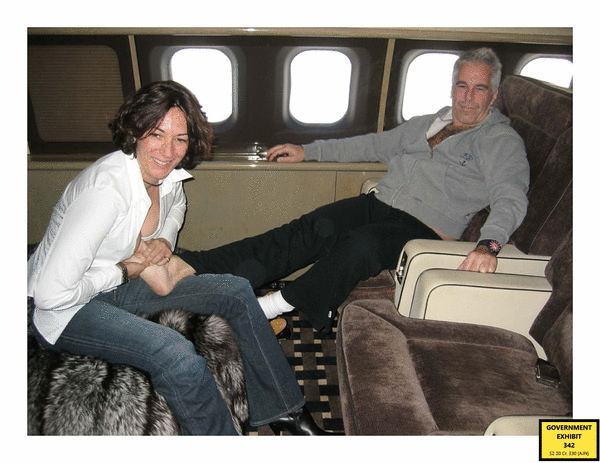
In another victory for survivors of sex trafficker Jeffrey Epstein, a New York federal judge on Tuesday ordered the release of thousands of pages of grand jury and other sealed investigative materials from the criminal case against Epstein’s accomplice, Ghislane Maxwell.
The trove of records are part of the voluminous files collected by the FBI and Department of Justice during a 20-year span in which Epstein was accused of sexually assaulting and trafficking hundreds, and perhaps thousands, of girls and young women.
Under a new law passed last month by Congress, known as “The Epstein Files Transparency Act,” all records held by the Justice Department and FBI must be released by Dec. 19.
In advance of the Dec. 19 deadline, the DOJ filed motions before three judges asking them to unseal court records in Florida and New York.
Tuesday’s court order covered Maxwell’s grand jury materials — as well as all the discovery materials collected in her criminal case, including witness and victims’ statements, photographs, plane logs, banking and financial records, civil depositions, police reports, prosecutors’ notes and emails and materials obtained in searches of Epstein’s various homes including the contents of computers and other electronic devices.
Also included: records from Epstein’s 2007 federal probe in South Florida that was turned over to prosecutors in New York as part of its criminal cases against Epstein and Maxwell brought in 2019 and 2020, respectively.
In his 24-page opinion, Judge Paul A. Engelmayer noted that the “The Epstein Files Transparency Act” applied not only to the grand jury files, but also to the discovery materials in Maxwell’s criminal case. In order to release those materials, he modified a standing protection order — with a stipulation that Justice Department certifies it will protect victims’ identities.
“The story here is the order allows for the complete disclosure of grand jury materials as well as discovery in the Maxwell case, subject to redacting victims’ identifying information,” said former federal prosecutor David Weinstein. “The judge is also asking the U.S. Attorney in New York to certify that he has reviewed the materials and that they have redacted all information that would identify victims.”
The new Epstein transparency act sets certain criteria for what materials can and cannot be made public. For example, the DOJ cannot redact information on the basis that it could cause embarrassment or reputational harm, and they must provide details for any redactions that are made. The Government can, however, withhold information that could jeopardize ongoing criminal investigations. Before the law was signed, President Donald Trump announced that the DOJ was opening investigations into Democrats who were associated with Epstein.
Englemayer’s decision followed an order Friday by a federal judge in Florida, pertaining to Epstein’s 2007 criminal case. That case led to a controversial non-prosecution agreement that allowed Epstein to escape serious charges – and ultimately to continue his crime spree for almost two more decades.
Another federal judge, Richard M. Berman of the U.S. District Court for the Southern District of New York, is also considering a similar DOJ petition for the release of materials in the 2019 federal criminal case against Epstein, who died in jail awaiting trial. His death was ruled a suicide.
Berman has requested a list of the materials the government intends to release and an explanation of how it will protect the victims’ privacy. Berman, who oversaw the trafficking case against Epstein, received a letter from victims’ attorneys who were concerned about some of the earlier government releases that revealed some victims’ identities.
The Epstein case attracted new scrutiny after publication of a 2018 Miami Herald series, “Perversion of Justice.” The stories revealed, for the first time, how prosecutors deliberately covered up the scope of Epstein’s crimes to justify giving him what amounted to a token state solicitation charge.
Besides the Justice Department files, the House Oversight Committee is investigating the case. The panel is expected to release additional records from Epstein’s estate that may expose more about others behind his criminal organization. Emails released in recent weeks show that Epstein had several people working for him besides Maxwell, the British socialite who helped him recruit victims and participated in some of the abuse.
Maxwell was mysteriously moved in July from a more restrictive federal prison in Florida to a more comfortable facility in Texas, closer to her family. The transfer happened after she was interviewed by Deputy Attorney General and former Trump personal lawyer Todd Blanche. She is reportedly angling for either a commutation of her 20-year sentence – or a pardon from President Trump, who was friends with both her and Epstein in the early 90s.
_____
©2025 Miami Herald. Visit miamiherald.com. Distributed by Tribune Content Agency, LLC.





Comments