House votes overwhelmingly to pass compromise NDAA
Published in News & Features
WASHINGTON — The House cast a strong, mostly bipartisan vote Wednesday to pass the bicameral compromise version of the fiscal 2026 National Defense Authorization Act.
The $900.6 billion defense authorization bill’s 312-112 vote was due mostly to strong support from the GOP majority.
Republicans backed the bill 197-18, while Democrats voted for it by the much narrower tally of 115-94.
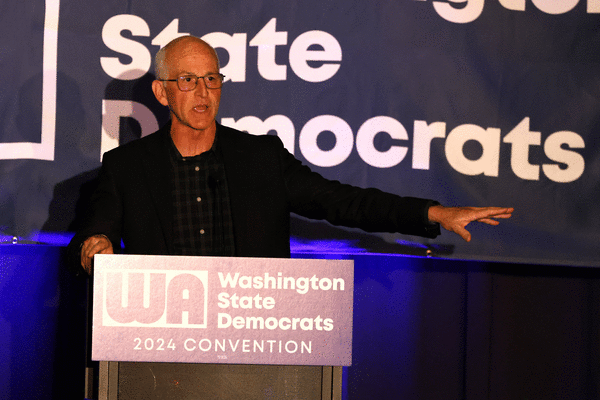
Rep. Adam Smith of Washington state, the top Democrat on the House Armed Services Committee, said at a Tuesday Rules Committee meeting and again on the floor ahead of the passage vote Wednesday that the NDAA has a little something for almost everyone in Congress to both love and hate but that, on balance, it is a strong positive for U.S. national security.
Smith has said that he agreed to include provisions he opposes and exclude others he supports in the interest of advancing the bill for U.S. troops.
Smith said, however, that the Pentagon under Defense Secretary Pete Hegseth has failed to do as Congress has asked or required in previous laws — with the implication that a new NDAA might also not be sufficiently heeded.
“This Pentagon, unlike any secretary of Defense I’ve dealt with, simply has not given Congress the information we are supposed to receive and given us the ability to do the level of oversight that we’re supposed to do,” Smith said. “The lack of respect for the law out of this Pentagon is a huge problem.”
Sprawling package
Now the NDAA moves to the Senate, which plans to vote on clearing the bill for President Donald Trump’s signature by year’s end. The White House, in a statement of administration policy issued Tuesday, said Trump intends to sign it.
The compromise NDAA is one of Congress’ only must-pass annual bills and has become law each of the last 64 fiscal years. It is a sprawling piece of legislation that often becomes a magnet for nondefense proposals, and this year was no exception.
The fiscal 2026 compromise bill would OK $900.6 billion in spending for national defense at the Pentagon and other agencies, though the funds must be provided separately in appropriations bills.
Included in the compromise package is a 3.8% pay raise for military personnel, plus endorsement of the bulk of the Pentagon’s weapons priorities and a sweeping overhaul of Defense Department acquisition processes.
The compromise version also includes many provisions aimed at restricting U.S. exports of critical technologies to China and limiting Defense Department use of end products or supplies and components sourced from China.
Record spending
The $900.6 billion total is $8 billion more than Trump requested, if it were all appropriated, and it would be slightly more in nominal terms than the $892.6 billion fiscal 2025 enacted amount for national defense programs.
Whatever amount of the funding recommended in the fiscal 2026 NDAA ends up being appropriated would come on top of the $156 billion allocated for defense in July via a 10-year reconciliation law, most of it slated to be spent in the first few years.
The potential for the military budget to meet or exceed $1 trillion in fiscal 2026 has defense hawks pleased, even if the authorized level does not meet the $924.7 billion that the Senate had endorsed authorizing for overall defense spending in its version of the bill.
This amount of spending has caused unease among some fiscal conservatives and many liberals alike, accounting for many of the House votes against the NDAA on Wednesday.
Each party’s misgivings
Five Republicans had made the NDAA’s procedural path rocky earlier on Wednesday when they withheld support for a rule governing debate on the measure. When four of the five relented, the rule was adopted 215-211.
The conservatives’ causes and concerns were varied. They included a desire for legislation that was not in the defense authorization bill, including a bill to ban a central bank digital currency and another to bar members trading in individual company stocks.
Conservative members also expressed agitation about elements that were included in the measure, such as its topline funding amount and the bill’s authorization of assistance to Ukraine and other U.S. allies and partners.
Liberals had their own grievances with the bill, apart from the discomfort of some in their ranks about the total amount of spending at issue.
Among the top concerns on the left was the legislation’s omission — for the second straight year — of a provision to require the Pentagon’s TRICARE health insurance program to cover fertility treatments, including in vitro fertilization, for active-duty troops and their dependents.
That provision was removed by Speaker Mike Johnson, R-La., after it had been approved by the House, Senate and the informal conference of Armed Services leaders writing the compromise measure.
Also taken out at the leadership level due to a reported White House veto threat were two other provisions important to most Democrats.
One would have ensured that no U.S. military bases carried the names of Confederate officers, and another would have guaranteed collective bargaining rights for Defense Department civilians.
_____
(Mark Satter contributed to this report.)
_____
©2025 CQ-Roll Call, Inc. Visit at rollcall.com. Distributed by Tribune Content Agency, LLC.



Comments