'Unimaginable': The toll on Haiti's women and girls raped by violent gangs
Published in News & Features


PORT-AU-PRINCE, Haiti — There were eight of them: hooded, merciless, armed men who burst into Micheline’s home, restrained her father at gunpoint and gang-raped her stepmother in front of them. They shot her father and torched their six-bedroom house. The gunmen then took her stepmother away.
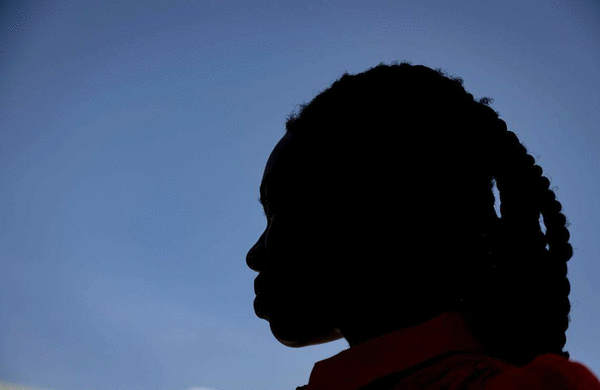
The men blindfolded Micheline, then 14 years old and still in her school uniform, took her to a trash-strewn field and tied her hands to a chair. For the next five days, she says, men repeatedly raped and beat her and five other captive girls.
“Practically every single day, they raped all six of us,” Micheline, who must now wear glasses because of facial injuries, said in a near-whisper about her March 2024 attack. “Every day, five men came to watch us, and those five used to rape us as well.”
Then, she said, “when you think that no more will come, another one comes and takes you.”
The women and the teen were given no water — not to drink, not for washing their defiled bodies. A good Samaritan later found Micheline face down in a wooded field and took her to the Haitian police’s child-protection brigade. There, Micheline made one fortuitous discovery: In a country where armed gangs have systematically weaponized rape to terrorize the population, victimizing thousands of women, girls and even men, she was neither pregnant nor infected with a sexually transmitted disease.
Many others have not been spared.
A Miami Herald investigation into the alarming rise of Haiti’s gang-related sexual violence shows that women and girls are disproportionately affected, yet the crisis receives relatively little attention, both because of cultural attitudes toward rape victims and because in the daily onslaught of violence the women’s suffering fades from view.
Yet assaults are happening with alarming frequency during travel along gang-controlled roads on public transportation, in squalid displacement camps scattered throughout the capital and in neighborhoods run by gangs. In some cases, survivors are subjected to prolonged captivity, repeated rape and forced “relationships.” The perpetrators, armed with assault rifles, often attack in packs, leaving survivors with profound psychological scars.
“The next generation of youth is going to be totally lost for Haiti,” said Dr. Jean William “Bill” Pape, a prominent public-health physician whose network of clinics opened one of the country’s first rape-treatment centers here more than 20 years ago.
The Herald interviewed more than a dozen rape survivors during the course of a year, along with doctors and advocates working with those who have been preyed upon. They paint a disturbing portrait of an epidemic that everyone agrees merits more attention, resources and action. But in the lack of national outrage, few people turn to the police as they grapple with shame and social stigma while facing limited access to medical care, little mental-health counseling and a severe shortage of emergency shelters.
Compounding the crisis: Aid to local and international organizations trying to respond is being severely slashed as the Trump administration cuts funding to United Nations agencies, limits access to contraceptives for women in low-income countries and ignores calls by European governments to make gender-based violence an important human-rights issue.
Rape culture
The sexual targeting of women and girls isn’t isolated to armed gangs. Assaults are also becoming commonplace inside the soiled makeshift displacement camps where shacks have no doors and lighting and security are luxuries. Meanwhile, as government authority collapses and poverty worsens nationwide, a culture of rape and sexual exploitation is also growing in communities outside of gangs’ control. Men in positions of power, whether they are community leaders, husbands or warlords, are coercing girls and women into sex in exchange for protection or money.
Geeta Narayan — the head of UNICEF, the U.N. child-welfare agency — calls it the “commercialization of women and girls’ bodies.” In addition to the heinous rapes, she said, Haitian society suffers from a culture in which women’s and girls’ bodies have little value.
Rape is not a new phenomenon in Haiti, where sexual violence against women and girls has long been used as a battlefield tactic during periods of political instability. But unlike in years past, when such violence went mostly hidden, that isn’t the case today. Rape has become a weapon of war, used by gang members to terrorize, punish and control populations. The unimaginable cruelty is often perpetrated by underage gang members — who, like their targets, are getting younger and younger.
“I’ve heard testimonies of women say that they were raped in front of their children and on top of their dead husbands,” said Ulrika Richardson, until recently the U.N. resident and humanitarian coordinator in Port-au-Prince. “Many say they were raped multiple times by several gang members.”
Many women have been maimed and mutilated. “The brutality of the violence is unimaginable,” Richardson said.
This year, humanitarian organizations have reported more than 7,400 cases of gender-based violence in Haiti between January and September, an average of 27 cases each day, according to the U.N. Population Fund. Sexual assaults account for more than half of the reported cases of “gender-based violence” — a broad phrase that includes acts that inflict psychological, physical, mental or sexual abuse or suffering based on an individual’s sex. Assaults involving several attackers account for 65% of the rapes. Fifteen of the victims were killed after they were raped, according to the Human Rights Service of the U.N. Integrated Office in Haiti, which has recently stepped up monitoring of sexual crimes.
Cases of gender-based violence in Haiti between January and September 2025
Experts believe that most of the perpetrators are gang members, though most organizations helping rape survivors do not ask about the assailants. Humanitarian groups say that while the number of reported rapes has already exceeded last year’s total, the actual figure is likely higher due to underreporting.
‘They woke up early and they raped us’
When Micheline arrived at the Haitian Police Brigade for the Protection of Minors after fleeing her captors, she could not speak. She was weak from going five days without food or water and deeply traumatized.
Inside the house where she and the others had been kept and repeatedly raped, she said, there was nothing but silence.
“We couldn’t speak to one another,” she said. “They didn’t want us to talk among each other.”
Her eventual freedom, she said, came as a result of rumors of a pending police operation, which sent her captors running. Before they did, however, Micheline said, “they woke up early, and they raped us. And then they left.”
When it was clear that the gang members would not be returning, a gunman who had stayed behind to guard the group untied them, Micheline said. That’s when she made a run for it to an overgrown field, where she lost consciousness.
A stranger found her lying face down. He asked her what she was doing there, and from the little she managed to tell him, he took her to the police brigade.
A week later, Micheline was finally able to tell police what had happened, including how her father tried to fight the bandits while being held at gunpoint and how she and her father had been forced to watch her stepmother’s rape. Her father was later killed in front of her. Her stepmother has not been seen or heard from since.
The police took Micheline to one of the few residential shelters for sexual-assault survivors in Haiti, Òganizasyon Fanm Vanyan an Aksyon (Strong Women in Action Organization). A woman-led nonprofit organization known by its Creole acronym OFAVA, the group has seen demand for its services surge in recent years.
Women and girls fortunate enough to get in find a place to sleep and receive psychological counseling, food and medical care.
“They had me speak to a psychologist every day, and I found other young people like me inside,” Micheline said.
The shelter offered activities like crocheting, embroidery, dancing and games to help her deal with her trauma. Slowly, she said, “I started getting back to my old self. But before the center, I thought that my life was over.”
More than a year after her ordeal, she is not only calm, but can speak about what happened without breaking down.
“I wouldn’t say that I’m completely recuperated,” she said, “but with time, I’m getting better.”
‘Massive genocide’
Some of those who survive the sexual assaults are infected with sexually transmitted diseases like HIV. Others end up pregnant and unable to have abortions because of religious reasons, family objections or simply because the procedure is illegal in Haiti. Most, if not all, who survive are psychologically and emotionally traumatized.
“What do we say to a 13-year-old girl who was gang-raped, became pregnant and was too young to understand what was happening to her own body?” Dr. Pape, the founder of Haiti’s nongovernmental health care and research center known as GHESKIO, told the U.N. Security Council in the fall of 2024 as he underscored the human cost of the violence. “We helped her deliver a baby she immediately rejected up to this day. What kind of future awaits her and her child?”
Haiti, he warned, is facing “massive genocide” and posed another question to the U.N.: “How do we console the man tied up in his home, forced to watch his wife and two daughters be raped and mutilated?”
Few safe spaces
Shelters for rape survivors are scarce, and some don’t accommodate children. Even a helpline is out of reach for many Haitians because many of the more than 1.4 million who are displaced from their homes have no access to phones or electricity, or they live on the streets.
Until last year, Òganizasyon Fanm Vanyan an Aksyon could accommodate up to 175 survivors of sexual assault. But when gangs tightened their grip on Santo, a neighborhood east of Port-au-Prince, the shelter had to relocate, moving to a much smaller space in Pétion-Ville, one of the few remaining areas in metropolitan Port-au-Prince not yet controlled by gangs.
The fewer beds and the alarming frequency of sexual assaults mean that founder Lamercie Charles-Pierre and her staff must frequently turn away those in need. Those who are admitted, Charles-Pierre said, often arrive “with nothing.”
Like others on the front lines, Charles-Pierre has to navigate Haiti’s rape epidemic amid funding cuts to U.N. agencies that support her outreach. That has meant scraping together money to cover services such as training and medical care, especially costly caesarean sections, and relying on a charity like Doctors Without Borders/Médecins Sans Frontières to provide therapists.
In the year and a half since Micheline’s horrific attack, more than a dozen neighborhoods in Port-au-Prince have fallen to gangs, giving them near-total control of the capital. Consolidating their strength under a powerful alliance that calls itself Viv Ansanm (Living Together), they’ve expanded their attacks into the rice-growing Lower Artibonite and Central Plateau regions. Still, at least 75% of the reported gender-based violence cases are in the West regional department, which includes Port-au-Prince, according to the U.N.
Guerda’s story
When clashes between rival gangs began erupting in Cité Soleil, the capital’s impoverished, sprawling slum, another young woman, Guerda, and her family relocated to the northern edges of metropolitan Port-au-Prince. Their peace in Source-Matelas, a quiet town of corn and plantain fields on the outskirts of the city of Cabaret, was short-lived.
A surprise armed attack on the morning of Nov. 28, 2022, continued for several days, leaving a trail of blood as young boys were burned alive and some were beheaded. Guerda, 22 at the time, was one of the casualties.
“They raped me,” she said, describing the attack at gunpoint by three gang members in front of her parents, young brother and her infant son before they set the family’s home on fire.
More than 20 people were massacred, she said, after the local self-defense brigade failed to stop the gunmen from seizing control of the rural community. Among the injured was her father, who was shot in his left leg.
“My mom was in a room in the front, and there were several men with guns, and they told me, move forward, and I didn’t want to. I was moving slowly, and they hit me,” she said, pointing to where she was struck with the butt of a rifle on her face. “I obeyed. But then they held me for a long time.”
Unable to get to a hospital after she was raped, she eventually learned she was pregnant. Although abortions are illegal in Haiti, Guerda said she tried to end her pregnancy over her mother’s objections. She was already three months along when she arrived at a hospital in Delmas, but then changed her mind: “Someone who was there to have an abortion had died,” she said. “I was scared. I didn’t want to die.”
The father of her oldest child, who is now 4, initially abandoned her after the rape, she said, but returned — only to be shot and killed two months later by a gang.
“We lost everything,” she said. She ended up sleeping on a public square in the nearby town of Cabaret.
Initially, Guerda tried hiding her pregnancy by wearing oversized clothing to avoid the social stigma. But the moment came when she could no longer conceal her growing belly.
“People were mocking me,” she said, recalling that they told her that she had “a fatherless child, a child of rape.”
“This could happen to them, too,” Guerda, now 25, added as she reflected on her ordeal and the lack of sympathy she faced. “You never know in life.”
She gave birth to a girl and has bounced from one displacement camp to another, sometimes finding refuge in the homes of strangers after scrubbing their pots and pans or staying in a church with her two children.
Though she has the support of her mother, Guerda said the memory and the aftermath of the assault are “overwhelming.”
Stigma and shame
What Guerda faces is common in Haiti, where survivors often blame themselves for their assaults or are blamed by members of their communities and even their own families, even when seeking help.
“It’s not only the incident itself, but the reaction of people around,” said Diana Manilla Arroyo, one of the Haiti heads of Doctors Without Borders.
Local health care workers sometimes lack sympathy for victims’ ordeals or even a full grasp of the reality in communities where gangs control access, where drinking water and electricity are luxuries and young girls and women live under constant threat of being turned into sex slaves, Manilla Arroyo said.
Sometimes, rape survivors arrive at the charity’s clinics without telling anyone they sought the services, she said, “because they decided not to share the incident with anybody, fearing they will be blamed and stigmatized and possibly rejected from their homes.”
Guerda’s rape was reported to the National Human Rights Defense Network, which, along with other human rights groups, documented the horrifying attack on Source-Matelas. Three years later, she’s still bearing the emotional and psychological scars.
“In the future, when the child asks me for her father, I will tell her, her father died,” she said, even though she says she knows there are people out there “who will tell her the truth.”
All she wants, Guerda, said, “is to have a place to stay, to have some means” to help her children.
“I worry, for them,” she said, cradling her daughter. “This is not what I wanted for them. I’m fighting for life, and I know that God won’t abandon me.”
Pregnant girls
In neighborhoods controlled by gangs, it’s not a question of whether women and girls will be raped, but when.
To protect themselves, women have started to use birth-control pills, which are increasingly difficult to get, to safeguard themselves against unwanted pregnancies, Manilla Arroyo said.
“They understand the conditions where they live, and they try to protect themselves from an imminent risk,” she said.
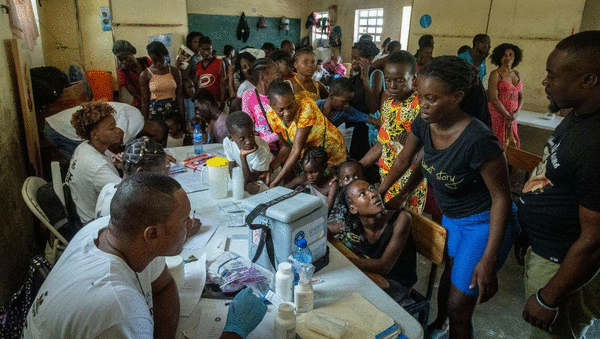
The French medical charity has a mobile clinic and three sites where it treats survivors of sexual violence. This year, staffers have documented thousands of rapes, Manilla Arroyo said. She cautioned that the numbers don’t fully tell the story because many survivors are unable to seek medical help, either because of blocked roads, fear or the lack of nearby medical facilities.
With numbers dramatically escalating, the charity has been trying to provide psychological services through partnerships with groups like the rape shelter where Micheline is being treated.
“Before, we saw psychological violence, physical violence primarily, but now rape is the most common form of sexual violence we see,” Manilla Arroyo said.
On average, 20% of the charity group’s patients are under the age of 18, she said. The charity’s numbers are consistent with what the U.N. has reported. While women still account for the majority of rape survivors, children accounted for 15% of those assaulted, and health providers are seeing more girls who end up pregnant and giving birth.
Of 268 pregnant survivors of gender-based violence assisted last year by UNICEF and its partners, 66 were girls under 18. It is estimated that 90% of the girls were survivors of rape committed by armed gangs.
“Survivors must have access to support and services,” Narayan, the UNICEF representative in Haiti, said. “It is very clear that reduction in any funding during these exceedingly difficult times for children is putting children’s lives at risk at a time when they need support more than ever.”
Mrs. Rape
Rita had given birth three months before to a baby girl when her life fell apart for the second time in April 2023. She was living at a campsite near the airport in the capital and was traveling to Cité Soleil to help a sick cousin when her bus was stopped by gunmen. All the women were forced off and led to an area of the slum known as Dèyè mi (Behind the wall), which is the only entry and exit and has become notorious for rapes by rival gangs.
“We were all afraid. We thought they were going to kill us,” said Rita, 29. “Some of us were beaten. All of us were raped.”
It was the second time in months that tragedy had struck her family. In July 2022, armed clashes between gangs took the life of her husband, Richardson, 28, a mechanic, and their 2-year-old daughter.
“I used to be a happy person. Now, I am always stressed,” said Rita — who, before her attack, eked out a living selling cooking oil, rice and food. Now, she survives by begging on the streets with her 3-year-old daughter at her side.
After initially seeking refuge at the Hugo Chávez public park near Toussaint Louverture International Airport in the capital, she and others were evicted by police. She now sleeps in an empty lot that has become a makeshift displacement camp with no bathrooms, no drinking water and the constant fear of a stray bullet or gang attack.
In Haitian culture, where women sexually assaulted by gangs are frequently stigmatized, many are no longer even identified by their names. Instead, they are referred to as Madame Kadejak (Mrs. Rape) — the Haitian Creole word for rape that has become a pejorative term, and the label Rita says many of her fellow Haitians have used against her
Raping in packs
Human-rights advocates say the gang violence is marked by another disturbing trend: Women, and especially girls, are more likely to be attacked by several men at once.
Marlene, a widow raising four girls, was gang-raped as she headed home to Cité Soleil from downtown Port-au-Prince, unaware that a deadly battle between rival gangs had erupted.
As she approached the path leading into the slum that evening, she was stopped at gunpoint and asked, “What do you prefer? Death or life?”
Scared, Marlene asked, “What’s happening?” Before she realized it, she was dragged into an isolated area, stripped of her clothes and raped at gunpoint by several gang members.
“Four men,” she said, describing the rape.
After the April 9, 2023, attack, Marlene said she had to be hospitalized. Two months later, she was referred to the Fondayson Je Klere (Eyes Wide Open Foundation), a local human rights group. It documented her assault and gave her food.
But even the human rights organization acknowledges that her needs are much deeper than it can deal with.
“She wants to find a place where she and her four children can sleep safely as well as activities to regain a semblance of a normal life,” the group wrote in an intake form.
Before her ordeal, Marlene provided for her daughters, ages 4 to 20, and a grandchild by selling food on the streets of Port-au-Prince. Nowadays, she lives on the streets, begs passing drivers for spare change and sleeps in a makeshift camp.
“I’m like a crazy person in the streets,” said Marlene. “I don’t know if I am coming or going.”
As proof of her attack, she walks around with a report from Doctors Without Borders, hoping it will be a pathway to the help she needs. But there is one secret that she shares only in a whisper:
“I have HIV.”
_____
(Miami Herald investigative reporter Shirsho Dasgupta contributed to this report.)
©2025 Miami Herald. Visit at miamiherald.com. Distributed by Tribune Content Agency, LLC.




Comments