Chicago appeals court blocks release of hundreds of Operation Midway Blitz detainees pending individual review
Published in News & Features
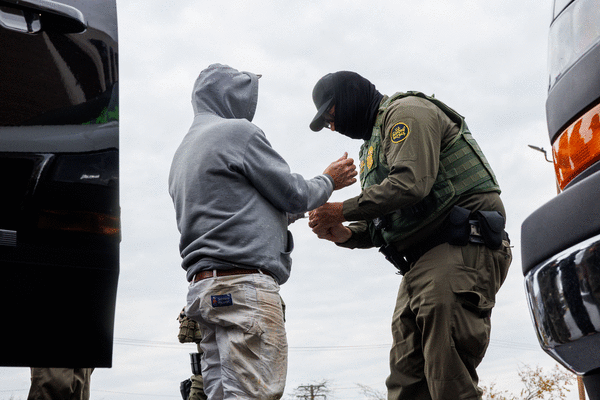
CHICAGO — A federal appeals court in Chicago issued a mixed opinion Thursday in a high-profile immigration case, blocking the immediate release of hundreds of people detained during Operation Midway Blitz, but allowing the extension of a consent decree governing so-called warrantless arrests.
The 2-1 split opinion from the 7th U.S. Circuit Court of Appeals said U.S. District Judge Jeffrey Cummings overstepped his authority in ordering the release of people arrested with “I-200” warrants that agents filled out in the field.
The appeals court said Cummings also erred in issuing a blanket order granting bond to other detainees who’d been arrested without judicially approved warrants, saying that each individual needed to be assessed for potential danger to the community.
“After all, this is not the bargain the Defendants agreed to, and the Consent Decree carefully maps out what the district judge can or cannot order, balancing Defendants’ immigration enforcement responsibilities … and the need to maintain public safety,” the majority opinion stated.
The appellate ruling did, however, find that the Department of Justice under President Donald Trump had improperly categorized all immigration arrestees as subject to mandatory detention, regardless of their individual circumstances or lack of criminal background.
And, in upholding the extension of the consent decree until February, the majority opinion said Cummings “cited multiple instances where (immigration officials) had failed to comply with the Consent Decree while making warrantless arrests” and “also relied on the unilateral proclamation by a DHS senior official … that DHS would no longer comply with the Consent Decree,” referring to the U.S. Department of Homeland Security.
”Accordingly, we cannot say that the district court abused its discretion when finding that Defendants’ substantial non-compliance with the Consent Decree constituted a significant change in circumstances that warranted a modification,” the majority opinion stated.
The appeals court agreed to stay its order on the consent decree extension to allow the administration of President Donald Trump to file an emergency appeal with the Supreme Court.
The third member of the panel, Judge Thomas Kirsch II, dissented, saying Cummings went well beyond his authority in his release order and in extending the consent decree, which he said essentially dictates how the executive branch should enforce the nation’s immigration laws.
“It was wrong about how much flexibility the executive branch is due when it gives up enforcement authority to the judiciary,” Kirsch wrote.
Mark Fleming, an attorney for the plaintiffs, told The Chicago Tribune on Thursday they were “most disappointed” the appeals court reversed the interim relief provided by Cummings.
Fleming said the government has been dragging its feet for months on producing the records as the court ordered, while hundreds of arrestees continue to be held in squalid detention facilities around the country and are quickly losing hope.
“We will go back to the district court and fight hard to get that adjudicated as quickly as possible,” said Fleming, of the National Immigrant Justice Center. “Because they deserve it.”
Fleming also said the 7th Circuit’s opinion is the first time an appeals court has ruled Trump administration is wrong on the treatment of all immigration arrestees as subject to mandatory detention.
The ruling comes nearly a month after Cummings ordered the release of hundreds of detainees — the vast majority arrested during Operation Midway Blitz — on a $1,500 bond and some form of monitoring, including electronic ankle monitors, pending the outcome of their immigration proceedings.
The Trump administration, meanwhile, immediately asked for a stay from the 7th Circuit, arguing Cummings made a “bevy of legal errors” that put public safety at risk and “cripple” immigration enforcement.
At issue is a 2022 consent decree known as the Castañon Nava agreement, which bars agents from making warrantless immigration arrests unless they have probable cause to believe someone is in the U.S. unlawfully and that the person is a flight risk.
It was originally supposed to sunset in March. Instead, after the second Trump administration began ramping up immigration enforcement efforts in January, lawyers for the National Immigrant Justice Center and ACLU alleged dozens of violations, mostly involving “collateral arrests,” or the detaining of individuals who are not targets.
In his Oct. 7 order extending the consent decree until February, Cummings said Immigration and Customs Enforcement had improperly told its field offices over the summer that the consent decree had been canceled. He also called into question the recent immigration raid on an apartment building in the South Shore neighborhood, where agents in military gear burst through doors and zip-tied residents regardless of citizenship.
Cummings also took particular issue with a practice by ICE agents of carrying blank I-200 warrant forms with them on missions and filling them out at the scene.
U.S. Department of Justice attorney Benjamin Hayes said the government was seeking a stay on both the extension of the consent decree as well as Cummings’ release order pending a full appeal.
The 7th Circuit panel that heard the case included Kirsch, a Trump nominee who previously served as U.S. attorney in Hammond, as well as a pair of Democrat-nominated judges: John Lee, a President Barack Obama nominee, and Doris Pryor, who was nominated by President Joe Biden in 2022.
During oral arguments last week, Lee said he found the Castañon Nava case unique because the Trump administration seemed to be arguing that the district court should not enforce a consent decree that “the government entered into eyes wide open.”
“The court is not kind of making things up on its own,” Lee said.
Lee cited a PowerPoint presentation disclosed during the litigation showing agents were being instructed to “go out with blank I-200 (warrants) to get around the requirements of the consent decree.”
Where is the line between operating in good faith and trying to duck a court order, Lee asked.
“It seems to me odd that the government — whoever has the White House at the time — can just say, ‘Oh, well, I think this sheet of paper is good enough,’” Lee said.
Toward the end of the 45-minute session, Kirsch asked Keren Zwick, the plaintiffs’ attorney with the National Immigrant Justice Center, whether issuing a stay of the consent decree extension would automatically trigger a stay on the release order as well.
“I think you’re probably right,” Zwick acknowledged.
©2025 Chicago Tribune. Visit chicagotribune.com. Distributed by Tribune Content Agency, LLC.






Comments