She fought segregation in 1951. Now her statue stands in the US Capitol
Published in News & Features
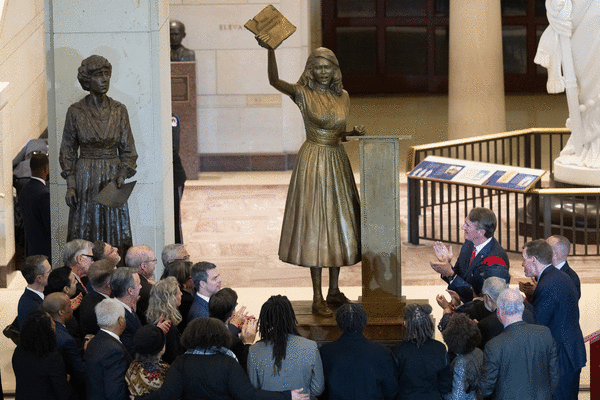
WASHINGTON — Barbara Rose Johns was just 16 years old when she led her Farmville, Va., classmates in a student strike protesting unequal education. That 1951 student-led protest paved a path toward the Supreme Court and the landmark 1954 Brown v. Board of Education ruling desegregating public schools across the country.
On Tuesday, a bronze-cast statue of Johns — standing next to a lectern, holding a book high above her head — joined the National Statuary Hall collection in the Capitol, which allows each state to display up to two statues honoring historically significant individuals.
“She was a trailblazer and a pioneer in the fight for equal education,” Speaker Mike Johnson, R-La., said during an unveiling ceremony in Emancipation Hall attended by Virginia politicians and roughly 200 of Johns’ descendants and extended family members. “At the remarkable age of 16, she conceived of a single simple act of protest that would go on to shape the lives of millions of American students across the nation.”
Johns’ path to the Capitol began in 2020, when Virginia’s then-Gov. Ralph Northam requested the removal of the state’s statue of Gen. Robert E. Lee amid a widespread effort to take down public statues honoring Confederates and rename buildings across the country. The Virginia state legislature launched a commission, chaired by state Sen. L. Louise Lucas, to select a replacement.
Virginia Del. Jeion Ward, vice chair of the commission, said the group received more than 80 write-in submissions from community members, which they eventually narrowed down to Johns.
Johns wasn’t a naturally outspoken student, Ward said ahead of the unveiling. Even her siblings were surprised when she organized the strike. But Johns knew she couldn’t let the injustice she and other Black students faced in Virginia continue.
“She’s going to be right in the Capitol where she belongs, because I see her as a center of our national story,” Ward said. “We got a lot of things wrong when we started this country … but we are seeing some corrections. And one major correction was led by Barbara Rose Johns, with trying to have an education system that was equal for everyone. She was the one that did that. She didn’t wait around for the adults.”
After the commission approved Johns for the statue, they set out to find a sculptor. Ward said that of the artists who submitted renderings, Steven Weitzman — a Maryland-based artist who also designed the statue of Frederick Douglass on display in the Capitol — was the natural choice. Weitzman made a commitment to Johns’ family members, Ward said, that he’d ensure the statue captured her true likeness.
“The core of who she was as a 16-year-old remained (for her whole life). She put God first in her life. She was brave, bold, determined, strong, wise, unselfish, warm and loving,” said Terry Harrison, Johns’ daughter, at the unveiling. “We are truly grateful for this magnificent monument to her story, the sacrifices that her family and her community made.”
Johns’ 1951 strike protested conditions at Robert Russa Moton High School, where students did not have adequate resources compared to the surrounding white schools. With the NAACP’s support, students were eventually able to file a lawsuit, Davis v. County School Board of Prince Edward County, protesting the unequal conditions. The case was consolidated into Brown v. Board of Education.
“You can’t tell the story of Virginia without telling the story of Barbara Rose Johns,” Virginia Gov. Glenn Youngkin said at the unveiling. “You can’t tell the story of the American civil rights movement. You can’t tell the story of how our nation struggled against — and then overcame — segregation without telling the story of the Moton school strike.”
Now, after delays due to the COVID-19 pandemic, the statue of Johns will join George Washington in the National Statuary Hall Collection as the second provided by the commonwealth of Virginia. Johns is the only person depicted as a teenager, and one of only 15 women in the collection.
Ward said she hopes that young people touring the Capitol see Johns’ statue and recognize their own ability to make change.
“I wanted them to see that, even now, they are more powerful than they think they are,” Ward said. “They can do a lot more. Sometimes they sit back and wait for adults to do things — but this young girl didn’t wait.”
_____
©2025 CQ-Roll Call, Inc., All Rights Reserved. Visit cqrollcall.com. Distributed by Tribune Content Agency, LLC.






Comments