Support for Japan's Takaichi stays firm as China dispute festers
Published in News & Features
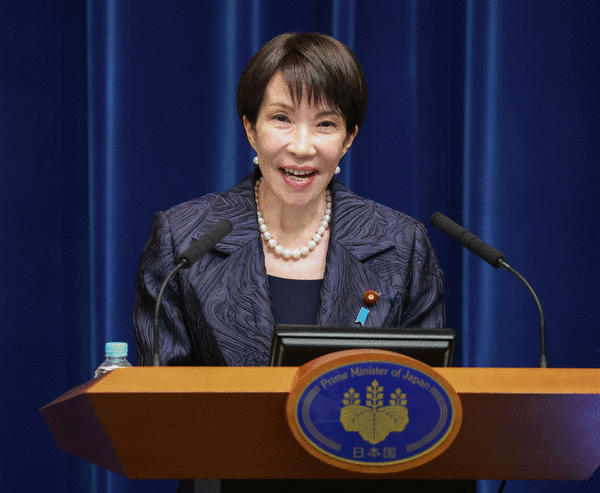
Japanese Prime Minister Sanae Takaichi’s support ratings held steady at historically high levels according to polls conducted over the weekend, in a sign of her continued popularity despite the fallout from a dispute with China over comments she made on Taiwan last month.
Surveys conducted over the weekend showed that about 70% of respondents were in support of Takaichi’s administration. The Nikkei newspaper put her approval rating at 75%, the Yomiuri at 73% and Kyodo newswire at 67.5%, while the Asahi and Mainichi newspapers put the figure at 68% and 67% respectively. An FNN poll gave the premier a support rating of 75.9%.
The poll results tracked a continued trend since she became the first woman to take the top job in October. She took over at a time when the ruling bloc’s grip on power was weakened by its loss of majorities in both chambers of parliament.
Since then, she has weathered the collapse of a long-standing coalition between her Liberal Democratic Party and Komeito and ushered in a new partnership with the Japan Innovation Party as well as the influx of a handful of independent lawmakers that allowed her to reclaim a razor thin majority in the lower house. The premier has also passed an extra budget with the help of some opposition parties.
Her ratings are the highest for a Japanese prime minister in about two decades stretching back to the administration of Junichiro Koizumi, according to the Yomiuri.
The extra budget funds an economic package that includes ¥8.9 trillion specifically meant to help households cope with inflation — a top policy priority after frustration over soaring costs of living led to election setbacks for the LDP. The package includes rice coupons, subsidies for electricity and gas, as well as a cut to gasoline taxes.
Inflation continues to be at the top of voters’ minds. Half of respondents to the Nikkei survey said they wanted to see Takaichi implement inflation countermeasures as a top priority, with defense and diplomacy coming in second at 31%, and then pensions at 29%.
Japan’s pace of inflation stayed at or above the Bank of Japan’s 2% target for a 44th straight month in November, data released Friday showed.
While keeping a handle on domestic issues, Takaichi has also had to navigate the ire of China after she said that a Chinese invasion of Taiwan could possibly be a ‘survival-threatening situation’ — a legal justification for Japan to deploy troops to aid other countries in a contingency.
China has sought a retraction of the comments, but Takaichi has refused to do so, saying that Japan’s policy on Taiwan remains unchanged.
Beijing has since railed against Tokyo, inflicting economic and diplomatic threats by warning its citizens against traveling to Japan and sending letters of complaint to the United Nations. Tokyo has also alleged that Chinese fighter jets trained fire-control radars on at least one of its jets.
A majority of respondents have supported Takaichi’s stance against China. People who said they agreed with Takaichi’s position on China amounted to 55% in the Asahi poll, while 30% disagreed. The Kyodo poll showed that 57% of respondents didn’t think Takaichi’s comments were careless.
The public appears to be wary of the impact from the dispute, however. The Nikkei poll showed that 46% were concerned about the economic impact of a deterioration in ties between Tokyo and Beijing, while 48% said they were not concerned. Some 53% of respondents were at least partially concerned about the economic impact in a separate Asahi poll, while the Kyodo poll put that rate at 59.9%.
Over the weekend, Itsunori Onodera, who heads the LDP’s research on security, said that Japan should not shy away from discussing nuclear weapons, while emphasizing that Japan is under the US nuclear umbrella.
The comments came after a senior government official last week expressed a personal opinion that Japan should have nuclear weapons. The official said that there were no formal discussions on the matter within the government, and added that the possibility of obtaining such weapons was remote. Still, the remarks sparked backlash from opposition parties and also from China.
Chinese foreign ministry spokesman Guo Jiakun called the situation ‘severe’ if true, saying it exposes the attempts of some in Japan to break international law and possess nuclear weapons.
©2025 Bloomberg L.P. Visit bloomberg.com. Distributed by Tribune Content Agency, LLC.






Comments