Supreme Court deals Trump a defeat on bid to deploy National Guard in Illinois
Published in News & Features
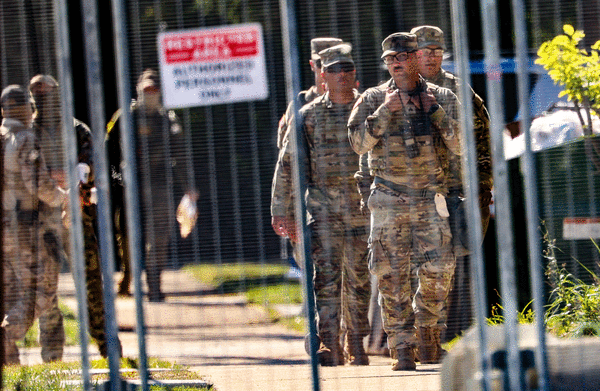
CHICAGO — The conservative-majority U.S. Supreme Court on Tuesday denied a request from President Donald Trump’s administration to allow the Republican president to deploy National Guard troops to Illinois while a lower court’s restraining order is appealed.
The high court’s order represents a victory so far for Gov. JB Pritzker and other Democratic governors in their escalating battle with Trump over his authority to go against their wishes and use federalized troops on U.S. soil.
While considering a motion to stay a lower court’s order blocking the deployment, the Supreme Court asked the Trump administration and the state of Illinois to submit supplemental briefs regarding a provision in federal law that Trump says allows him to dispatch National Guard troops in cases where there is an invasion, a rebellion or a time when the president “is unable with the regular forces to execute the laws of the United States.”
“At this preliminary stage, the Government has failed to identify a source of authority that would allow the military to execute the laws in Illinois,” the order Tuesday said. “Thus, at least in this posture, the Government has not carried its burden to show that (the law) permits the President to federalize the Guard in the exercise of inherent authority to protect federal personnel and property in Illinois.”
The key issue the high court sought briefings on was whether the term “regular forces” means “the regular forces of the United States military,” and if so, how that fits into existing law involving the president’s power to order up the National Guard.
In the temporary order denying the stay on Tuesday, the justices did not find merit to the Trump administration’s argument that “regular forces” refers to civilian law enforcement such as immigration agents.
“We conclude that the term “regular forces”… likely refers to the regular forces of the United States military,” the order said. “This interpretation means that to call the Guard into active federal service … the President must be ‘unable’ with the regular military ‘to execute the laws of the United States.’ Because the statute requires an assessment of the military’s ability to execute the laws, it likely applies only where the military could legally execute the laws.”
Three of the conservative justices, Clarence Thomas, Samuel Alito and Neil Gorsuch, logged dissents, with Thomas and Alito writing that the court “has unnecessarily and unwisely departed from standard practice.”
Unlike a recent appellate ruling allowing troops to be deployed in Oregon, the Supreme Court in this case went against the president’s wishes, keeping a restraining order in place that currently has no termination date.
Right now, 300 Illinois National Guard troops remain under Trump’s control over Pritzker’s objections until April 15 to support the Department of Homeland Security’s immigration enforcement efforts under Operation Midway Blitz, even though the Guard members have carried out no significant operational missions and have spent most of their time stationed at a northern Illinois base.
But with Tuesday’s Supreme Court ruling, it remains to be seen how much longer those troops will truly remain under the president’s purview.
U.S. District Judge April Perry’s temporary restraining order barring National Guard troop deployment in the Chicago area and elsewhere in Illinois was issued Oct. 9 and was later extended indefinitely pending a hearing on a more permanent injunction.
But in granting the stay, the Supreme Court had effectively given Trump the green light to send in National Guard troops while the case is playing out, which could take several months or more.
In its filing asking the Supreme Court to issue a stay on Perry’s order, the Trump administration called it part of a “disturbing and recurring pattern” that “improperly impinges on the President’s authority and needlessly endangers federal personnel and property.”
It asked that Trump be allowed to deploy some 700 troops in Illinois — 300 from the Illinois National Guard and another 400 federalized out of Texas earlier this month.
In the 46-page response, the state said it would be inappropriate for the high court to get involved at this stage in the proceedings, where a district court’s decision has yet to be decided on appeal.
The filing also said lawyers for Trump offered “no meaningful response” to the factual basis for Perry’s restraining order, adding that declarations submitted by a series of immigration officials outlining purported violence against agents and out-of-control protests simply did not hold water.
_____
©2025 Chicago Tribune. Visit chicagotribune.com. Distributed by Tribune Content Agency, LLC.

Comments