Why US forces snatched Venezuelan leader Maduro's wife: She faces drug charges too
Published in News & Features
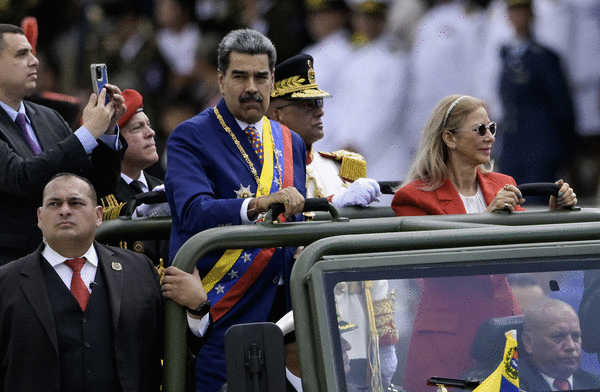
When U.S. special forces captured Venezuelan leader Nicolas Maduro early Saturday morning, he wasn’t snatched alone: His wife, Cilia Flores, was taken as well, and put on an American warship ultimately bound for New York.
The reason: Flores as well as her husband faces drug-trafficking charges in the United States, along her son and other high-ranking members of the Venezuelan government accused of participating in a long-running drug trafficking conspiracy.
Cilia Adela Flores de Maduro, a political figure in her own right, was named alongside the president’s son, Nicolás Ernesto Maduro Guerra, in a superseding indictment unsealed Saturday in federal court in Manhattan. The four-count indictment, which also names the former South American leader and his interior minister, Diosado Cabello, was unsealed after U.S. officials said they had captured Maduro and his wife in U.S. military operations in Caracas.
President Donald Trump confirmed later Saturday, as he and his administration walked the public into the behind-the-scenes details of the operation, that Flores and her husband would face “American justice,” after being indicted “for their campaign of deadly narcoterrorism against the United States and its citizens.”
Federal prosecutors say that while Maduro led “a corrupt, illegitimate government,” his relatives, including his wife and son, personally profited from “that massive-scale drug trafficking” that relied on protection from state institutions and military. Also named in the indictment are Ramon Rodriguez Chacin and Hector Rusthenford Guerrero Florida. Rodriguez is a Venezuelan politician and former member of the armed forces who served as minister of the interior and justice, and is former governor of Guarico state. Rusthenford is described in court documents as a leader of Tren de Aragua, the Venezuelan transnational criminal organization recently designated by the United States as a foreign terrorist organization.
Members of Maduro’s inner-circle, they are all accused of partnering “with some of the most violent and prolific drug traffickers and narco-terrorists in the world,” for decades, while relying on corrupt officials to move drugs into the U.S., according to prosecutors.
In the case of Flores, U.S. officials say that between in 2004 and 2015, she and her husband “worked together to traffic cocaine, much of which had been previously seized by Venezuelan law enforcement, with the assistance of armed military escorts.”
During that time, the couple “maintained their own groups of state-sponsored gangs known as colectivos to facilitate and protect their drug trafficking operation,” according to the indictment. U.S. authorities also accuse the couple of ordering kidnappings, beatings and murders of those who owed them drug money or otherwise undermined their drug trafficking operation, including setting up the murder of a local drug boss in Caracas.
In one incident, Flores is accused of attending a meeting at which she “accepted hundreds of thousands of dollars in bribes to broker a meeting between a large-scale drug trafficker and the director of Venezuela’s National Anti-Drug Office, Nestor Reverol Torres.” The indictment said the trafficker later paid Reverol Torres monthly bribes, in addition to approximately $100,000 for each flight that was transporting cocaine to ensure the flight’s safe passage. A portion of the money was paid to Flores, the indictment said. Reverol Torres was charged with narcotics offenses in the Eastern District of New York in 2015 but remains a fugitive.
U.S. officials also recount the high-profile case of Flores’ nephews, Efrain Campo Flores and Franqui Francisco Flores de Freitas. Between October and November 2015, the two met with U.S. Drug Enforcement Administration confidential sources and agreed during recorded meetings to dispatch multi-hundred-kilogram cocaine shipments from Maduro’s “presidential hangar” at the Maiquetia Airport, the indictment said.
The two men were commonly known as the Narcosobrinos (Narco-Nephews), and were arrested in Haiti in 2015. They were sent to the U.S. where they were later convicted and sentenced to 18 years in prison for conspiring to import cocaine into the U.S. However, they were later freed as part of a high profile U.S. prison swap during the Biden administration.
Described as the “de-facto” first lady of Venezuela, Flores married Maduro in 2013 and has held senior political posts dating back to 2006. She served as president of the National Assembly from 2006 to 2011, as Venezuela’s attorney general from 2012 to 2013, and as a member of the National Constituent Assembly beginning in 2017.
U.S. officials also claim that Maduro’s son, Nicolas Ernesto Maduro Guerra, known as “Nicolasito,” and “The Prince,” was also an important figure in trafficking operations. He is described as “a corrupt Venezuelan politician” who rose quickly after his father took office in 2013. Soon after, he was appointed head of the Corps of Special Inspectors of the Presidency, a position that was created for him by his father. He later joined the National Constituent Assembly, and entered Venezuela’s National Assembly, where he continues to hold office.
Prosecutors allege that all who have been indicted worked with narcotics traffickers and armed groups to move cocaine from Venezuela through Central America and the Caribbean to the United States. By 2020, the State Department estimated that between 200 and 250 metric tons of cocaine transited Venezuela each year, according to the indictment. Shipments were moved by sea aboard small boats and commercial vessels and by air from clandestine airstrips and commercial airports controlled by corrupt officials.
©2026 Miami Herald. Visit miamiherald.com. Distributed by Tribune Content Agency, LLC.





Comments