Maduro's cocaine-trafficking charges will be hard to prove, legal experts say
Published in News & Features
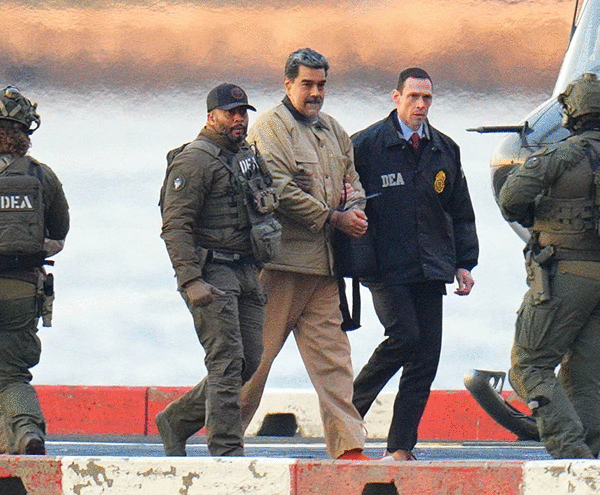
To be sure, the optics don’t look good for Nicolás Maduro.
For months, the Trump administration pilloried him as a corrupt drug-trafficking politician who consorted with terrorists to harm America, setting the stage for the U.S. military’s seizure of the Venezuelan president in a predawn raid on Saturday.
A newly unsealed indictment accuses Maduro, his wife and other powerful Venezuelan officials of participating in “a relentless campaign of cocaine trafficking” for 25 years, alleging they received millions in bribes from Latin American drug cartels in exchange for providing “law enforcement cover and logistical support for the transport of cocaine through Venezuela” north to the United States.
Yet despite the main allegation that Maduro headed the campaign “resulting in the distribution of thousands of tons of cocaine to the United States,” the U.S. government’s narco-terrorism case against the captured Venezuelan leader will be hard to prove, according to four legal experts with decades of criminal trial experience who reviewed the indictment for the Miami Herald.
They cited the apparent lack of evidence directly implicating the former Venezuelan president accused of being at the top of the sprawling conspiracy, while noting that classified government information around Maduro is likely to shroud his trial and cause problems for prosecutors.
“To say that Maduro was in control of all this is ridiculous — he was just a functionary,” said Richard Gregorie, a retired federal prosecutor in Miami who brought a similar indictment against the Panamanian strongman Manuel Noriega in 1988.
During Noriega’s capture two years later in Panama, U.S. authorities gathered incriminating records from his office, which helped seal his conviction in Miami on drug trafficking, racketeering and conspiracy charges involving the military general’s cocaine dealings with the Medellin cartel in Colombia.
“Maduro was not Noriega. He did not control the military like Noriega did in Panama. The military controlled him. Maduro did what the military wanted him to do,” Gregorie told the Herald on Wednesday. “The (United States) didn’t arrest anybody else but him and his wife, and they apparently didn’t obtain any records from him.”
Gregorie said prosecutors who filed the federal case in New York will not only face serious challenges showing Maduro knowingly collaborated with terrorist-designated cartels in Colombia and Mexico, but will have a major problem proving he supplied machine guns as part of the alleged cocaine-smuggling racket. He also predicted a fierce battle over the government’s expected use of classified information to prosecute Maduro.
Michael Sherwin, a lawyer based in Miami and Washington, who served as the acting U.S. attorney in the nation’s capital during the first term of the Trump administration, agreed across the board, saying “This is a convoluted indictment that strains credulity.”
Sherwin, who also served as a federal prosecutor in Miami, noted, “It’s dangerous to bring a case like this against anyone” because it could potentially “open the floodgates” of sensitive U.S. intelligence that could compromise the federal government.
“I don’t think it’s good practice, unless you have a substantial amount of direct evidence, which doesn’t appear to be the case here,” Sherwin said. “There is always a balancing test of intelligence equities. What if Maduro turns out to have been an intelligence asset for the United States?”
Maduro, who took over Venezuela’s government in 2013 following the death of President Hugo Chavez, was initially charged with a handful of other officials and drug traffickers by federal prosecutors in New York in 2020.
The new drug-trafficking indictment — unsealed Saturday in Manhattan federal court after the capture of Maduro and his wife Cilia Flores — charges the couple; their son, Nicolas Maduro Guerra, a deputy in the Venezuelan National Assembly; Diosdado Cabello, an influential interior minister; Ramon Rodriguez Chacin, a former interior minister; and Hector Guerrero Flores, leader of the Tren de Aragua gang.
The Venezuelan gang drew notoriety when President Donald Trump accused its members of illegally entering the United States and committing violent crimes at Maduro’s behest, an allegation contradicted by U.S. intelligence.
The only two defendants in U.S. custody, however, are Maduro and his wife, who are being held at a federal detention center in Brooklyn. The other defendants are still in Venezuela or are fugitives.
On Monday, Maduro declared “I’m innocent” as he pleaded not guilty in Manhattan federal court to the indictment’s four charges: narco-terrorism conspiracy, cocaine-importation conspiracy, possession of machine guns and destructive devices, and conspiracy to possess machine guns and destructive devices. His wife also pleaded not guilty to the latter three charges; she’s not charged with the narco-terrorism conspiracy count.
The U.S. attorney’s office in Manhattan declined to comment for this article, and Maduro’s defense attorney, Barry Pollack, did not respond to an email inquiry.
Allegations go back to Chavez
The origin of the Maduro indictment dates back to 2011, when federal prosecutors in both New York and Miami obtained indictments against Hugo Carvajal Barrios, a former Venezuelan general who was the director of military intelligence during Chavez’s government for eight years. The allegations in his case, which jibe with those in the Maduro indictment, have roots reaching back even further to 1999.
Carvajal, nicknamed El Pollo, evaded U.S. authorities until he was extradited from Spain to the United States in 2023. Last year, Carvajal pleaded guilty to the same four charges in the indictment brought against Maduro and the others, including providing protection for the leftist Fuerzas Armadas Revolucionarias de Colombia, or FARC, to traffic multi-ton loads of cocaine into the United States and use weapons to facilitate the operations. The FARC sold large loads of cocaine to fund its civil war with the Colombia government, which ended with a peace agreement in 2016.
Carvajal faces between 50 years and life in prison, according to court records. As he awaits sentencing in New York, he is expected to emerge as the main witness in the case against Maduro and the other defendants. Carvajal’s attorney, Robert Feitel, did not respond to an email request for comment on his likely cooperation with federal authorities.
Issues with main witness, attorneys say
Legal experts contacted by the Herald questioned how prosecutors could build their case around Carvajal, who has insider knowledge but also profound credibility issues and faces spending the rest of his life in prison. To use him as their central witness, prosecutors will have to cut him a deal on his prison term while corroborating his likely testimony — no easy task.
“Their star witness is their major flaw,” said Jon May, who was one of Noriega’s defense attorneys along with lawyer Frank Rubino at his Miami federal trial in 1991 and 1992.
“In the classic narcotics case, the reason the government sometimes loses is that they put cooperating witnesses on the stand with serious credibility problems,” May said. “The defense can say to the jury, ‘Why believe them? They have made deals. There’s no reason to believe them.’ ‘’
Sherwin, the former federal prosecutor, put the government’s challenge another way: “This is not an easy case to solve outside of the ‘flip’ testimony (from Carvajal),” he said. “I don’t see any hard documentary evidence in the indictment tying Maduro to the allegations.”
Cartel of the Suns
Maduro is accused of developing a corrupt political culture that was set in motion by his predecessor, Chavez, who had ordered a few of his trusted political allies to take over the cocaine trade in Venezuela two decades ago. Chavez argued the regime’s incursion in drug trafficking was necessary to help the FARC take power in Colombia, which borders Venezuela. He wanted to hurt the United States because he saw the U.S. as the main obstacle to his socialist movement in Venezuela, according to DEA documents obtained by el Nuevo Herald.
The four-count indictment alleges that Maduro played a pivotal role in the Venezuelan drug-trafficking syndicate known as the Cartel de los Soles, or Cartel of the Suns. The cartel, made up of military officers and senior Maduro administration officials, controlled most smuggling operations in Venezuela with the FARC in Colombia and Sinaloa and Zeta narcotics organizations in Mexico.
The cartel is accused of providing protection for the high-level drug traffickers, allowing them to transport large-scale loads of cocaine by boats or planes from Venezuela through the Caribbean or Central America and Mexico to the United States. (The cartel’s name refers to the sun insignias affixed to the uniforms of top Venezuelan military officials.)
Maduro, like Chavez before him, “participates in, perpetuates, and protects a culture of corruption in which powerful Venezuelan elites enrich themselves through drug trafficking and the protection of their partner drug traffickers,” the indictment says. “The profits of that illegal activity flow to corrupt rank-and-file civilian, military, and intelligence officials, who operate in a patronage system run by those at the top — referred to as the Cartel de Los Soles or Cartel of the Suns.”
In-depth news accounts have spotlighted Venezuela’s corrupt spoils system built on the country’s valuable geographic position in the drug trade.
“The Cartel of the Suns today is a disparate network of traffickers, including both state and non-state actors, but all operating with the blessing and protection of senior figures in the Venezuelan government,” said a 2018 report published by InSight Crime, which studies organized crime throughout Latin America. “Without such political top cover, and paying off the correct people, drug smuggling operations are shut down.”
While that assessment remains accurate, U.S. government data suggests that Venezuela is not a primary transit country for U.S.-bound cocaine. The main routes flow from cocaine-producing countries such as Colombia through Honduras, Guatemala and Mexico to the United States.
Nonetheless, Trump unleashed a barrage of attacks on Maduro in recent months, saying he has turned Venezuela into a narco-state, allowing traffickers to use his country to ship not only cocaine, but the deadly synthetic drug fentanyl into the United States. (There’s no evidence of the latter.)
Moreover, in the months before the strike against Venezuela on Saturday, Trump authorized the U.S. military to carry out lethal bombing attacks on 35 boats traveling in the Caribbean and Eastern Pacific, killing at least 115 people suspected of drug trafficking — without showing any proof of such illegal activity.
The most notable Venezuelan political figure charged in the Maduro case is, of course, the former Venezuelan president. But the senior official who allegedly orchestrated the country’s drug-trafficking enterprises was Cabello, the regime’s current interior minister.
He’s a former military officer who was close to Chávez and has exerted tremendous influence over Venezuela’s military to this day, including in the aftermath of Maduro’s seizure. The Drug Enforcement Administration has been investigating Cabello for years, claiming he was the actual leader of the Cartel de los Soles.
Maduro’s drug-traffickers’ connections detailed in new indictment
In the latest version of the indictment, Maduro is accused of selling diplomatic passports to known drug traffickers when he was Venezuela’s minister of foreign affairs from 2006 to 2008 during Chavez’s administration. He’s also accused of helping them fly private planes under diplomatic cover to Mexico and back to Venezuela to conceal their illicit activities.
“On these occasions, Maduro called the Venezuelan embassy in Mexico to advise that a diplomatic mission would be arriving by private plane,” the indictment says. “Then, while the traffickers met with the Venezuelan Ambassador to Mexico under the auspices of a diplomatic mission from Maduro, their plane was loaded with drug proceeds. The plane would then return to Venezuela under diplomatic cover.”
The indictment also alleges that dating back more than a decade, Maduro and his wife “ordered kidnappings, beatings and murders against those who owed them drug money or otherwise undermined their drug-trafficking operation, including ordering the murder of a local drug boss in Caracas, Venezuela.”
Maduro’s wife, who was previously president of the Venezuelan National Assembly, is accused of accepting hundreds of thousands of dollars in bribes in 2007 to set up a meeting between a drug trafficker and the director of Venezuela’s national anti-drug office, Nestor Reverol Torres. The indictment alleges the drug trafficker then paid monthly bribes to the anti-drug director in addition to $100,000 for each flight transporting cocaine to ensure its safe passage — a portion of which was shared with Flores, Maduro’s wife.
But Reverol Torres, who was charged with drug-trafficking offenses in New York a decade ago, is still at large and considered a fugitive.
In another allegation, two senior officials in the Chavez and Maduro administrations — Carvajal and Cabello — are accused of coordinating the shipment of 5.5 tons of cocaine on a DC-9 jet that departed from the presidential hangar at the international airport in Maiquetia, Venezuela, to Mexico in 2006. In exchange for bribes, members of the Venezuelan National Guard loaded the cocaine onto the plane. But when it arrived in Campeche, Mexico, the cocaine was seized by Mexican authorities.
To cover his tracks, a captain of the National Guard, Vassyly Villarroel Ramirez, arranged for the drug traffickers to pay a $2.5 million bribe to Cabello to ensure that none of his guard members would be arrested, the indictment says. Villarroel Ramirez was charged with narcotics offenses in 2013, but he too is at large and considered a fugitive.
At the time of this incident, Chavez was president of Venezuela and Maduro was the foreign minister. May, Noreiga’s defense attorney, called this allegation a “classic case of guilt by innuendo,” because it suggests that the drug traffickers use of the presidential hangar for the cocaine shipment in Venezuela was possibly connected to Chavez and Maduro.
However, in another allegation, Maduro is accused of meeting with Carvajal and Cabello a few months after he succeeded the late Chavez as president in 2013. He met with them that September to discuss the seizure of 1.3 tons of cocaine from a commercial jet that flew from Maiquetia airport in Venezuela to the international airport in Paris. French authorities confiscated the cocaine.
During the meeting, the indictment says, Maduro told both men that “they should not have used the Maiquetia airport for drug trafficking after the 2006 seizure (in Mexico), and that they should instead use other well-established drug routes and locations to dispatch cocaine.”
Miami connection, feds say
Then, in 2017, Maduro’s son allegedly “worked to ship hundreds of kilograms of cocaine from Venezuela to Miami,” according to the indictment.
It alleges Maduro Guerra “spoke with his drug-trafficking partners about, among other things, shipping low-quality cocaine to New York because it could not be sold in Miami, arranging a 500-kilogram shipment of cocaine to be unloaded from a cargo container near Miami, and using scrap metal containers to smuggle the cocaine into the ports of New York.”
It’s unclear from the indictment whether Maduro’s son ever carried out the drug trade or the father knew about it.
Defense lawyer David Weinstein, former chief of the narcotics and national security sections at the U.S. Attorney’s Office in Miami, said there are numerous allegations in the 25-page indictment against Maduro and the other defendants, but it wasn’t clear how the New York prosecutors were going to make their case while relying on Carvajal as their only cooperating witness of substance.
“There’s a lot here in the indictment, but where’s the direct proof tying any of the allegations to Maduro, his wife and the other defendants,” Weinstein said. “That’s going to be a big challenge for the prosecutors.”
Weinstein was the lead prosecutor in a federal crackdown on drug trafficking and bribery payments linked to the administration of Haitian President Jean-Bertrand Aristide and the national police two decades ago — although Aristide was not charged with receiving bribes in exchange for providing protection. Citing that case, Weinstein pointed out the risk of using classified information that might expose confidential sources, including Maduro, if he ever worked as a government asset for the CIA or other federal agency.
“Anytime you get into these situations it is a balancing test,” Weinstein said. “The fundamental question is, how critical is this source and the information in making the case. The decision could crumble an indictment.”
©2026 Miami Herald. Visit at miamiherald.com. Distributed by Tribune Content Agency, LLC.



Comments