Md. Gov. Wes Moore pitches significant school funding hike amid $1.4B shortfall
Published in News & Features
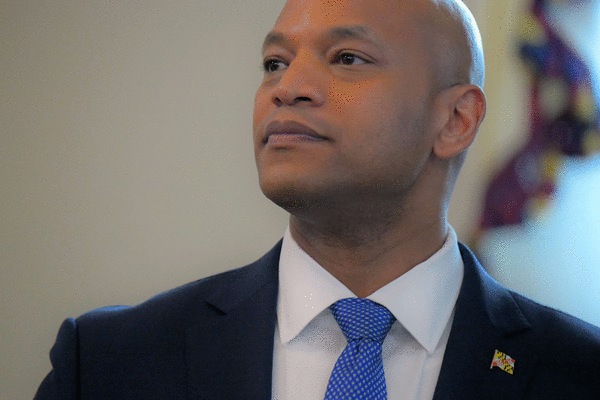
Maryland Gov. Wes Moore on Thursday proposed a $373.8 million increase in the education budget, pitching a historic investment in schools even as the state heads into a looming $1.4 billion budget deficit expected to dominate the next legislative session.
The proposal would raise per-pupil spending to $11,811, up from just over $9,200 allocated for the FY2026 budget. The plan represents nearly a 17% increase in overall K-12 funding since Moore took office.
“Maryland has the talent and the drive to have the best schools in the country, but that requires more than just high standards — it requires us to continue making historic investments,” Moore said. He said the proposal prioritizes educators, community schools and aging facilities to ensure “opportunity reaches every ZIP code.”
The announcement comes as state lawmakers prepare to return to Annapolis in January facing a projected $1.4 billion deficit, a shortfall expected to shape budget negotiations during the 2026 legislative session. Budget pressures have already prompted warnings from legislative leaders that difficult trade-offs lie ahead. When asked Thursday where the money would come from, officials from Moore’s office said a combination of the General Fund and the Blueprint Fund.
Concerns raised over the plan
Both lawmakers and residents raised concerns about the proposal, especially as it comes while the state faces a deficit.
David Williams, president of the nonpartisan Taxpayers Protection Alliance, said he came across the announcement scrolling through social media. When he saw the amount pledged, Williams said he was shocked.
Paired with a deficit, he said an investment like that is historically supported by tax hikes, the rainy day fund or spending cuts. Williams added he believes that cuts are the only good option for Maryland.
“You’re balancing the budget on the backs of taxpayers and consumers, and that’s not what the governor and state legislature should be doing,” he said.
Williams told The Sun on Thursday that he suspects the Blueprint announcement would only be the beginning of an expensive election year for the governor, who has distanced himself from an official bid for the White House despite being brought up informally as a possible candidate.
Whether Moore ends up in Washington in a few years or doesn’t make it back to Annapolis next term, Williams said financial decisions like Thursday’s could “follow taxpayers for years. Basically, (Moore is) giving out money,” Williams said.
His comments were echoed by Maryland Senate Minority Leader Steve Hershey, who questioned if this is fiscally responsible.
“Maryland already spends billions of dollars each year on public education under the Blueprint for Maryland’s Future, and that program is on track to drive up to $4 billion in new structural deficits in the coming years,” Hershey said in a statement. “At a time when the state is facing serious budget shortfalls, piling even more spending on top of an already unsustainable mandate is fiscally irresponsible.”
He also questioned how this would be paid for, as there were no specifics given.
“The governor is announcing new spending without explaining whether it will be paid for through higher taxes, more borrowing, or cuts to other essential services,” Hershey said.
Senate Minority Whip Justin Ready asked the same funding question, saying in a statement that “this is not a sustainable model, and it puts Maryland’s long-term fiscal health at risk.”
Details on Moore’s proposal
Under Moore’s proposal, school systems would receive $228 million in additional K-12 aid above statutory formulas to offset a lapse in state law that would otherwise reduce compensatory education funding. The plan also includes $480.5 million in school construction funding, including $80 million aimed at fast-growing counties struggling with overcrowded classrooms.
The budget sets aside $10.9 million for a new Academic Excellence Program to place literacy and math coaches in classrooms, and $19.4 million to expand the “Grow Your Own” teacher pipeline program, which helps school employees become licensed teachers debt-free. The administration says those efforts have helped cut statewide teacher vacancies in half since Moore took office.
Community schools would receive a record $572 million through the Concentration of Poverty grant program, a 16% increase from fiscal 2026. More than half of Maryland’s public schools are designated as community schools, which provide wraparound services such as mental health support and family engagement.
State Superintendent of Schools Carey Wright called the proposal a critical step toward closing achievement gaps and improving outcomes statewide. “By prioritizing instructional coaching, modern facilities and evidence-based programs, we are laying the foundation for academic excellence and equity,” Wright said.
Districts say they need more information
Local school leaders across Maryland said they are cautiously optimistic — but need more information.
In Worcester County, Vince Tolbert works as the school district’s chief financial officer. He said the impact can’t be truly analyzed until the Maryland State Department of Education releases funding allocations broken down by school system and by each program.
Wicomico County Public Schools echoed that wait-and-see approach. Paul Butler, the district’s director of community outreach, said officials are only beginning to review early funding proposals for the next fiscal year.
“It’s too early to say how state education funding might affect our school system,” Butler said. “We will be carefully monitoring the upcoming legislative session and the development of the state’s FY2027 budget.”
In Somerset County, which ranked next-to-last in the latest Maryland Report Card, the proposal was met with urgency and hope. Gordana Schifanelli, an attorney representing the Somerset County Board of Education, said the district is Maryland’s poorest and that’s a key part of why they rank lowest in student achievement.
“We desperately need it,” Schifanelli said, adding that the board hopes the funding boost directly reaches Somerset students and teachers. She also noted that board members receive annual stipends of $2,700, an amount she said does not even cover travel costs.
Challenges for the proposal
Democratic lawmakers acknowledged the challenges to get this pushed through. Sen. Karen Lewis Young, a member of the Senate Budget and Taxation Committee, said the state faces tough fiscal realities but praised the governor’s focus on education.
“I am intimately aware of the budget challenges that we face for fiscal 2027,” she said in a statement. “Nevertheless, I commend the governor for supporting our shared values to leave no child behind.”
_____
©2026 Baltimore Sun. Visit baltimoresun.com. Distributed by Tribune Content Agency, LLC.






Comments