Out eof jail, ex-Councilor Tania Fernandes Anderson spills the tea on shocking Boston City Council president vote
Published in News & Features
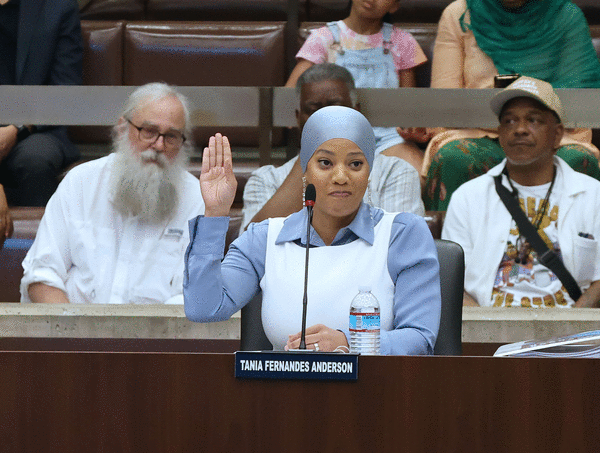
BOSTON — Freshly sprung from jail, ex-Boston City Councilor Tania Fernandes Anderson is spinning a twisted tale of treachery and deceit that she says left Brian Worrell and the Black community on the losing end of this week’s vote for City Council president.
Fernandes Anderson, who resigned last year after being convicted on federal corruption charges, wrote a letter to her former District 7 Advisory Council on Wednesday that was obtained by the Herald and shed further light on the tumultuous behind-the-scenes maneuvering that led up to Liz Breadon’s shocking election as Council president.
“What unfolded in the City Council leadership vote was not confusion or chaos; it was choreography,” Fernandes Anderson wrote. “And like most carefully staged performances, the loudest accusations were acts of projection.
“This was never about unity, compromise or leadership,” the ex-Roxbury councilor added. “It was about power, who holds it, who protects it, and who is expected, once again, to wait.”
Breadon, an immigrant from Northern Ireland who represents Allston/Brighton for District 9, defeated Worrell, a Black man who represents Mattapan and Dorchester for District 4, by a 7-6 vote on Monday.
Worrell was actively seeking the Council presidency for months, and appeared to have the election clinched the night before the vote, after Gabriela Coletta Zapata, who claimed to have the job for months, dropped out of the race, after three of her key supporters flipped their votes to Worrell, per City Hall sources.
The three councilors who defected to Worrell were Breadon, Enrique Pepén, and John FitzGerald, and, per sources, did so out of concerns about Coletta Zapata’s decision to select Henry Santana, an ally of Mayor Michelle Wu who needed help from the mayor’s campaign to qualify for the September preliminary ballot, as vice president.
Breadon, who like Coletta Zapata is seen as an ally of the mayor, said she had not been seeking the position until Sunday night, when Councilors Sharon Durkan and Pepén, two Wu allies who previously worked for the mayor, visited her home “quite late” to ask her to consider to run as a “compromise candidate.”
Breadon, the first openly-gay woman to be elected to the Council, was nominated by Councilor Benjamin Weber, a Wu ally, and all seven of her votes were cast by allies of the mayor: Coletta Zapata, Durkan, Ruthzee Louijeune, Pepén, Santana and Weber. Breadon voted for herself.
“Councilors Enrique Pepén and Sharon Durkan positioned themselves as political intermediaries, ushering Breadon forward as the so-called ‘default’ Council president,” Fernandes Anderson wrote. “Their calculus was transactional: deliver stability for Mayor Wu at the eleventh hour, and be recast as responsible stewards worthy of reward.”
The ex-councilor also accused Weber’s nomination of Breadon as being self-serving in nature, as a way to secure favorable committee chair assignments for himself, a “reality” that Fernandes Anderson said will become “unmistakable when nominations are formally introduced at the next council meeting.”
Fernandes Anderson described a last-minute scramble leading up to Breadon’s election, where Louijeune, a Black Haitian-American woman, “rushed from office to office attempting to renegotiate committee assignments with Brian Worrell, despite having already given him her word.”
The ex-councilor also said the mayor and her allies attempted to “neutralize FitzGerald through committee punishment while securing an outcome favorable to the (Wu) administration” — after FitzGerald’s “insistence on a council president willing to hold the administration accountable disrupted the mayor’s preferred order of operations.”
Sources told the Herald FitzGerald was at one point in line for Ways and Means committee chair under a potential Coletta Zapata presidency, and was offered the same budget committee chairmanship to flip to Worrell.
FitzGerald voted for Worrell, along with fellow moderates Ed Flynn and Erin Murphy, Julia Mejia, and Council newcomer Miniard Culpepper, a Black pastor. Worrell voted for himself. Flynn, Murphy and Mejia are seen as Wu’s harshest Council critics.
Fernandes Anderson said the way this election played out stood in stark contrast to how Louijeune’s election as Council president went down two years ago.
“Brian Worrell stood with Louijeune when it mattered most,” Fernandes Anderson wrote. “In the previous term, when Councilor Mejia and others had secured the votes to make Worrell Council president, he chose integrity over ambition. He honored his word to Louijeune rather than exploiting the moment.”
Fernandes Anderson said that last term, Worrell “faced the same pressure, the same maneuvering, and he refused to bend,” and voted for Louijeune “as promised.”
“Mayor Wu’s inauguration speech cast Boston as a ‘beacon,’ a city committed to protecting those targeted by authoritarian harm,” Fernandes Anderson wrote. “That rhetoric collapses under scrutiny when placed beside her conduct at City Hall. One cannot credibly claim to defend democracy while orchestrating, by any means necessary, the blocking of a Black man from becoming Council president precisely because he exercised democratic power with integrity.”
Worrell was vice president and Ways and Means chair last term. He would have been the third Black man to serve as Council president, and the first in 25 years.
When asked why she chose a late bid for president, rather than vote for Worrell, Breadon told reporters she had considered seeking the job in the past.
“It just seemed like this door opened at the last moment,” Breadon said, “and I had the support of other members of the Council and I was honored to be asked to consider it.”
----------
©2026 MediaNews Group, Inc. Visit at bostonherald.com. Distributed by Tribune Content Agency, LLC.






Comments