Unprecedented livestock attacks by one California wolf pack cost $2.6 million
Published in News & Features
SACRAMENTO, Calif. — The unprecedented reliance of a single Sierra Valley wolf pack on livestock for food cost local ranchers and the state of California at least $2.6 million over a roughly six-month period last year, according to researchers at the University of California, Davis.
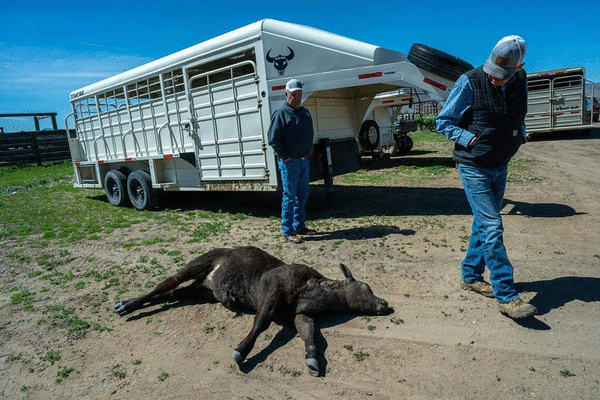
The Beyem Seyo pack hunted at least 92 calves and cows from late March through early October, costing ranchers $235,000 in livestock losses and the state more than $2 million in intervention costs, economist Tina Saitone and researcher Tracy Schohr said in the university’s quarterly agricultural economics update on Friday. If another two dozen cattle are confirmed to have been killed by wolves also, the livestock losses would rise to about $300,000, they said.
The pack’s unusual hunting behavior caused panic among residents and ranchers in the state’s high rangeland north of Truckee, eventually leading state wildlife regulators to euthanize its three adult wolves and accidentally kill one of four juveniles in October. It was the first time California had sanctioned the killing of wolves, a protected species under both the federal and state endangered species acts, in a century.
“Despite extensive nonlethal deterrence efforts, the pack became irreversibly dependent on cattle as a food source, and habituated to human presence and deterrence measures,” the scientists wrote.
The pack, which at one point numbered three adults and six pups, killed more livestock than did the entire wolf population of other western states. For example, Montana has about 1,100 wolves, which in 2024 killed 54 domestic animals — 35 cattle, 16 sheep and 3 foals, the scientists said. In Wyoming’s 352 wolves killed 41 cattle, 3 sheep, 4 goats and a horse in 2023 — less than half the animals killed by the Beyem Seyo pack in less than seven months last year.
Statewide in California, the population of between 50 and 70 wolves were responsible for 175 livestock kills between January and October of last year, state data show. The Beyem Seyo pack alone was responsible for more than half of them.
Conflicts between wolves and human settlement surfaced again last week in Lassen County, where wolves believed to be part of the Harvey pack killed a calf and hunted down a family horse, mauling it so badly that it had to be euthanized.
Wolves were hunted to extinction in California in 1924, when the last known animal of the species, starving and missing a leg, was captured and killed. They were gone from the landscape as many of the ranches and communities in Sierra Valley and other parts of the north state were developed.
The predators made their way back to the state starting in 2011, years after they were successfully reintroduced in Yellowstone Park and parts of Idaho. But in a scenario that is also playing out in other western states, the environmental triumph of the protected canids’ return was accompanied by serious complications.
California planned for a measured approach to managing its growing wolf population, setting aside funds to pay for the inevitable attacks on livestock as well as the cost of helping ranchers deter the animals from settling near their properties.
But they were not prepared for the Beyem Seyo pack’s laser focus on livestock, which included hunting in broad daylight, and which the UC Davis scientists said could not be reversed. In their article, they trace what they call an unprecedented surge in attacks on livestock to the arrival of a new alpha male from Siskiyou County in 2024.
By March 2024, the state had already spent $3 million reimbursing ranchers for damages caused by wolves throughout the northern part of the state, as well as the cost of investing in nonlethal deterrents to keep them away, such as fencing, flags and other methods.
Another $2.6 million was allocated last year, and the state also spent about $2 million on interventions, including sending game wardens and wildlife managers to Sierra Valley last summer in a months-long effort, ultimately unsuccessful, to direct the Beyem Seyo wolves away from livestock and human communities, the scientists said.
Their calculations did not include the cost of euthanizing the adult wolves, Saitone and Schohr said. That operation required several wildlife experts, a helicopter and weeks of work.
____
©2026 The Sacramento Bee. Visit at sacbee.com. Distributed by Tribune Content Agency, LLC.






Comments