'A country at war': Haiti earthquake vigil is plea for compassion to Trump administration
Published in News & Features
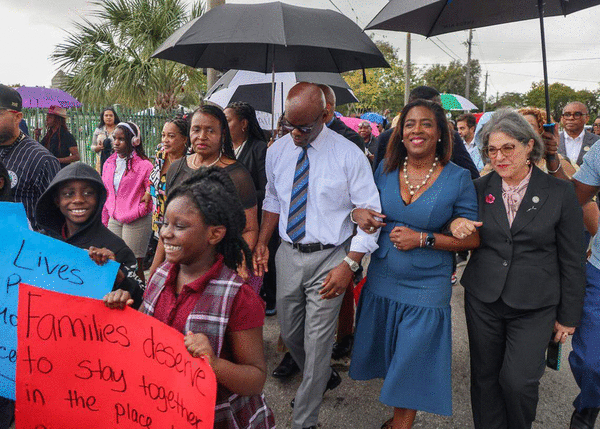
MIAMI — It is typically a somber day, one in which Haitians remember the magnitude 7.0 earthquake that struck Haiti on Jan. 12, 2010, destroying much of Port-au-Prince and surrounding cities, killing hundreds of thousands of people and leaving 1.5 million injured and an equal number homeless.
But on Monday, as residents of South Florida gathered in Little Haiti alongside current and former elected officials from Miami-Dade and Broward counties to commemorate the disaster’s 16th anniversary, the observance took on a different meaning — and a renewed sense of urgency.
More than 350,000 Haitians are facing possible deportation with the pending end of Temporary Protected Status, which until recently had protected them from deportation by allowing them to legally live and work in the United States. Now with its pending end, absent a change of heart by the Trump administration or a court order, many will soon find themselves targeted for deportation to a country where more than half of the population do not have enough to eat, more than 1.4 million are displaced and kidnappings and killings are rampant as armed gangs control most of the capital and other parts of the country.
“It would have been encouraging to tell you that after 16 years things are better,” said Miami-Dade County Commissioner Marleine Bastien, speaking at the corner of North Miami Avenue and 61 Street, where a statue honors one of Haiti’s founding fathers, Toussaint Louverture. She described Haiti as “a country at war.”
“Based on the reports coming out, Haiti is 10 times in worse shape than in 2010,” she added.
“Young women and girls do not think about if they’re going to be raped,” said Bastien, quoting a recent Miami Herald series on her homeland’s rape epidemic, titled Haiti’s Lost Generation. “They think about when, to the point now, according to the recent reports, that young girls were too young to be sexually active, their parents are putting them on birth control.”
During an impassioned plea in which she asked her fellow Haitians in the Caribbean nation to unite and put down their arms, she also asked the question that immigration lawyers and advocates have for months been asking: “How can we plan to deport people who have lived their lives here, worked here? These are brothers, our teachers, our doctors, our engineers who live here.”
Bastien’s grassroots organization Family Action Network Movement organized Monday’s commemoration. “How can we send them to a place where they will, they can, and some will lose their lives?” she added.
TPS slated to end Feb. 3
Last year, after losing a rare court battle to rescind an extension of TPS that the Biden administration had granted before leaving office, the Trump administration announced that Haiti’s designation would end on Feb. 3. In her notice, Department of Homeland Secretary Kristi Noem said Haitians can return to other parts of the country other than the gang-ravaged capital, and it is not in the national interest of the United States for them to remain.
The rationale has been challenged in court. Last week, U.S. Judge Ana C. Reyes in Washington, presiding over one of several lawsuits seeking to block the termination of TPS for Haitians, questioned the administration’s position.
She is expected to issue a decision by Feb. 2.
On Monday, amid pleas for compassion and questions about the administration’s rationale, advocates warned that ending TPS would leave thousand of jobs unfilled, from nursing homes to airports, and it would destabilize communities. Miami’s new mayor, Eileen Higgins, said Haitian families have built homes, businesses and institutions across South Florida.
“The elimination of TPS is going to break our hearts again,” Higgins said. “We have to make it clear to our elected officials in Washington that enough is enough. TPS is there for a reason until there is stability, safety and prosperity in Haiti.”
‘We are waiting on God’
Rose, a mother of three who asked that her last name not be used for fear of being targeted, says despite TPS’ official end date, she was forced to leave her $16-an-hour job at Home Depot on June 20. Unable to pay her rent, she was later evicted and now struggles to come up with the $1,900 for her new place.
“Up until now, there is nothing but uncertainty,” said Rose. “We are waiting on God, hoping he does something for us.”
One of more than 100,000 Haitians who arrived in the U.S. through a humanitarian parole program introduced under President Biden and later curtailed under Trump, Rose says she was a survivor the devastating quake.
“I was standing on my porch when we felt the house shaking,” she said. “I had a child sitting next to me in a chair and the chair slid away as I reached out. Before we knew it, people were coming toward us covered in dust, some injured, some who had lost an eye. It was really difficult.”
Although none of her children were killed, she lost friends and family members. The anniversary, she said, is always painful — especially this year. Asked whether she had a home to return to in Haiti, Rose said armed gangs have taken over her house.
‘We are afraid’
“For those of us who have seen the destruction of our nation, year after year, we are still grieving. We’re grieving those we lost, but we are also grieving the hopes we had after the earthquake, hope for a new nation, hope for new beginnings, hope for a bright future,” said Tessa Petit, executive director of the Florida Immigrant Coalition, as she recalled the loss of her own mother.
In recent weeks, organizers have tried to conduct outreach with parents of minor children, in hopes of getting them to designate who should care for them in case they are targeted under the administration’s mass deportation.
But instead of finding willing participants, she said, they are encountering fear.
“We are afraid, afraid because we know that this means sending hundreds of thousands of people to their deaths,” Petit said. “We are not asking for a handout. We are not asking for favor. We are asking for fair treatment. We are asking for the application of the rule of law, because by law, we qualify for TPS. We also ask that we are recognized for everything that We contribute to this country.”
Those sentiments were reiterated throughout the event, which began at the statue and concluded at the Little Haiti Cultural Complex after a rain-soaked procession through the neighborhood.
Before the march, Miami-Dade County Daniella Levine Cava noted that the U.S. government currently advises Americans to stay away from Haiti.
“Yet, we say we can return Haitians, cancel their TPS and they must go home. To what home?” she said. “It’s inhumane.”
She and other local leaders stressed that the issue transcends politics.
“Our national interest doesn’t just exist where they have oil,” Miami-Dade Country Commissioner Oliver Gilbert III said, referring to the recent U.S. actions in oil-rich Venezuela. ”We don’t just need immigrants from northern European countries.”
With more than 53 percent of Miami-Dade County residents born abroad, he added, “ We’re the epitome of the American dream. We’re how it lives, and it breathes, and it works, and we do it together. I’m not asking for charity. I’m asking for our own selfish, our own self-interest that says that TPS should actually remain in place.”
©2026 Miami Herald. Visit at miamiherald.com. Distributed by Tribune Content Agency, LLC.






Comments