Supreme Court gives candidates right to challenge election rules
Published in News & Features
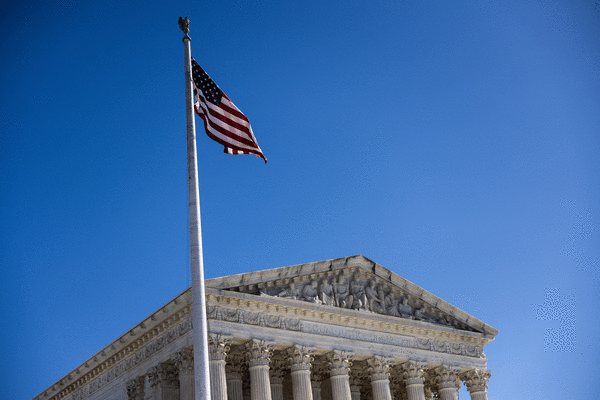
WASHINGTON — The Supreme Court on Wednesday ruled that candidates for federal offices have the right to file lawsuits that challenge election rules that govern the counting of votes, regardless of their chances of winning or campaign costs.
The 7-2 decision specifically revived a lawsuit from Rep. Mike Bost, R-Ill., over an Illinois law that allowed ballots to be counted if they arrive as late as 14 days after Election Day, arguing that it conflicts with federal laws that set election dates.
Lower courts had found that Bost and other plaintiffs were not directly harmed by the state election rule in a way that would allow them to challenge it.
Chief Justice John G. Roberts Jr., in an opinion joined by four other justices, found Wednesday that federal candidates have “an obvious personal stake” in how election results are determined and regarded.
“Departures from the preordained rules cause them particularized and concrete harm,” Roberts wrote, such as how a runner in a 100-meter dash would suffer if the race were unexpectedly extended to 105 meters.
“The fastest to run 105 meters has not won the 100-meter dash. And in much the same way, an unlawful extension of vote counting deprives candidates of the opportunity to compete for election under the Constitution and laws of the United States,” Roberts wrote.
Roberts also wrote that election rules that undermine the “integrity” of an election also undermine the legitimacy of a candidate, even if those rules did not alter the outcome of the contest.
“The counting of unlawful votes — or discarding of lawful ones — erodes public confidence that the election results reflect the people’s will,” the opinion said. “And when public confidence in the election results falters, public confidence in the elected representative follows. To the representative, that loss of legitimacy—or its diminution—is a concrete harm.”
The lawsuit from Bost, along with several Republican presidential electors, argues the state law violated federal law mandating Election Day as the first Tuesday following the first Monday in November. The Supreme Court decision Wednesday did not address the merits of his challenge.
Under the Illinois law, state officials count absentee or mail-in ballots that are postmarked before or on Election Day and arrive between Election Day and the end of the period to count provisional ballots, which the challengers identify as 14 days. Illinois is one of dozens of states with similar post-Election Day ballot counting.
Justice Amy Coney Barrett filed a concurring opinion, joined by Justice Elena Kagan, that agreed with the outcome of reviving the lawsuit but disagreed with the reasoning.
Barrett wrote Bost should not have a special status because he is a congressional candidate, but should be able to sue because he had to spend more money to keep competing.
“By holding that a candidate always has an interest in challenging vote-counting rules, even if those rules do not impose a competitive disadvantage on him, the Court today relieves candidates of having to show any real harm,” Barrett wrote.
Justice Ketanji Brown Jackson, in a dissent joined by Justice Sonia Sotomayor, warned that the majority decision “opens the floodgates to exactly the type of troubling election-related litigation the Court purportedly wants to avoid.”
“For example, under the Court’s new harm-free candidate-standing rule, an electoral candidate who loses in a landslide can apparently still file a disruptive legal action in federal court after the election is over,” Jackson wrote.
“All he must do is assert that an election rule somehow deprived him of a fair process—even if that rule played no role in the election’s outcome or otherwise caused him harm,” Jackson wrote.
And she wrote that it destabilizes both law about who has the right to file a lawsuit and America’s electoral processes.
“No matter that, in a democratic society like ours, the interest in a fair electoral process is common to all members of the voting public. The Court thus ignores a core constitutional requirement while unnecessarily thrusting the Judiciary into the political arena,” Jackson wrote.
Roberts’ downplayed concerns the decision would open the floodgates for election lawsuits, and wrote in a footnote that he did not think candidates would “waste their resources” on “trivial” challenges to rules like ballot formatting.
Separately the Supreme Court accepted a case for argument this year directly challenging a Mississippi law that allows the counting of ballots that arrive after Election Day but were postmarked before the day.
Republicans have targeted the counting of late-arriving ballots for years, including in the 2020 election when President Donald Trump spread unfounded claims of fraud around mail voting in his loss to President Joe Biden.
Last year, Trump sought to end the post-Election Day counting of ballots in an executive order mandating states stop counting late-arriving ballots, among other unilateral election law changes. That order has largely been blocked by federal courts.
The case is Bost v. Illinois Board of Elections.
©2026 CQ-Roll Call, Inc., All Rights Reserved. Visit cqrollcall.com. Distributed by Tribune Content Agency, LLC.





Comments