New Office of Inspector General data portal details misconduct patterns among Chicago police officers, crews
Published in News & Features
CHICAGO — In recent decades, some of the Chicago Police Department’s most notorious scandals were perpetrated by officers assigned to the same team or unit, including Jerome Finnigan of the special operations section and Ronald Watts of the public housing unit.
But it took extensive searches to connect individual accusations and see wider patterns. It might take years for the actions of CPD officers working together to come to light in lawsuits that often resulted in millions of dollars in settlement payments, thrown out convictions and the tarnishing of the reputation of the department.
This week, the city’s Office of Inspector General offered the public a shortcut. It published an interactive data portal that allows anyone to see which CPD officers are most often accused of misconduct and identifies which other officers faced accusations related to the same incident.
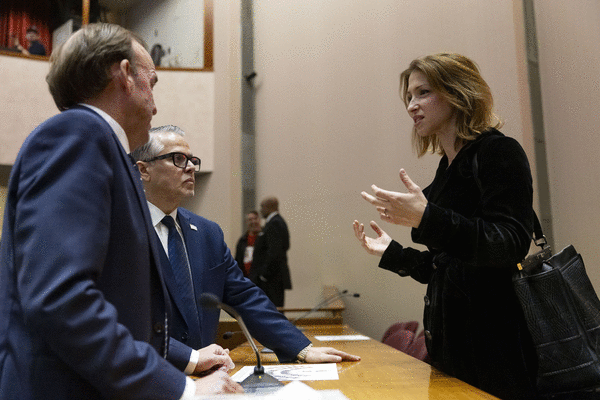
Chicago Inspector General Deborah Witzburg told the Tribune that the visualized data “opens the door to tremendously powerful insights” to both members of the public and the Police Department.
“Chicagoans have long known it to be true that in a Police Department where a great deal of good work is being done every day by the men and women wearing the uniform, there have, for a long time, been these clusters of officers, these groups of people, who generate more than their fair share of harm,” Witzburg said.
“If this tool had been available to the department decades ago and somebody had looked at the cluster of misconduct around the (Jon) Burge crew or the (Reynaldo) Guevara crew or the Watts crew and had simply said, ‘We can’t have this group of people work together anymore,’ it would be hard to overstate the potential there to mitigate future harm.”
The data goes back to 2000, encompassing thousands of internal misconduct complaints, and will be continuously updated as pending investigations are brought to a close, Witzburg said.
A Tribune review of the data portal showed, for example, that in recent years a team of officers assigned to the Near North (18th) District, covering River North, the Gold Coast and Lincoln Park, was the subject of more complaints than any other in the city. The allegations mostly concerned illegal searches of civilians and their property.
Records made public last week by the Civilian Office of Police Accountability show the agency sustained allegations against at least one of those officers last year, and CPD Superintendent Larry Snelling agreed with COPA’s recommendation that he be suspended.
That officer — who was the subject of 23 complaints in just the last three years — remains assigned to desk duty in CPD’s alternate response section, the typical landing place for officers awaiting disciplinary action.
OIG’s new data visualization portal shows that another Near North District officer was co-accused of wrongdoing in nine of those 23 instances. CPD staffing records obtained by the Tribune show that officer remained on street duty in the same district as of Jan. 1.
The city’s federal consent decree requires CPD to develop an early intervention system to identify patterns in officer misconduct complaints, though that system has yet to come to fruition.
Tuesday, during a status hearing in the ongoing consent decree, Snelling said the department’s 22 district commanders will soon face heightened scrutiny for officer misconduct allegations and the subsequent investigations into those claims.
“When we’re doing these investigations, we want to get them done as quickly as possible because if there’s a sustained finding (of misconduct), we want to be able to apply training or discipline as quickly as possible,” Snelling told U.S. District Judge Rebecca Pallmeyer.
City data shows the number of complaints received by CPD internal affairs has steadily ticked up each year since at least 2020. That year, during the initial outbreak of COVID-19 and a summer of widespread unrest, internal affairs received 4,000 complaints. Last year, BIA received a little more than 5,300 complaints.
The OIG’s new database is the latest public-facing portal to allow for inspection of CPD misconduct records. The office already maintains a portal to search for the number of complaints filed against a given officer.
Final summary reports authored by COPA are made available at the conclusion of an investigation, and CPD regularly publishes complaint intake documents to the department’s Accountability Dashboard. Moreover, data detailing the overall number of complaints is made available by the city on a rolling basis.
In November 2015, around the same time as the release of the Laquan McDonald shooting video, the Citizen’s Police Data Project published years of records detailing CPD officer misconduct.
Still, Witzburg said, there is a “yawning gap between something being theoretically publicly available and meaningfully publicly accessible.”
“The transparency work that we do for transparency’s sake really is animated by that idea that where things have gone wrong, we all benefit tremendously from sunlight,” she said, “and the foundational notion that information about the government belongs to the governed.”
____
©2026 Chicago Tribune. Visit at chicagotribune.com. Distributed by Tribune Content Agency, LLC.



Comments