Venezuela opposition leader Machado says she 'presented' her Nobel Peace Prize to Trump
Published in News & Features
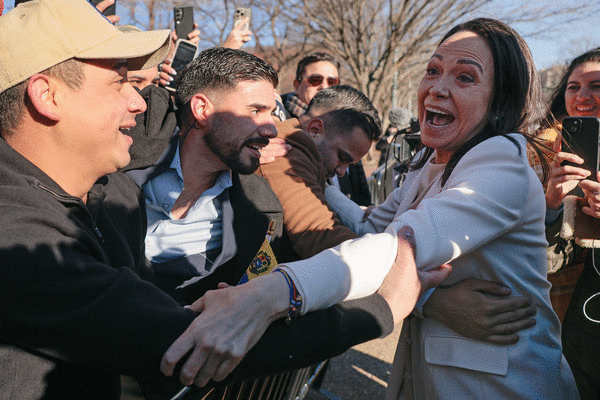
WASHINGTON — Venezuelan opposition leader María Corina Machado said Thursday that she “presented” her Nobel Peace Prize medal to President Trump during a private meeting at the White House, but he has not changed his view that she does not have the support to lead her country.
Machado, who won the prize last year for her work to promote democracy in Venezuela, said she presented the 18-carat gold medal to Trump as a “recognition of his unique commitment to our freedom.” It is unclear whether the president, who has been fixated on getting the prize in recent year, accepted it. The Nobel Peace Center has maintained the award cannot be transferred.
The gesture was made on the day the two leaders met for the first time at the White House. The highly anticipated get-together came as the United States has allowed top deputies of deposed president Nicolás Maduro’s regime to remain in charge as Trump oversees the transition of power.
White House press secretary Karoline Leavitt told reporters that Trump went into the meeting without any expectations, other than to have a “frank and positive discussion about what’s taking place in Venezuela.”
Leavitt added that Trump continues to assert that Machado does not have the “support” or “respect” to lead Venezuela, an assessment he first made on the day of Maduro’s capture to the surprise of many Venezuelans.
“At this moment in time, his opinion on that matter has not changed,” Leavitt said at a news briefing.
While Leavitt described Machado as a “remarkable and brave voice for many of the people in Venezuela,” she also said the United States had found an “extremely cooperative” partner in Maduro’s handpicked vice president, Delcy Rodríguez, who is serving as acting president of Venezuela.
“They have met all of the demands and requests of the United States and the president,” Leavitt said, noting that the Venezuelan government already agreed to release political prisoners and reached a $100-billion deal to rebuild Venezuela’s energy sector.
As Machado left the White House, the scope of the discussions between her and the president remained unclear. She did not take questions from the reporters, but a few of them were able to capture a moment on video when she was greeted by supporters outside the White House. She told them: “Know that we can count on President Trump for Venezuela’s freedom.”
She then left to meet with a bipartisan group of U.S. senators on Capitol Hill. It was after this meeting that Machado told reporters she had presented the medal to the president.
Sen. Rick Scott (R-Fla.) was one of 14 senators who met with Machado. After the meeting Scott said Machado was “very appreciative of the U.S. military” capturing Maduro and was pushing for “free and fair elections and free press.”
“We have got to continue to understand that Delcy Rodriguez is not the leader, she was never elected as a president, she is still the leader of drug cartels,” Scott said. “We need to make sure we hold her accountable.”
It appears unlikely that much will change for Machado after meeting with Trump, who largely has sidelined her and Edmundo González Urrutia, the opposition candidate who won the 2024 presidential election that was stolen by Maduro.
Days after Maduro was captured, Machado told CBS News the people of Venezuela had “already chosen” González Urrutia as the rightful leader of the country and that they were “ready and willing to serve our people, as we have been mandated.”
Trump, however, has maintained that before elections can take place in Venezuela, the United States needs to “fix” the country.
Asked if the president was committed to holding elections in Venezuela, Leavitt said Trump hopes to see “elections in Venezuela one day” but did not have a timeline for them yet.
Trump says he is happy with his administration’s working relationship with Rodríguez. At a White House event Wednesday, Trump called Rodríguez a “terrific person.”
The praise came after Trump said he had a “very good call” with her that morning that left him feeling hopeful that the United States and Venezuela could have a “spectacular” working relationship.
Rodriguez, in turn, used her first state of the union address Thursday to promote oil industry reforms that would drawn in foreign investment, which is in line with the Trump administration’s goals. She also criticized the Washington officials and said there was a “stain on our relations” but said she was open to strengthening the relationship.
“Let us not be afraid of diplomacy,” with the U.S., Rodriguez said in Venezuela.
©2026 Los Angeles Times. Visit at latimes.com. Distributed by Tribune Content Agency, LLC.




Comments