The quiet ascent: How Delcy Rodríguez took over Venezuela's criminal networks
Published in News & Features
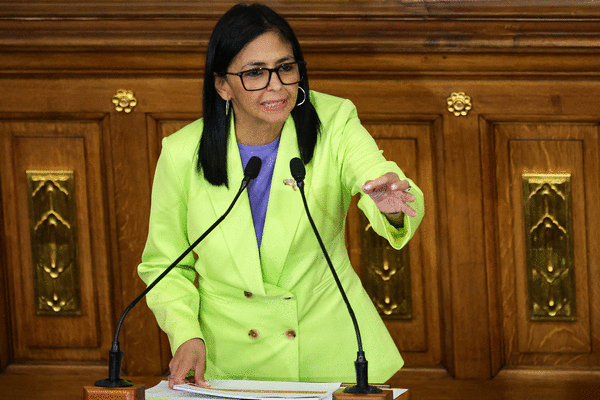
On a March 2023 afternoon in Caracas, the corridors of power in Venezuela’s government were shifting beneath the surface. Tareck El Aissami, once the regime’s top power broker and a man long accused by Washington of narcotics trafficking, had vanished from public view. His fall—swift and opaque—created a dangerous void in the structure that sustained Venezuela’s authoritarian system.
Into that vacuum stepped Delcy Rodríguez, the country’s vice president, former foreign minister and a central figure in the regime’s inner family circle. In a system that has long blurred the line between politics and illicit enterprise, Rodríguez quietly assumed control of the networks El Aissami once managed—networks that U.S. officials and investigative reports have linked to state-sanctioned corruption, gold smuggling and drug trafficking across the Caribbean.
Her ascent, however, did not come as a surprise to one man who says he watched the architecture of power inside Venezuela take shape from within.
Responding to a questionnaire sent to him by the Miami Herald through his lawyer, retired Venezuelan Gen. Cliver Alcalá Cordones, who is serving a 21-year, eight-month sentence in the U.S., asserts that Delcy Rodríguez and her brother, Jorge Rodríguez, have long been the real architects of Venezuela’s criminalized power structure.
“That photo clearly shows us who holds the real power in Venezuela,” Alcalá wrote, referring to the image of Jorge Rodríguez being re-elected head of the National Assembly and swearing in his sister as acting president after Nicolás Maduro’s recent capture by U.S. forces. “They are the true architects of the Venezuelan dictatorial regime.”
Alcalá’s claims, which are disputed by the Venezuelan government, echo and amplify what U.S. intelligence assessments, investigative reporting, and years of U.S. sanctions enforcement have increasingly suggested: that before Maduro was captured in a U.S. pre-dawn raid in Caracas to face drug trafficking charges in New York, Venezuela’s center of gravity had shifted away from the strongman and toward a disciplined, family-run network operating largely out of sight.
That consolidation has taken on greater relevance following the dramatic U.S. military operation earlier this month that captured Maduro and his wife, Cilia Flores, and transferred them to U.S. custody to face drug trafficking and narco-terrorism charges in New York. In the aftermath, Rodríguez emerged not only as the regime’s internal operator, but as Washington’s publicly preferred link in a volatile post-Maduro transition.
‘A criminal organization with multiple activities’
Alcalá, who served more than three decades in the Venezuelan armed forces before breaking with the regime, paints a picture of a state that, in his telling, ceased functioning as a conventional government years ago.
“It is evident that the Venezuelan dictatorial regime functioned for more than a decade as a true criminal organization with multiple activities,” he wrote.
For years, the regime has run a wide array of criminal enterprises, ranging from drug trafficking and illegal mining to the operation of illegal casinos, along with widespread kidnappings, human trafficking and crimes controlled from prisons by gangs such as the notorious Tren de Aragua. In his letter, Alcalá says he fought these operations from within the regime before breaking away from Maduro.
Those activities, he said, were not peripheral corruption but core revenue streams. Illegal mining of gold, diamonds, columbite-tantalite ore and other strategic minerals—many extracted in environmentally devastated regions of southern Venezuela—served not only as sources of wealth but also as money-laundering mechanisms.
The Herald spoke with three of the more than half a dozen U.S.-protected witnesses who for years have helped U.S. law enforcement agencies build cases against the so-called Cartel de los Soles, an organization embedded deep within the regime that controls the most profitable criminal enterprises, including drug trafficking.
U.S. officials believe that drug trafficking helped the Caracas regime compensate for the shortfall in oil revenues caused by U.S. sanctions imposed on the state-run Petróleos de Venezuela in 2019. Dealing primarily in cocaine originating in Colombia, the cartel was exporting between 350 and 500 tons per year by 2024.
In separate, lengthy interviews with the Herald, the sources independently confirmed that one of the most important cogs in the cartel’s criminal machinery is run by the Rodríguez siblings. While they never reached the notoriety of other alleged cartel members such as Interior Minister Diosdado Cabello, El Aissami, Defense Minister Vladimir Padrino López, or Maduro himself, the siblings were cartel members from very early on, the sources—who spoke on condition of anonymity—said.
The sources said the siblings became the cartel’s administrators, handling funds obtained from its various criminal enterprises through their vast networks of companies.
According to the sources, the amount of cartel wealth controlled by the siblings outside Venezuela ascends to several billion dollars.
Alcalá, who was accused by the United States of being a cartel member and received a 21-year-plus sentence for collaborating with Colombia’s rebel group FARC, said the consolidation of power within the regime’s criminal structure stemmed from the authority held by Maduro, who was heavily influenced by Jorge Rodríguez and the top leadership of Venezuela’s close ally, Cuba.
The fall of El Aissami
For years, Tareck El Aissami was seen as the regime’s indispensable man. He oversaw Venezuela’s energy and economic portfolios and, according to U.S. officials, played a central role in facilitating narcotics shipments through the country. The U.S. Treasury Department sanctioned him in 2017 under the Foreign Narcotics Kingpin Designation Act, accusing him of “playing a significant role in international narcotics trafficking.”
The sanctions froze his assets and dismantled his access to the global financial system. Within months, his name became synonymous with the corruption and criminality that Washington said had penetrated the Venezuelan state.
By 2023, he abruptly fell from grace. He was charged with corruption, but the regime later claimed he had been caught conspiring with the U.S. government and opposition leaders to topple Maduro. He largely disappeared from view that year. His resignation from senior posts was unannounced, his inner circle fractured, and his empire left in limbo.
Behind the scenes, Maduro faced a pressing challenge: how to keep the regime’s financial arteries functioning under unprecedented international scrutiny without relying on figures who had become too exposed to manage openly.
Enter Delcy Rodríguez
Delcy Rodríguez was already one of the most trusted figures in the government. Fiercely loyal and unflinchingly disciplined, she had served as foreign minister, vice president and the regime’s chief international defender, often acting as its sharpest voice against U.S. sanctions at the United Nations and other global forums.
She was also considered as family by Maduro and his wife. Her brother presided over the National Assembly and controlled much of the regime’s political choreography. Rodríguez was also a very close and trusted ally of Cilia Flores, Maduro’s wife and a central gatekeeper within Chavismo’s inner sanctum.
According to U.S. officials and protected witnesses interviewed by the Herald, Delcy Rodríguez began absorbing much of the operational authority once exercised by El Aissami. That included oversight of state-run companies, shadow financial systems used to bypass sanctions, and what Western intelligence agencies describe as “state-protected smuggling routes” for gold, oil and cocaine.
Publicly, Rodríguez remained the polished diplomat condemning U.S. “economic warfare.” Privately, she consolidated her role as custodian of the regime’s most sensitive operations—responsible for sustaining the cash flows that allowed the government to survive.
A new power circle
A report from a foreign intelligence service obtained by the Herald describes the rise of what it calls a new “power center” around Delcy Rodríguez and her brother Jorge—one increasingly intertwined with a group of businessmen led by the Abou Nassif family, Venezuelans of Lebanese origin whose influence expanded rapidly during the height of international sanctions.
According to the report, Yussef Abou Nassif Smaili—identified by Venezuelan news reports as Delcy Rodríguez long-time romantic partner since around 2017—emerged as a key intermediary between political authority and private capital. His brothers, Omar and Jamal Abou Nassif, are also described as central figures in a sprawling corporate network spanning construction, tourism, real estate, food imports, packaging, logistics and retail.
The intelligence assessment notes that dozens of companies linked to the group frequently rotate formal ownership and executive roles among family members, a structure investigators say is designed to complicate oversight, dilute legal exposure, and obscure ultimate beneficiaries.
From CLAP to bodegones
The report traces the group’s rapid rise to Venezuela’s heavily politicized food import system. Between 2017 and 2019, companies tied to the Abou Nassif brothers secured at least $413 million in contracts under the government food program that goes by the initials CLAP, launched as a subsidized community initiative but later transformed into a discretionary import-and-distribution scheme.
According to an investigation conducted by Venezuelan journalism site Armando. info, the contracts were awarded through offshore firms registered in Hong Kong. In 2019, the same network obtained an additional 145 million euro contract for hemodialysis kits, with payment mechanisms reportedly linked to crude oil or fuel oil—allowing transactions to bypass conventional banking systems.
Officials cited in the intelligence report referred internally to the group as the “Arab group,” and analysts say their operating model closely mirrored that of sanctioned businessman Alex Saab, the Colombian businessman and alleged business partner of Maduro who faced money laundering charges in Miami before being released in 2023 as part of prisoner exchange arrangement with the regime.
As scrutiny mounted, the network pivoted toward Venezuela’s dollarized informal economy. In 2019, associates registered Ok Mart, a chain of luxury stores known in Venezuela as bodegones that sell imported goods at hard-currency prices. During the COVID-19 pandemic the chain expanded rapidly across Caracas.
Critics cited in the report describe Ok Mart not as organic entrepreneurship but as a product of privileged access—its growth coinciding with Rodríguez’s consolidation of authority inside the state.
The Cartel de los Soles
For years, U.S. investigations have pointed to the existence of the Cartel de los Soles—an alleged alliance of senior Venezuelan military and political figures accused of facilitating cocaine shipments through Venezuelan territory.
Alcalá, who once served at senior levels of the military hierarchy, claims the cartel evolved from a fragmented system into a centralized structure.
“Since Maduro took power, this has always remained that way,” he wrote. “The thing is that the Rodríguez brothers were the most intelligent. They remained in the shadows but operated like puppeteers.”
Since El Aissami’s fall, foreign intelligence assessments reviewed by the Herald suggest operational control over trafficking routes and their financial architecture migrated closer to Maduro’s family circle, with Delcy Rodríguez emerging as a key civilian coordinator—though Washington has not publicly accused her of direct involvement in drug trafficking.
Under the DEA’s lens
That scrutiny predates the post-Maduro transition. According to reporting by The Associated Press, Rodríguez has been on the radar of the U.S. Drug Enforcement Administration for years and was designated a “priority target” in 2022—a label reserved for individuals believed to have a significant impact on the drug trade.
DEA records reviewed by AP show the agency has maintained a detailed intelligence file on Rodríguez since at least 2018, cataloging known associates and allegations ranging from drug trafficking to gold smuggling. One confidential informant alleged she used hotels on Isla Margarita as fronts to launder money.
Rodríguez has never been charged, and the U.S. government has not publicly accused her of criminal wrongdoing.
Washington’s calculated bet
Despite that history, President Donald Trump has publicly embraced Rodríguez as a stabilizing figure following Maduro’s capture, praising her as a “terrific person” and holding what he described as a “very good talk” with her. She has met with CIA Director John Ratcliffe and maintained contact with Secretary of State Marco Rubio.
That contradiction—between law enforcement scrutiny and diplomatic engagement—underscores the dilemma facing Washington.
“The current Venezuela government is a criminal-hybrid regime. The only way you reach a position of power in the regime is by, at the very least, abetting criminal activities,” Steven Dudley, co-director of InSight Crime, an investigative non-profit that reports on organized crime, told AP. “This isn’t a bug in the system. This is the system.”
Opposition leader María Corina Machado was blunter still.
“The American justice system has sufficient information about her,” Machado said. “Her profile is quite clear.”
Alcalá, for his part, says Maduro was never the real decision-maker.
“I retired from the Venezuelan army in 2013 after 34 years of service, even in the face of very relevant political offers from Maduro. I rejected them all. I didn’t want to be part of what was clearly going to be a criminal structure,” Alcalá wrote to the Herald. “From that moment on, the information I got indicated that the fundamental decisions were not made by Maduro. It was a task shared by the leadership of the dictatorial regime, in which the Rodríguez brothers, Cabello and Cuba were a part of.”
©2026 Miami Herald. Visit at miamiherald.com. Distributed by Tribune Content Agency, LLC.




Comments