States, cities are hard-pressed to fight violent ICE arrest tactics
Published in News & Features
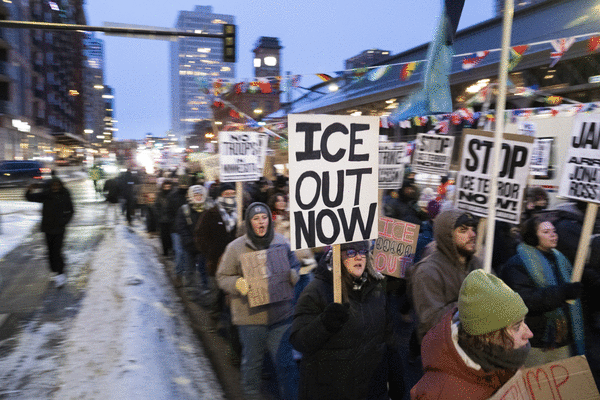
State leaders who want to curb the increasingly violent arrest tactics of immigration enforcement agents in Minneapolis and elsewhere are struggling to push back.
They’ve promised civil rights legislation that could offer alleged victims another route to courts, ordered up official tribunals to gather video and other records, or asked cities to refuse requests to cooperate with raids. But for the most part, states looking for concrete ways to push back find themselves largely hamstrung.
Violence in immigration enforcement is on the rise. A federal immigration agent’s killing of Renee Good in Minnesota on Jan. 7 was one of half a dozen shootings since December. An immigrant’s death in a Texas detention facility this month was ruled a homicide. And detention deaths last year totaled at least 31, a two-decade peak and more than the previous four years combined.
There also have been dozens of cases in the past year of agents using dangerous and federally banned arrest maneuvers, such as chokeholds, that can stop breathing.
U.S. Immigration and Customs Enforcement agents in masks and tactical vests have been recorded firing pepper spray into the faces of protesters, shattering car windows with little warning, punching and kneeing people pinned face down on the ground, using battering rams on front doors, and questioning people of color about their identities.
U.S. Homeland Security Secretary Kristi Noem has defended many recorded incidents as legitimate uses of force against dangerous people. And some Republican state lawmakers have said they’ll work to bolster ICE’s work within their borders.
Some lawmakers, legal experts and immigrant advocates worry about whether a lack of oversight from the federal government and the weak positions of state governments could give rise to even more violence as President Donald Trump continues his push to arrest immigrants who are living illegally in the United States.
Previous administrations have prioritized arresting immigrants living in the U.S. illegally who also have criminal records, but that isn’t the case in Trump’s second term.
“You can’t go after a murderer and a garden-variety immigration violator like a poor nanny or a poor landscaper with equal emphasis. This administration has abandoned all discretion and all priorities, and you create this narrative that you’re doing this patriotic, godly thing,” said Muzaffar Chishti, an attorney and policy expert at the Migration Policy Institute, a Washington, D.C., think tank.
Chishti said there has been a surge in abusive tactics that comes from a series of federal policies. He cited the massive infusion of inexperienced officers under heavy pressure to make arrests, the military-style tactics meant to create spectacle and fear, and the harsh rhetoric aimed, he said, at instilling warlike hostility toward immigrants and protesters.
More agents, more incidents
The number of ICE law enforcement agents doubled in less than a year, with Homeland Security announcing this month it has hired 12,000 new agents out of some 220,000 applicants. More agents have surged into cities such as Chicago and Minneapolis, their semiautomatic weapons, bulky vests and balaclavas often contrasting with local police officers wearing name badges and carrying sidearms.
Noem has insisted that ICE and other officers are the real victims of increased violence, citing instances like one on Jan. 14, when a man was shot in the leg by an ICE agent. She said in a news release that bystanders struck an officer with a snow shovel and broom handle in Minneapolis as the officer tried to catch a fleeing suspect. Noem called it “an attempted murder of federal law enforcement” in which, “ambushed by three individuals, the officer fired a defensive shot to defend his life.”
Court papers released Jan. 20 included an officer’s account of only two assailants, the suspect and a friend who owned the car he had been driving, and said the injured suspect was trying to escape into the apartment building and that tear gas had been used to force the men to surrender.
Noem, who claimed Monday that more than 10,000 immigrants have been arrested in Minnesota, has described some people living in the U.S. illegally as “foreign invaders.” She characterized Good’s shooting as self-defense against “an act of domestic terrorism.”
And in a press briefing Tuesday, Trump told reporters that the people being deported “make our criminals look like babies. They make our Hells Angels look like the sweetest people on Earth.”
Such descriptions have become a tool that incites violence, Chishti said.
“When they say that they were doing God’s work with Renee Good, that she was a domestic terrorist, when you frame it that way from the highest leadership of the agency, you’re basically sending a signal that there’s no accountability,” he said.
Democrats push back
State leaders who say they’re worried about violence are trying different approaches, though they can’t completely curb federal policies.
New York Democratic Gov. Kathy Hochul said state resources would not be used to assist in immigration raids, citing the shooting of Good. But local agencies in New York could still use other funds to help with raids.
New Mexico Democratic Gov. Michelle Lujan Grisham called for curbs on immigrant detention in the state, though two of three existing detention centers there could still continue to operate.
Colorado has launched a new system for claims of misconduct by federal agents, including ICE agents.
Some Republican-led states are taking the opposite tack, with Tennessee proposing legislation that would go beyond cooperation with federal immigration by setting up its own state immigration laws. If enacted, it would test the limits of a 2012 Supreme Court decision that struck down state-based immigration enforcement based on a similar Arizona law.
Tennessee is using White House guidance to draft the legislation, and other states are likely to follow. That would create new civil rights concerns if states pick up some of the same tactics as the federal government.
“That’s another way of unleashing the states, not only to work with the federal government, but also to acquiesce in the states’ enactment of their own immigration enforcement, detention, and removal regimes,” said Lucas Guttentag, a Stanford Law School professor who runs a project tracking federal immigration policy, speaking in a May interview published by Berkeley Journal of Criminal Law.
Combating the federal moves is already fraught, said Guttentag, who has served in immigration policy positions in the Obama and Biden administrations.
“No single political strategy can change it,” Guttentag told Stateline this week. “But litigation has proven both critical and effective in limiting some of the most egregious violations. The violence is a clear violation.”
It’s hard to police an administration that constantly pushes legal boundaries, Guttentag added.
“It’s like a ‘catch me if you can’ administration. They adopt tactics and basically challenge anyone to try to stop them.”
Two former federal prosecutors, Kristy Parker and Samantha Trepel, argued for state civil rights legislation and investigation in a Jan.14 op-ed published in The Guardian with the headline “Cities and states must hold ICE accountable for violence. The feds won’t.”
Accountability commissions — like one created by Illinois in October after ICE operations there — can help, they wrote, preserving evidence and gathering testimony in the face of federal obstruction, like the blocking of a state investigation into Good’s death in Minnesota.
Potential civil rights legislation
Another method mentioned by the former prosecutors: State civil rights legislation could theoretically give people harmed by federal agents a hearing in state court under a legal concept called “converse-1983.”
New York’s Gov. Hochul has proposed such legislation. A similar Wisconsin measure died in July when the Republican majority on the Assembly judiciary committee would not give it a hearing, said Democratic Rep. Andrew Hysell, the bill’s sponsor.
“It’s a positive approach to preserving our rights here in Wisconsin, our constitutional rights, because you can no longer count on the federal government to do that,” Hysell said. “In the situations we’ve seen in Minnesota, the federal government is crossing the line into what appears to be violations of constitutional rights.”
However, the idea of “converse-1983” has yet to be used successfully to sue a federal agent, and might never succeed, said John Preis, a law professor at the University of Richmond.
“I would be shocked if converse-1983 [lawsuits] went anywhere,” Preis said. “States may not enact laws that impede federal officers who were doing their jobs. A converse-1983 action would seem to do this.”
However, in some cases, such as the shooting death of Renee Good, victims may be able to successfully sue the federal government without such a state law, Preis said. The process is difficult but the lawsuit could succeed if a constitutional civil rights violation can be proven, he said. Attorneys for Good’s family announced Jan. 14 that they were considering a lawsuit.
____
Stateline reporter Tim Henderson can be reached at thenderson@stateline.org.
____
©2026 States Newsroom. Visit at stateline.org. Distributed by Tribune Content Agency, LLC.




Comments