Legislative analysts suggest ways to raise Maryland revenue during budget analysis
Published in News & Features
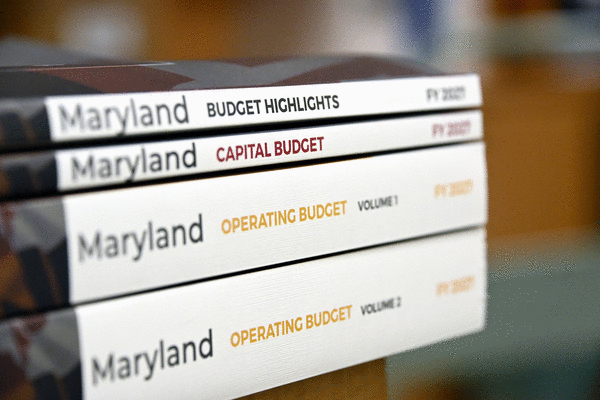
State budget analysts told Maryland lawmakers Monday that Gov. Wes Moore’s proposed fiscal 2027 budget improves the state’s short-term outlook but leaves major structural problems unresolved in the years ahead, setting the stage for weeks of legislative deliberations over the administration’s spending plan.
Moore released a $70.8 billion budget proposal last Wednesday that relies on nearly $1.8 billion in program cuts and fund transfers to eliminate the state’s projected $1.4 billion shortfall, in part by reducing cost-sharing with local governments.
In a joint virtual briefing before the Senate Budget and Taxation Committee and the House Appropriations Committee, the Department of Legislative Services (DLS) — the nonpartisan agency that advises the Maryland General Assembly — said Moore’s proposal meets targets set by the state’s Spending Affordability Committee for fiscal years 2027 and 2028, but does little to address projected multibillion-dollar gaps later in the decade.
The DLS presentation outlined the size and structure of the governor’s proposal, highlighted major spending increases and cuts, and flagged issues lawmakers may want to examine as they begin budget deliberations. The agency also went over options that produce more revenue in Maryland.
During the hearing, DLS analysts flagged several cost-shifting measures that could draw scrutiny from lawmakers. They include asking local governments for a second consecutive year to absorb half of the state’s increased retirement costs for teachers, librarians, and community college employees — about $39 million — and capping formula-driven funding growth for community colleges. The budget also proposes freezing disparity grants at current levels, a move analysts said disproportionately affects Prince George’s and Allegany counties.
While the overall general fund spending will grow modestly, analysts also identified several areas where costs exceed prior expectations. Funding for the Judiciary stood out, with spending projected to rise nearly 4.5% as the courts add more than 50 positions and prepare for higher judicial compensation and employee health insurance costs. Employee health insurance expenses statewide are expected to increase about 9% in fiscal 2027, consistent with national trends.
DLS also raised concerns about potential underfunding in behavioral health and Medicaid, where the administration’s cost estimates were about $170 million below what analysts projected in December.
Other options to separate from federal tax actions
On the revenue side, analysts highlighted unresolved questions surrounding Maryland’s conformity with federal tax law, particularly provisions of the “One Big Beautiful Bill Act.” While Moore’s budget proposes decoupling, or separating, from certain federal tax changes, DLS said additional options are available.
Among these options are permanently decoupling from a provision allowing businesses to immediately deduct all research and experimental expenses, which analysts say would generate about $100 million in state revenue over fiscal years 2026 and 2027, and decoupling from a separate provision expanding deductions for business interest expenses, which analysts say would raise another $28 million over the same period.
“These are decisions for the General Assembly,” Romans said, noting that lawmakers will weigh revenue options against competitiveness and economic impacts.
Looking ahead, analysts warned that long-term pressures, including rising education costs from the controversial Blueprint for Maryland’s Future, uncertainty around federal funding and employment, and unresolved liabilities under the Child Victims Act, continue to loom over the state’s finances. Under current projections, Blueprint costs alone could add more than $3 billion annually to the general fund by 2031 once dedicated reserves are exhausted.
“This is more of an informational briefing than a briefing where anything’s going to happen,” Romans told The Sun in a phone interview. “It’s just kind of a broad-brush overview of everything… and where does this leave us in terms of the state’s financial outlook based on what the governor is proposing.”
While lawmakers asked questions during the hearing, no votes or formal action happened Monday. Instead, the hearing served as a starting point for a budget process that will stretch over the coming weeks.
The Senate Budget and Taxation Committee and the House Appropriations Committee will then hold hearings on individual agency budgets, with each department appearing before lawmakers to defend its spending plan. DLS will release more detailed analyses at that stage, including specific recommendations.
The process sets the stage for potential friction between Moore and lawmakers, who constitutionally have broad authority to rewrite the budget. While the governor has emphasized fiscal restraint and pledged not to raise taxes, some legislators — especially the GOP — have raised concerns about relying on fund transfers and cuts that could shift costs to local governments or limit future spending flexibility.
The Senate is expected to take the first round of formal action on the budget in early March, followed by the House of Delegates. Differences between the chambers are typically resolved in a conference committee in late March or early April, ahead of the legislature’s April 6 constitutional deadline to pass a balanced budget.
________
©2026 The Baltimore Sun. Visit at baltimoresun.com. Distributed by Tribune Content Agency, LLC.





Comments