Starmer says UK won't be forced to choose between US, China
Published in News & Features
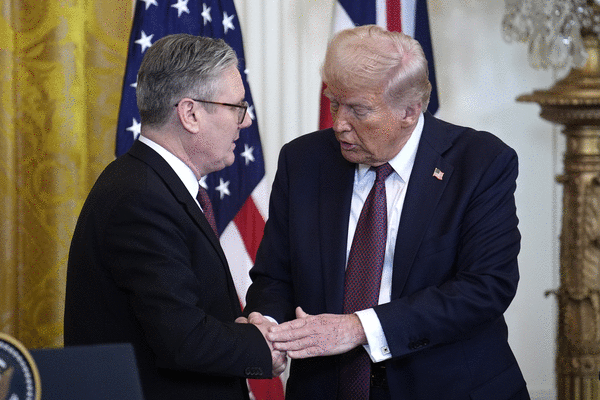
Prime Minister Keir Starmer said the United Kingdom wouldn’t have to choose between the United States and China, as he heralded “significant opportunities” for British businesses ahead of his trip to Beijing this week.
In an interview with Bloomberg on Monday, Starmer dismissed questions about whether he was seeking stronger ties with China at the expense of the U.K.’s relationship with its closest allies. Starmer’s trip to China — the first by a British prime minister in eight years — comes on the heels of a similar delegation by Canadian counterpart Mark Carney that drew fresh tariff threats from U.S. President Donald Trump.
“I’m often invited to simply choose between countries. I don’t do that,” Starmer said in 10 Downing St. “I remember when I was doing the U.S. trade deal, and everybody put to me that I’d have to make a choice between the U.S. and Europe, and I said, ‘I’m not making that choice.’”
The long-anticipated China trip follows through on a Labour Party campaign pledge to reset a relationship beset by conflicts over Hong Kong, Covid-19 and spying. Starmer’s government has spent recent months trying to smooth over disputes between the two sides — notably approving China’s controversial plan for a massive embassy in London last week — to pave the way for the trip.
Starmer insisted the U.K. could meet President Xi Jinping without angering Trump or harming relations with the U.S., rejecting the idea he’d have to make trade-offs in his approach to the two countries. He also made clear he wasn’t seeking to send the same kind of signal as Carney, who at Davos last week urged smaller countries to band together to survive in what he called a “new era of great-power rivalry.”
“We’ve got very close relations with the U.S. — of course, we want to — and we will maintain that business, alongside security and defense,” Starmer said, arguing Britain could enjoy the best of both worlds. “Equally, just sticking your head in the sand and ignoring China, when it’s the second-biggest economy in the world and there are business opportunities wouldn’t be sensible.”
Starmer, who came to power pledging not to reverse Brexit even though he had been against Britain leaving the European Union, has sought to simultaneously expand ties across multiple trading blocs. That’s seen the U.K. sign a landmark trade deal with its fast-growing former colony, India, and reduce bureaucratic hurdles with the European Union, but a U.S. framework announced by Starmer and Trump in May has been bogged down in extended negotiations.
China is the biggest market with untapped potential, after the “golden age” of ties promised by former Prime Minister David Cameron devolved into sanctions and recriminations over China’s crackdown on Hong Kong’s democratic opposition. The U.K. had $93 billion in trade with China in 2024, compared to $141 billion with the U.S.
Starmer has chosen to play down continued disagreements over national security or human rights, such China’s imprisonment of former newspaper tycoon Jimmy Lai, a British national, on allegations of colluding with foreign forces.
Starmer says he will raise such concerns when he meets with Chinese leaders including President Xi Jinping this week, but he’s clearly prioritizing the economic relationship. The prime minister is bringing some 60 leaders from companies, universities and cultural institutions during his visit to Beijing and Shanghai.
“They understand the opportunities that there are,” Starmer said of the delegation. “That does not mean compromising on national security — quite the opposite.”
Reflecting on a week of turbulent diplomacy with the U.S., which began with Trump threatening Britain and other European countries with tariffs over Greenland, before relenting, Starmer said he had a “mature” relationship with the president.
On Friday Starmer had condemned as “appalling” comments by the U.S. president downplaying the role of NATO troops in the 2001 invasion of Afghanistan, where he said they’d stayed “a little off the front lines.” The U.S. president later praised the the U.K. military in a social media post, even if he stopped short of the apology Starmer had urged.
“There were a number of challenges last week. We approached those with British pragmatism, British common sense, and British adherence to our principles and our values, as a result of which the end of the week was better than the beginning,” Starmer said.
Still, the premier indicated the U.K. would have to forge closer military links to Europe as the Trump administration pivoted away from the continent, and signaled he’d listen to those calling for higher defense spending.
“I do think that Europe needs to be stronger in its own defense and security,” he said, calling for closer interoperability between the continent’s militaries. “I think we need to step up to that challenge.”
Starmer said he spoke by phone to Trump about Ukraine at the weekend and warned that both Kyiv and Europe needed American backing to ensure their security.
“Ukraine is a very good example of why we need to maintain a very close U.K.-U.S. relationship. He insisted Kyiv’s allies had “made progress this year” by advancing security guarantees with the U.S., but said negotiations with Russia on territory remained a “challenge.”
____
(With assistance from Ellen Milligan.)
©2026 Bloomberg L.P. Visit bloomberg.com. Distributed by Tribune Content Agency, LLC.




Comments