Trump's border enforcer plans to leave Minnesota after backlash
Published in News & Features
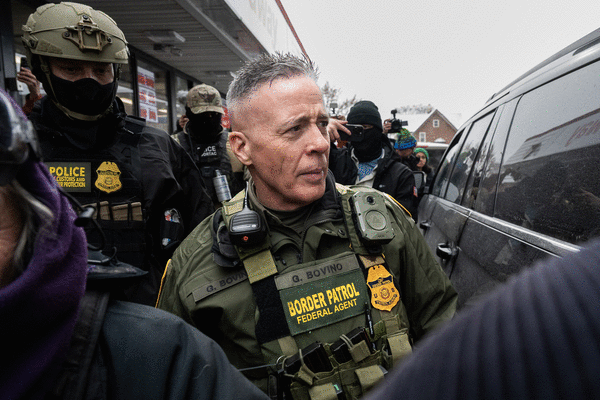
Greg Bovino, the U.S. Border Patrol commander who became the face of President Donald Trump’s sweeping immigration crackdown in Minneapolis, is leaving the city following a mounting public outcry over the killing of two U.S. citizens by federal agents in recent weeks.
Bovino and some Border Patrol agents are expected to begin departing as soon as Tuesday, according to local officials. The move follows protests, political turmoil and nationwide scrutiny of Operation Metro Surge, a federal enforcement effort that has posted thousands of immigration agents to Minnesota since last month.
The White House said it’s dispatching border czar Tom Homan to Minneapolis, where he will report directly to Trump and has been charged with easing tensions. Homan, a former acting director of Immigration and Customs Enforcement, will meet with Minneapolis Mayor Jacob Frey on Tuesday to discuss coordination between federal and local law enforcement.
Bovino had become a polarizing figure over his hard-line tactics, including deploying chemical agents against protesters and his presence on the front lines of clashes between demonstrators and federal officers.
Before the Minnesota operation, he led immigration enforcement operations in Los Angeles; Chicago; Charlotte, North Carolina; and New Orleans. In Chicago, a federal judge ordered him to wear a body camera and report daily to court as part of oversight of enforcement actions there.
The Atlantic reported on Monday that Bovino had been removed from his role as “commander at large” and was expected to return to his previous CBP position in Southern California. The Department of Homeland Security disputed that report, with Tricia McLaughlin, a spokesperson, saying in an email that “Bovino has NOT been relieved of his duties.”
The backlash in Minnesota intensified after the Jan. 24 fatal shooting of 37-year-old intensive care nurse Alex Pretti by a Border Patrol agent during an immigration enforcement operation. Officials initially said Pretti posed a threat, but video circulated on social media contradicted those claims and showed Pretti subdued before he was shot.
Senior Trump adviser Stephen Miller intimated on social media that Pretti was an “assassin” and “domestic terrorist,” while Homeland Security Secretary Kristi Noem said the demonstrator showed up to “impede a law enforcement operation.”
Pretti’s death came just weeks after the Jan. 7 killing of Renee Good, a US citizen and Minneapolis mother of three, by an ICE agent during a similar operation in a residential neighborhood of the city.
Local officials called the federal presence chaotic and counterproductive. Frey said Minneapolis would continue to cooperate with state and federal authorities on serious criminal investigations but will refuse to assist in immigration arrests he deemed unconstitutional.
“Some federal agents will begin leaving the area tomorrow, and I will continue pushing for the rest involved in this operation to go,” Frey said Monday after speaking with Trump by telephone. “I will continue working with all levels of government to keep our communities safe, keep crime down, and put Minneapolis residents first.”
Minnesota Governor Tim Walz also spoke with Trump, describing the conversation as “productive,” a marked change from earlier tense exchanges. Walz’s office said the president agreed to consider independent investigations into the two fatal shootings and to review the size of the federal footprint in Minnesota.
Trump’s move to send Homan, who is seen as more focused on targeted enforcement than broad street operations, suggested the president might recognize that his maximum pressure deportation campaign had eroded public faith in immigration officials. Trump described Homan as “tough but fair.”
At a briefing Monday, White House Press Secretary Karoline Leavitt said Trump had laid out steps he wants Minnesota officials to take to “restore law and order,” including turning over immigrants accused or convicted of crimes to federal authorities and requiring local police to assist in apprehending and detaining those sought by federal agents.
Homan, she said, would manage ICE operations on the ground and focus on arresting “criminal” undocumented immigrants.
The sanctuary city debate lies at the heart of the conflict. Trump has long criticized those cities and states, typically run by Democrats, that limit cooperation with ICE, accusing them of shielding criminals and threatening to withhold federal funding.
Public opinion polls show increasing discomfort with the administration’s tactics, even among voters who broadly support immigration enforcement. Nearly half of Americans in a recent Politico poll said the deportation campaign was too aggressive, and one in three Trump voters said while they support the goals of the effort, they disapproved of how it’s being implemented.
Business leaders in Minnesota, including executives from Target Corp. and Best Buy Co. Inc., have joined calls for deescalation, warning that the federal operation was damaging worker morale and the state’s economic stability.
In Washington, Senate Democrats have threatened to block funding for the Department of Homeland Security unless restrictions are placed on enforcement operations — raising the specter of a partial government shutdown — while some Republicans are urging for more restraint and clearer strategy on immigration from the administration.
_____
©2026 Bloomberg L.P. Visit bloomberg.com. Distributed by Tribune Content Agency, LLC.






Comments