Letter from CEOs on immigration actions in Minnesota stirs strong public reactions
Published in News & Features
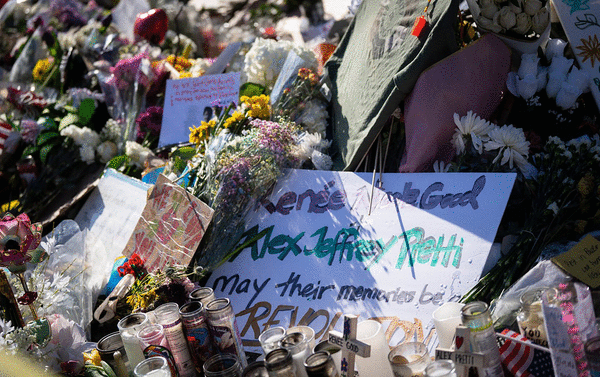
The letter by Minnesota’s top CEOs condemning the recent escalation of violence in the state was met by strong, often opposing, reactions in the local business community.
After weeks of growing criticism for failing to speak publicly on the massive federal immigration enforcement surge in the Twin Cities, 60 of Minnesota’s most notable business leaders on Sunday released a joint, signed statement asking local, state and federal politicians to de-escalate tensions and “find real solutions.”
By Monday, Jan. 26, social media within in the Minnesota business community was buzzing with reactions. Some expressed disappointment in the letter’s perceived tardiness, its neutral tone and lack of specificity. The letter, for example, did not mention the names of Renee Good or Alex Pretti, the two Minneapolis residents killed this month by immigration agents.
Others applauded the group’s willingness to attach their names to a letter that risked drawing harsh attacks from the White House.
The Minnesota Business Partnership, both a cosigner and organizer of the letter, turned off public comments on its LinkedIn post when the responses turned negative, calling the statement weak.
The message seemed aimed at politicians rather than the local community, said Amy O’Connor, a University of Minnesota associate professor whose research focuses on social responsibility communication.
“The community members are kind of lost in that shuffle a bit,” she said, adding the letter felt “oddly out of touch with what’s happening in Minnesota right now.”
Former Medtronic Chairman and CEO Art Collins said he supports the letter but wished it would have gone further by urging U.S. Immigration and Customs Enforcement to pull out of Minnesota immediately. ICE’s continued presence, Collins said, “serves no useful purpose and only further enflames an already volatile situation.”
However, the White House has proven quick to retaliate against leaders who speak out, Collins said, citing last week’s lawsuit by President Donald Trump against J.P. Morgan and chief executive Jamie Dimon.
Minnesotans remember the state’s top business leaders making broad declarations in 2020 that denounced racism and the murder of George Floyd.
Yet getting more than 60 companies to agree on a letter must have been a “gargantuan effort,” said Ellen O’Brien, the founder of public relations firm Hudsons Media. The task likely required the companies’ compliance, public affairs, and investor relations departments to come together, she added.
O’Brien — who has worked with some of the companies included in the letter — said Minnesotans are feeling fearful in these times. The letter, she said, shows that “fear extends to the highest levels of corporate leadership. Because if they didn’t feel that fear, I think they would have taken further steps to put more teeth into the statement.”
Adam Duininck, president and CEO of the Minneapolis Downtown Council, said he noticed dueling reactions to the statement with some feeling the response was “too little, too late.”
Others are thankful they were urging peace and not siding with either state officials or the Trump administration, which could further enflame the situation, Duininck said.
“I viewed [the letter] as an important step forward,” Duininck said. “The fact that you can get that many companies to agree in a pretty strong way on a pretty impactful statement, I think, was meaningful.”
Fred Haberman, CEO of marketing agency Haberman, said “Minnesota is hurting” with the detention of children and such an overwhelming presence of immigration enforcement officers at businesses and in neighborhoods.
Despite “getting the first public relation statement wrong,” Haberman urged the companies to use their coalition to make a stronger statement of opposition and resist being “bullied” by the Trump administration.
Nancy Lyons, a local entrepreneur, author and speaker, called the letter a failure of messaging. “But more importantly, it was a failure to meet the moment,” she said.
The moment, she said, is “about people and pain and neighborhoods and communities and real suffering. I think we need our leaders — the people we perceive as having power and muscle in these moments — to show up, willing to leverage those things.”
©2026 The Minnesota Star Tribune. Visit at startribune.com. Distributed by Tribune Content Agency, LLC.





Comments