With TPS deadline near, South Floridians urge Trump administration to protect Haitians
Published in News & Features
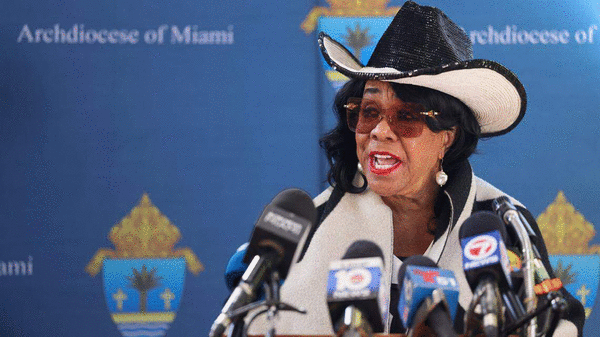
MIAMI — South Florida leaders urged the Trump administration on Tuesday to extend immigration protections for Haitians, warning that the loss of protections from deportations would be devastating not only for affected families but for the communities where they live and work.
The appeal comes just days before Haiti’s temporary protected status, or TPS, designation is set to expire on Feb. 3. Without a court order or a reversal by President Donald Trump, more than 350,000 Haitians nationwide would become vulnerable to detention and deportation to a country overwhelmed by gang violence, political instability and one of the world’s worst humanitarian crises.
The prospect has fueled deep anxiety in South Florida, where about 100,000 Haitian residents benefit from the immigration status and contribute significantly to the local economy, according to the American Business Immigration Coalition Action, the Archdiocese of Miami and elected officials.
“We should not force Haitians back into a crisis, back in Haiti, nor should we create another crisis here, because we are forcing them out of their jobs,” Miami Archbishop Thomas Wenski said at a press conference at the Archdiocese of Miami in Miami Shores.
“They are working legally. They have documents. They are not violating any laws. They are not the worst of the worst by any stretch of anybody’s imagination,” Wenski said, employing the phrase frequently used by Trump and Homeland Security Secretary Kristi Noem to describe the targets of their immigration enforcement.
Randolph McGrorty, the head of Catholic Legal Services for the archdiocese, described the pending loss of status as “a disaster, unlike any other hurricane. We know exactly when this is coming, where it’s going to hit, who is going to be affected by it,” he said. “And unlike other hurricanes, this can be avoided because its is manmade.”
The American Business Immigration Coalition Action said that ahead of the expiration it is holding similar events around the country to press upon members of Congress and the White House about the economic impact of Haitians loss of TPS.
In South Florida, many TPS holders work in critical healthcare and elderly services. Catholic Health Services alone employs 44 Haitians with TPS. The status has provided them with authorization to live and work in the U.S. since Haiti was devastated by an earthquake in 2010 that killed more than 300,000 people and left 1.5 million homeless.
“We have most of our essential caregiving roles filled by our Haitian community nurses, nursing assistants, home health aides, long term care workers, even now, to our cemeteries, who make our daily ministry possible,” said Dr. Brian Kriedrowski, chief medical officer at Catholic Health Services. “These men and women are not just our employees. Over the years, they’ve become our partners in our mission and our family.”
The American Business Immigration Coalition campaign also seeks to preserve work authorization for TPS holders from other countries, including El Salvador and Venezuela, after the administration moved to end protections for several nationalities, prompting a wave of federal lawsuits.
“If TPS for Haiti is allowed to expire, thousands of immigrant workers will overnight lose their ability to work legally in this nation,” said Luis Zaldivar, project director for the business council. Haitians with TPS, he said, are among a group of immigrants who pay $4.6 billion a year in taxes and $690 million each year into Social Security.
“The current immigration plight is tearing our nation apart and hurting our economy,” he said.
Tony Argiz, a Cuban-American accounting executive, said Haitians’ plight resonate deeply with him. He recalled arriving in the U.S. at age 9 and being cared for by the Catholic Church. He benefitted, he said, from America’s immigration policies that recognize humanitarian crises and responded with compassion.
“I see my own experience in the experience of our Haitian community here in Miami and around the country,” Argiz said. “It is shameful and devastating to Miami to see the community that built so much here in Little Haiti and across our city and state targeted in this fashion.”
Miami-Dade Mayor Danielle Levine Cava and U.S. Rep. Frederica Wilson of Miami Gardens called on the administration to rescind its decision and extend the status, citing Haiti’s worsening security crisis and instability.
“This is a community in pain,” Levine Cava said, “and this is no time, no time to force them to go back to a place that is in chaos, crime infested, violent and death. These are not violent criminals, these are great contributors to our community. They are people that we’ve welcomed.... They’ve created jobs, they’ve created opportunities, they are professionals across every field.”
Last week members of the congressional Black and Haiti caucuses said they are pursuing a petition to attempt to force a House vote aimed at protecting Haitians from losing TPS. The effort, led by Democratic Rep. Ayanna Pressley of Massachusetts, needs 218 votes including four Republican supporters to pass.
One of those at risk is Father Feliere Louis, a priest in the Archdiocese of Miami who is from Petit-Goâve, a coastal town cut off from Port-au-Prince by gang-controlled roads. In October, the town was inundated by floodwaters after days of heavy rain from Hurricane Melissa caused a river to overflow its banks, killing dozens.
The flooding compounded an already dire humanitarian emergency. According to the United Nations, more than half of Haiti’s population lacks sufficient food, and more than six million people require humanitarian assistance.
The Department of Homeland Security has argued that Haitians have other places to relocate, an assertion recently raised in federal court. Wilson rejected that position, saying the end of TPS would harm both U.S. cities and Haitian families.
“In Haiti, there’s open warfare and rape, there’s violence against women and against children. There are no school days, no work,” she said, describing it a “humanitarian disaster beyond belief.”
If TPS ends, Wilson added, “350,000 Haitians nationals will be thrown into a pit of despair and chaos overnight. These are neither criminals nor strangers to us. These are our neighbors, our co-workers, our families, our friends. These are hardworking people in our community, parents caregivers. People who have built lives and followed the law.”
Wenski said there is till time for the administration to extend TPS before the Feb. 3 deadline.
“It’s never too late to pivot. This is the right thing to do.”
©2026 Miami Herald. Visit at miamiherald.com. Distributed by Tribune Content Agency, LLC.






Comments