Cal Fire task force recommends tougher fireworks oversight after Esparto blast that killed 7
Published in News & Features
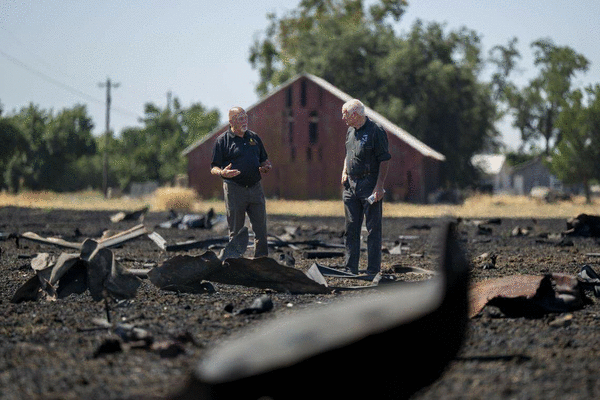
SACRAMENTO, Calif. — A state task force this week issued wide-ranging recommendations aimed at tightening California’s fireworks laws and oversight in the wake of the deadly Esparto fireworks explosion July 1.
The panel presented its initial findings Tuesday in San Diego to Cal Fire’s General Fireworks Advisory Committee. Cal Fire formed the task force in August, about six weeks after an unpermitted fireworks facility exploded in rural Yolo County, killing seven people and sparking a 78-acre wildfire.
The task force included representatives from local police and fire departments and focused on identifying weaknesses in fireworks licensing, regulation and enforcement. Among the issues flagged were licensing loopholes that allowed Kenneth Chee and his company, Devastating Pyrotechnics, to import fireworks despite Chee’s prior conviction for a violent felony.
The panel also cited gaps between state and local enforcement agencies.
The California Department of Forestry and Fire Prevention convened the task force after revoking fireworks licenses held by Devastating Pyrotechnics and BlackStar Fireworks, the other company based at the same Esparto property. The property was owned by a Yolo County deputy sheriff with his wife, a legal secretary for the Sheriff’s Office. Both remain on administrative leave, according to the Sheriff’s Office.
In all, the panel issued 35 recommendations addressing fireworks laws and regulations. Some aligned with Senate Bill 828, legislation introduced by Sen. Christopher Cabaldon, D-West Sacramento, that is moving through the Legislature. But, as the report acknowledged, other reforms fell outside Cal Fire’s authority.
While Cal Fire can make changes to regulations, it cannot change the law. To address licensing failures like those identified in Esparto, the task force said parts of the regulatory framework would need to be shifted from statute to Cal Fire oversight, according to the task force.
Many of the recommendations echoed concerns raised in previous Cal Fire reports.
Closing licensing loopholes
The task force’s recommendations focused heavily on closing licensing gaps exposed by the explosion.
Among them was a proposal to bar people with certain criminal convictions from obtaining fireworks licenses. Kenneth Chee, who owned one of the companies operating in Esparto, was prohibited from holding a federal import license because of a state conviction for a violent felony crime. In spite of that federal rule, Chee and his company held multiple state fireworks licenses.
The task force recommended aligning fireworks licensing standards more closely with those governing firearms. “The hazards to the public of dangerous individuals obtaining explosives mirror the dangers of them obtaining firearms,” the task force wrote.
The panel’s report also recommended that Cal Fire amend its licensing process to require applicants to provide relevant permits issued by other authorities, including the federal Bureau of Alcohol, Tobacco, Firearms and Explosives and local agencies.
The two companies operating in Esparto repeatedly told Cal Fire they stored fireworks at the property. But because the agency was not required to verify local permits, Cal Fire did not learn the companies lacked local approvals until after the explosion.
The task force also recommended expanding Cal Fire’s authority to suspend fireworks licenses for up to 90 days, instead of the current 30-day limit. The longer suspension period would allow more time for complex investigations like Esparto, the report said.
Cal Fire investigators determined within the agency’s 30-day suspension window that the two companies operating in Esparto violated state fireworks law, leading the agency to revoke their licenses. The investigation into the cause of the explosion, however, is now in its seventh month. No criminal charges in the blast have been filed.
The panel further recommended requiring input from local agencies before fireworks licenses are issued in the first place. The change would “increase clarity for the regulated community that the state fireworks license is only one of the necessary and regulatory documents to be obtained before commencing operations.”
The importance of that coordination became evident after the explosion, when Esparto fire Chief Curtis Lawrence said he was aware of the fireworks on the site and conducted “site visits,” but never carried out formal safety inspections.
The task force also recommended that local permits be submitted and verified during annual license renewals.
In addition, the panel said Cal Fire needs expanded enforcement authority to penalize people who violate state fireworks law. The agency has limited ability to cite license holders, no authority to cite the general public, and cannot revoke licenses without a hearing before an administrative law judge.
Tighter oversight of explosives
The task force also called for tighter controls on the importation and regulation of fireworks and explosive materials.
Among its recommendations was strengthening oversight of precursor chemicals used to manufacture fireworks. Laws governing the possession of a “fireworks kit” — which includes the components needed to make fireworks — can complicate prosecutions involving certain explosive materials. Devastating Pyrotechnics had imported raw ingredients, a Bee investigation found in July, allowing the company to make flash powder for homemade fireworks.
The task force recommended giving Cal Fire authority to retest fireworks brands approved for sale in California, publish a more detailed guide to identifying illegal fireworks and require clearer labeling to help local agencies determine whether fireworks are legal.
Fireworks license holders are required to file import notices with Cal Fire but Devastating Pyrotechnics failed to do so for years without the agency’s knowledge. The task force recommended strengthening the import notification process to require disclosure of the destination of imported fireworks. That change would allow Cal Fire to verify shipments are headed to permitted and safe storage facilities.
The report also recommended requiring storage facilities to maintain more detailed inventory logs and requiring license applications to list every storage location used in California. Currently, companies are only required to identify their primary storage site. Devastating, for example, listed the Esparto property on the 26400 block of County Road 23 near County Road 86A as its primary storage facility in license applications six times before the explosion. Past reporting by The Bee showed Devestating had socked away fireworks at a warehouse in the Los Angeles suburb of Commerce and at a commercial self-storage facility in San Jose that exploded in 2023.
The task force urged closer collaboration among Cal Fire, the ATF and local public safety agencies, including joint annual safety inspections of all fireworks storage sites. The panel recommended making such inspections mandatory.
In the weeks between the federal Department of Transportation and the ATF warning Cal Fire about Devastating Pyrotechnics’ dangerous imports and the Esparto explosion, none of the three regulatory bodies that knew about the explosives took steps to prevent the company from bringing more illegal fireworks into California. Import records showed the company brought seven shipments of fireworks into California after federal regulators warned Cal Fire.
A Bee investigation found that federal regulators did not block those imports even while the company was under investigation for importing illegal fireworks.
The panel also recommended that Cal Fire develop safety training for fireworks workers. Licensed pyrotechnic operators receive training, but there are no clear requirements for non-operators employed by fireworks companies. A Cal-OSHA investigation into the Esparto explosion found numerous workplace safety violations, including some related to safety training, leading the agency to fine Devastating Pyrotechnics more than $220,000.
Reiterating prior priorities
Several of the task force’s recommendations echoed proposals Cal Fire and lawmakers had previously advanced, particularly those related to training and fireworks disposal.
The panel again called for expanded training for local fire and law enforcement agencies. Lawmakers and Cal Fire acknowledged that need in Assembly Bill 1403, a 2023 bill signed into law by Gov. Gavin Newsom requiring Cal Fire to develop enhanced local training. AB 1403 also required Cal Fire to produce a report outlining the resources needed to provide that training. The report was delivered more than nine months late — after the Esparto explosion.
That report estimated it would take about five years for representatives from every police and fire agency in California to receive the training. The task force said webinars or other remote options could accelerate the process.
The panel also recommended that Cal Fire conduct a workforce analysis to determine staffing needs for fireworks enforcement, training and disposal. AB 1403 required a similar analysis be sent to lawmakers by Jan. 1, 2025. That report was not submitted until Oct. 2.
The task force called for increased and more stable funding for fireworks disposal, noting costs nearly doubled in 2024 amid a shrinking disposal industry and rising seizures. The panel suggested bolstering funding and creating a centralized facility for seized fireworks.
The task force also recommended training for district attorneys on fireworks law, a proposal included in the AB 1403 workforce analysis.
The panel further suggested increasing penalties for fireworks-related crimes, though penalties were already increased under AB 1403.
The General Fireworks Advisory Committee has about a week to submit questions and comments. The task force plans to finalize its report and submit it to the Office of the State Fire Marshal — the Cal Fire division that continues to investigate the Esparto blast alongside the Yolo County District Attorney’s Office — by the end of February. The committee is expected to share its feedback at an April meeting.
State Fire Marshal Daniel Berlant said during Tuesday’s meeting in San Diego that the task force grounded its recommendations in public safety, with a focus on licensing, enforcement and interagency coordination to prevent another Esparto.
“The hard part is going to be how do we take this and do something with it,” he said.
____
©2026 The Sacramento Bee. Visit at sacbee.com. Distributed by Tribune Content Agency, LLC.





Comments