Kansas lawmakers vote to police bathrooms in public buildings -- without comment
Published in News & Features
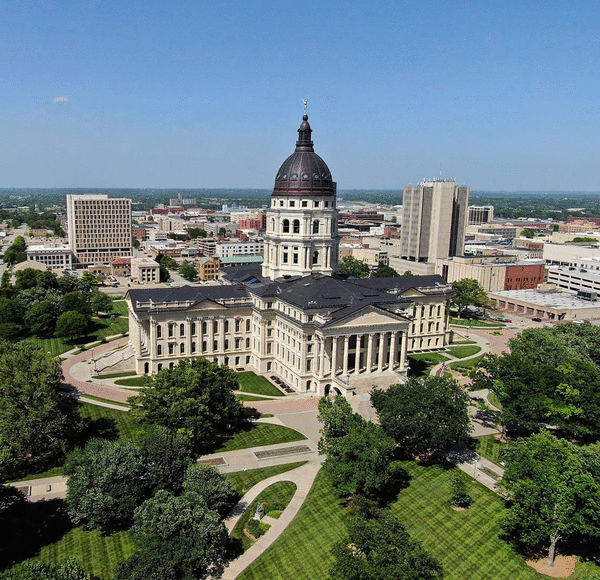
Republican supermajorities in the Kansas Legislature passed a bill late Wednesday barring people from using restrooms in government buildings that don’t align with their sex assigned at birth.
The legislation targeting transgender Kansans was adopted after a series of remarkable procedural maneuvers that circumvented all public input on key provisions of the bill, including a ban on multi-occupancy unisex restrooms and other private spaces.
The restrictions on restrooms, changing rooms and locker rooms would apply to all buildings owned by the state of Kansas, local governments, and school districts, as well as public colleges and universities.
“Right now, anyone can walk in any bathroom. This is about making it really clear who can go in each restroom,” said Rep. Susan Humphries, a Wichita Republican who carried the bill on the House floor and cast it as an effort to protect the safety and privacy of women.
The bill contains another provision requiring the Department of Revenue to revoke and reissue driver’s licenses and birth certificates that have been updated to reflect trans Kansans’ identities.
LGBTQ rights groups condemned the bill as discriminatory, saying its implementation would sow confusion and put trans people in danger by requiring them to out themselves in public life.
Logan DeMond, ACLU of Kansas policy director, said in a statement that the bill opens up all Kansans to “scrutiny and gender policing by strangers.”
“Transgender people are already vulnerable to violence, especially in restrooms, and this bill layers prospective physical violence on top of the existing privacy violation of forced changes to identification documents,” DeMond said.
The bill passed 87-36 in the House after a nearly six-hour debate. The Senate followed suit by a vote of 30-9 shortly thereafter.
The bill will now be sent to Gov. Laura Kelly, a Democrat who has consistently vetoed anti-LGBTQ legislation passed by lawmakers. It could be enacted into law over a veto with the support of two-thirds of lawmakers in both chambers.
Policing public bathrooms
The restrictions on restrooms and other multi-occupancy private spaces would not apply to private establishments.
Government entities that fail to clearly designate facilities as either male or female could face a $25,000 fine for a first violation and a $125,000 fine for subsequent violations.
The legislation includes no funding to pay for modifications and no estimate of the proposal’s overall cost. Humphries suggested the price tag would be negligible.
“It might require a change on your door, but it doesn’t require anything to be built,” she said.
Rep. Lindsay Vaughn, an Overland Park Democrat, said school districts and other public entities would be forced to scramble to come into compliance.
“The bathrooms that I know are in some of our K-12 schools to support and be inclusive, that have multiple gender-neutral stalls, will be illegal. And that is cruel,” Vaughn said. “It is not just discrimination. This bill actively takes away spaces that are created to be inclusive for people who are gender diverse.”
The bill would allow anyone who believes a person entered the wrong restroom in their presence to submit a complaint and seek $1,000 in damages. The attorney general’s office would ultimately be responsible for determining the validity of complaints.
Anyone found to have improperly used a restroom or other private space in a government building would face a written warning for a first violation. A second violation would carry a $1,000 fine, and each subsequent violation would be a misdemeanor offense punishable by another fine and up to six months in jail.
Rep. Abi Boatman, a Wichita Democrat, said that as a transgender woman, sitting through Wednesday’s debate was a surreal and painful experience.
“I have sat here for five and a half hours and listened to this entire room debate my humanity and my ability to participate in the most basic functions of society, and from the bottom of my heart, I hope none of you have to ever sit through something like that,” Boatman told her colleagues.
“While I am somewhat flattered that this chamber seems so obsessed with me, I want to take this opportunity to apologize to my constituents for this massive waste of time and taxpayer money,” she said.
Preventing public input
The restroom language was abruptly added to a bill that had been solely focused on prohibiting the Department of Revenue from accommodating gender marker change requests on state identification documents.
That bill was introduced earlier this month at the behest of Attorney General Kris Kobach, who lashed out at the Kansas Court of Appeals after a panel of judges overruled a district court injunction, allowing KDOR to resume its practice of updating trans Kansans’ documents to reflect their identities.
On Jan. 13, Kobach testified before the House Judiciary Committee on the original bill without the bathroom amendment after a public hearing was called with less than 24 hours’ notice. Despite the lack of time to prepare, more than 200 people submitted written testimony opposing the bill.
The bathroom amendment was introduced in the judiciary committee on Monday by Rep. Bob Lewis, a Garden City Republican.
The amendment was added over the vehement objections of the committee’s Democratic members, who argued that no such major addition to the bill should be made without an opportunity for more public feedback.
Instead, Humphries, who chairs the judiciary committee, executed a legislative maneuver to fast-track the bill and ensure that it wouldn’t receive a hearing in the Senate either.
She made a motion to insert the language of the bathroom and driver’s license bill into a completely unrelated piece of legislation that the full Senate had already approved in 2025. That maneuver, known in Topeka as a “gut and go,” meant that if the anti-trans bill was approved by the full House, the Senate could vote to concur without working the bill in committee.
That’s exactly what happened on Wednesday.
“This bill is not fair,” said Rep. Dan Osman, an Overland Park Democrat. “Procedurally, it is the absolute worst bill that I have ever heard in my time in the Kansas Legislature.”
Will Rapp, managing director for the Kansas chapter of the Gay, Lesbian, and Straight Education Network, described the legislative maneuvering as “complete cowardice.”
“When a legislature has a super majority and could pass anything they wish, yet still insist on using a ‘gut and go’ tactic to eliminate hearing from the public, you know that even they are embarrassed by their actions,” Rapp said in a statement.
During the debate, Rep. Charlotte Esea, an Olathe Republican, pushed back on Democrats’ insistence that the bill should have received a thorough hearing.
“For generations, we have protected women in women’s spaces,” Esau said. “We need to continue to do that for the women. They should not have to come here in mass numbers to tell you they have been traumatized in order for us to do the right thing.”
Transgender people are over four times more likely than cisgender people to be victims of violent crimes, according to data from the Williams Institute at UCLA School of Law.
If the bill is enacted into law, it will almost certainly face court challenges.
________
©2026 The Kansas City Star. Visit at kansascity.com. Distributed by Tribune Content Agency, LLC.



Comments