As Indiana Legislature hits halfway point, bills advance quickly
Published in News & Features
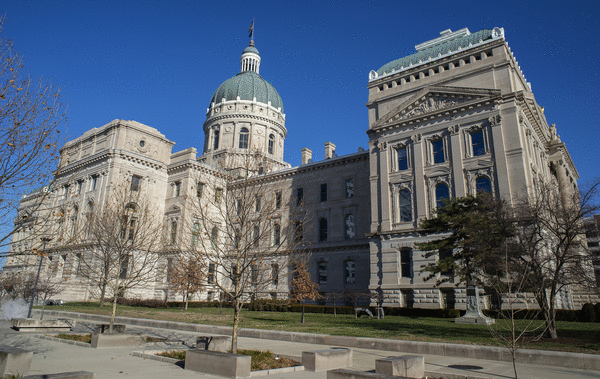
The Indiana legislative session has almost reached the halfway point with major bills advancing at quick pace this week and shifting from one chamber to the other for consideration.
The Senate concluded its session Thursday with all bills on third reading passing. The House took the day off Monday, due to the inclement weather, so its deadlines for second reading approval was moved to Thursday and third reading approval was moved to Monday.
Any bills that haven’t been heard to this point won’t be heard in the rest of the session, though legislators could try to offer portions of their bills as amendments to existing bills before the session adjourns at the end of February.
Electric bill affordability
House Bill 1002 passed the House in an 89-4 vote Wednesday afternoon. State Rep. Alana Shonkwiler, R-Noblesville, authored the legislation, which offers solutions to rising electricity bills statewide.
If the bill passes the Senate, all residential ratepayers will be placed on budget billing plans on July 1 and utilities will be prohibited from disconnecting low-income customers’ services during periods with extreme heat warnings. House Bill 1002 also ties utility profits to performance metrics, including affordability and service restoration. Utilities will also use a three-year rate plan, which Shonkwiler said “provides predictability for the utility customer and the utility.”
“The core of House Bill 1002 is simple,” Shonkwiler said. “Utility regulation should reward performance that benefits Hoosiers and correct performance that does not.”
Doxing
A bill criminalizing doxing passed 44-0 in the Senate Monday and heads to the House for consideration.
Doxing is when a person who knowingly or intentionally posts information, like an address or phone number, of a targeted person in retaliation. Under Senate Bill 140, authored by State Sen. Vaneta Becker, R-Evansville, doxing will become a Class A misdemeanor and a Level 6 felony if the posting of the personal information results in the targeted person or someone closely connected to the person suffering serious injury. It would rise to a Level 5 felony if the targeted person experienced catastrophic injury or death.
State Sen. Aaron Freeman, R-Indianapolis, said the bill increases the penalty for the “new crime” of doxing from a misdemeanor to a felony. Freeman amended the bill on second reading to include language about intent “to simply make that the crime” when it comes to doxing.
In November, Senate Pro Tem Rodric Bray, R-Martinsville, announced he would cancel an early December session to take up mid-census redistricting because the chamber did not have the votes to pass the measure.
Two days after the cancellation announcement, President Donald Trump issued a statement on his social media site Truth Social calling out “RINO” Bray and Greg Goode, R-Terre Haute, “for not wanting to redistrict their state, allowing the United States Congress to perhaps gain two more Republican seats.”
Hours after Trump posted his comment, Goode received a false swatting call. After Organization Day, when the Senate voted to reconvene in January, at least seven more State Senators — Dan Dernulc, Spencer Deery, Rick Niemeyer, Kyle Walker, Greg Walker, Linda Rogers and Andy Zay — received swatting calls.
Ultimately, the Indiana Legislature met in early December to take up redistricting. The measure passed the House, but failed in the Senate.
Indiana Crime Guns Taskforce
Senate Bill 148, authored by State Sen. Rodney Pol Jr., D-Chesterton, would add Porter and LaPorte counties to the Indiana Crime Guns Taskforce, which was created during the 2021 legislative session and currently has 10 county members.
The bill was amended in the appropriations committee to state that both counties would be added to the task force July 1, 2027.
The Senate approved the bill Tuesday, 46-0. The bill moves forward to the House.
In a statement after the bill passed, Pol said northwest Indiana’s proximity to Chicago as a reason to add Porter and LaPorte counties to the task force.
“Keeping our communities safe is a top priority,” Pol said in the statement. “Adding Porter and LaPorte counties to the Indiana Crime Guns Taskforce will provide law enforcement with more tools to solve crimes and strengthen public safety.”
Carbon sequestration
During Thursday morning’s session, Indiana senators passed legislation by state Sen. Rick Niemeyer, R-Lowell, that would place local regulations on carbon sequestration projects. Senate Bill 7 would require a carbon storage operator to receive approval from a county legislative body or plan commission if the sequestration project would transport or store carbon dioxide outside the county where it’s generated.
Various county commissioners have supported the bill, praising its ability to create more local control. Oil and gas advocates have said local governments don’t have the necessary expertise of carbon sequestration to make these decisions.
“If you have a carbon sequestration project in your own county, and it’s all planned in your county and on that footprint, (this bill) doesn’t apply to them,” Niemeyer said.
Encouraging new housing
A bill aimed at loosening local zoning guidelines to encourage new housing starts passed the Indiana House Tuesday, 76-15.
The bill, a House Republican priority for this session, addresses long permitting processes, zoning restrictions, and minimum parking requirements.
State Rep. Doug Miller, R-Elkhart, the bill author, said the goal is to expand the state’s housing supply and decrease the cost of homeownership by rolling back costly regulations that impede development.
When the bill was heard in the House Local Government Committee, Amy Krieg, government affairs director with Accelerate Indiana Municipalities, said the organization has concerns with the bill because it “extends beyond setting statewide guardrails into areas that remove local decision making in ways that have unintended consequences,” Krieg said.
Merging townships
The Indiana House will soon hear a bill that aims to merge townships statewide after it passed the Senate this week.
State Sen. Rick Niemeyer, R-Lowell, authored Senate Bill 270, which would require the Indiana Department of Local Government Finance to compile data on each township, except those in Marion County, by Dec. 31. The merit and data-driven plan will help merge townships statewide.
The bill passed in a 39-9 vote, and state Rep. Hal Slager, R-Schererville, will be the House sponsor.
According to the bill, the department will assign points to each township, and one with at least four points would merge with one that has less than four points. The department will assign points for various reasons, including if a township did not provide assistance in 2023 or 2024, if it doesn’t manage fire protection or emergency medical services on Jan. 1, 2025, or if it didn’t file an annual finance report to the State Board of Accounts in 2023 or 2024.
____
©2026 Chicago Tribune. Visit at chicagotribune.com. Distributed by Tribune Content Agency, LLC.






Comments