A disabled child, a panicked teen: A Haitian mom's agonizing choice as end of TPS nears
Published in News & Features


MIAMI — For Emma, the heartrending decision became clear came the night the police descended on her North Miami neighborhood.
Her 14-year-old son heard police sirens, and the fear that had kept him awake at night and distracted him in school finally spilled into panic.
“He was worried about me. He’s like, ‘Oh, Mom, do you think they’re coming for you?’” Emma, 40, recalled. “He thought it was an ICE raid going on in the middle of the night.”
Between her son’s panic attacks over a routine police incident, the constant images on television of Immigration and Customs Enforcement agents deploying across American cities, and her son’s persistent fear that she could be detained because of her temporary immigration status, Emma made an agonizing choice.
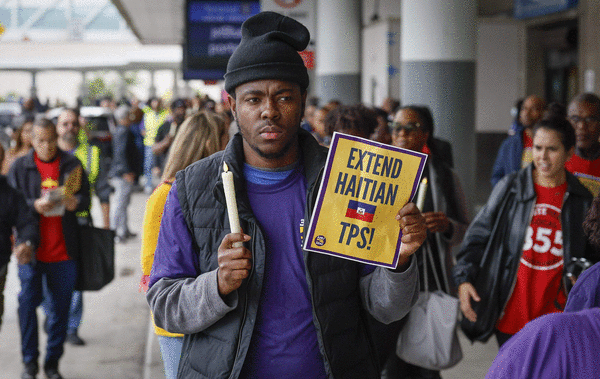
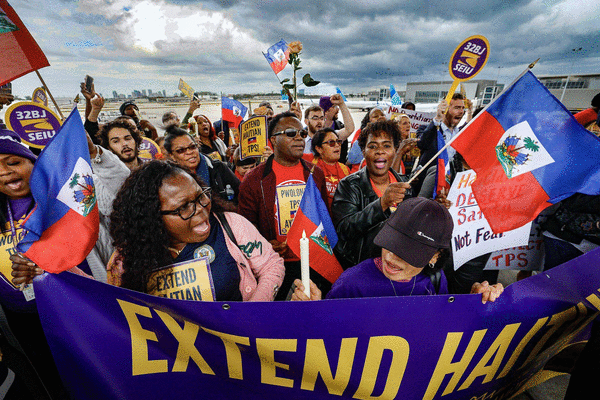
She decided to leave her job as a social worker, pack up her belongings and return to Haiti this weekend, before the fateful date of Feb. 3 — the day she and more than 350,000 Haitians with temporary protected status are scheduled to lose their legal rights to live and work in the United States, exposing them to detention and deportation.
Like other TPS holders, Emma, 40, asked not to be identified by her full name for fear of U.S. immigration authorities here as well as what awaits her in Haiti, a country where armed groups control every major road into the capital, more than 1.4 million people have been forced to flee their homes — and Haitians from abroad are routinely targeted by kidnapping gangs.
“I’m taking a chance,” said Emma, who is among more than 100,000 Haitians with TPS who live and work in Florida, the majority of them in South Florida.
The decision has meant more than just uprooting herself. It also means taking her six-year-old U.S.-born daughter — who suffers from epileptic seizures, is losing her hearing and has autism — to a country where schools are shuttered, businesses have collapsed and an estimated 80% of health facilities in the capital are shuttered due to the pervasive gang violence.
Unable to find the words in English to express the depth of her anguish, she turned to her native Creole.
“You’re choosing between one bad decision and the next,” said Emma, who in addition to her daughter and teen son, both of whom were born in the U.S., is also mother to an older son currently enrolled in college. “It’s not getting detained by ICE that I fear; it’s the fact that I might get separated from my daughter. I am everything to her. I am her support system; her eyes, her ears. Sometimes people don’t understand her, and I’m here to advocate for her.”
Ahead of her move back to Haiti this week, she sent her teen son ahead to be with his father, hoping that being away from the police sirens and news about immigration raids would calm his anxiety.
“I was afraid he might do something that could get him into trouble,” she said. “He spoke to me about having dreams that ICE was coming after me, and how he would fight for me. At some point, it was very stressful for him. He was not doing well at school.”
Eventually, the weight of it all forced her to make the painful decision to forgo the life she has been building in Miami in exchange for the uncertainty of Haiti.
Now, after weeks of separation Emma has decided to board a flight this weekend for Haiti, where she will also explore the possibility of migrating to Canada.
“My going back means I’m not able to offer a safe environment for my kids, especially a teenager, to raise him the way I want him to be raised,” she said. “I’m telling myself, maybe when I get to Canada, I will catch up with all of this and rebuild.”
Her return to Haiti comes will come nearly five years after she left shortly after the July 7, 2021, assassination of President Jovenel Moïse. His slaying plunged the volatile Caribbean nation even deeper into a spiral of violence and political upheaval, surpassing the chaos that prompted President Barack Obama to designate Haiti for TPS after its devastating 2010 earthquake left more than 300,000 dead and 1.5 million homeless.
Emma said her decision to migrate to the United States was driven not only by the instability in Haiti but by necessity. At the time, she could not get adequate medical care for her daughter, then two years old.
“She has special needs, and obviously that’s why I chose to come here and stay here, because she would get the services that she needs,” Emma said. “She has multiple disabilities. That’s why I am worried, because I know that I won’t get all those resources in Haiti.”
The effect of moving her daughter back to Haiti, she says, is her greatest fear.
“I’ve seen her evolution,” Emma said of her daughter, whom she has tried to prepare for the move by drawing pictures for her and telling her they are going to reunite with her brother. Still, she acknowledges the risk. “I know that she can regress in a year.”
As a U.S. born child with special needs, the girl qualifies for services that are not available in Haiti. But Emma’s lack of permanent immigration status means she has no protections.
“I’m going only with the essentials, because I have to pack medication for my daughter,” she said. “I’ve packed six months of medication until I find another way to refill.”
In ending Haiti’s TPS status, Homeland Secretary Kristi Noem has acknowledged her own administration’s description of Haitian gangs as “foreign terrorists” and that “certain conditions in Haiti remain concerning.” But in the notice terminating TPS, Noem also said that Haiti no longer faces “extraordinary and temporary conditions” that would prevent nationals from returning. Allowing Haitians to remain, her lawyers recently argued in a Washington federal court, is “contrary to the U.S. national interest.”
During the Jan. 7 hearing, U.S. District Court Judge Ana Reyes expressed confusion over what she described as opposing conclusions in the termination notice. It seemed odd, Reyes said, for the DHS secretary to say “it’s perfectly safe to return to Haiti, and then in the same breath, say that there are gangs” operating freely and terrorizing the population.
“How can it be safe to return to Haiti if we’re also making the determination that it does not have a functioning government?” Reyes asked. She noted that even Noem’s description of Haiti in the Federal Register notice seems to say there is no safe haven for Haitian TPS holders to return to in their home country.
The lawsuit is one of many that have been filed since Noem began dismantling TPS protections. Congress created temporary protected status in 1990 to allow immigrants from countries deemed too dangerous for safe returns to legally remain in the U.S. The Justice Department is asking the judge to throw out the caser. Advocates are asking her for a stay on Noem’s decision to terminate the status.
Reyes has said she plans to issue a decision by Monday. Still, the stress and the possibility of still being targeted for deportation — in other similar situations the Trump administration has gone directly to the U.S. Supreme Court to get a stay lifted while litigation continues — has become too much for many immigrants to bear.
Emma said she had been prepared to leave once before when it appeared last year that TPS was about to end, only to pause her plans when a federal judge in New York forced the Trump administration in July to maintain an 18-month extension for Haitians that had been granted by the outgoing Biden administration.
“Everything was in boxes. I was ready to go,” she said. “And then they made another decision.”
This time is different. A lot has changed during President Donald Trump took office last year. TPS has been terminated for a number of countries, not just Haiti, along with humanitarian protections for hundreds of thousands of Haitians and Venezuelans paroled into the U.S. by President Joe Biden.
In addition, Haiti has been placed on a full travel ban, and all immigration processes, including adjustment of status for those who legally qualify and citizenship ceremonies, have all been paused by the current administration. And then, there are the ICE raids, which have already made it into Florida cities.
“The atmosphere has changed,” Emma said. “The atmosphere is very fearful.”
©2026 Miami Herald. Visit miamiherald.com. Distributed by Tribune Content Agency, LLC.






Comments