Federal government denies Dunleavy request that it fully pay for initial storm response in Western Alaska
Published in News & Features
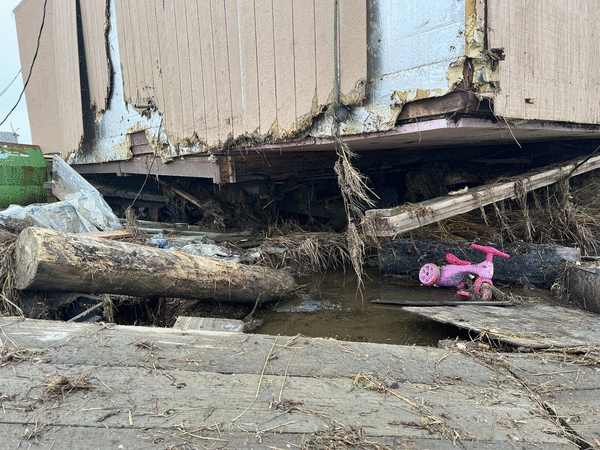
Federal officials have denied Alaska's request to cover all initial expenses associated with a costly and complicated disaster response effort following a catastrophic Western Alaska storm last fall.
Gov. Mike Dunleavy is appealing the decision, revising his request to ask that the Federal Emergency Management Agency instead pay 90% of the cost.
In early October, the remnants of Typhoon Halong inundated numerous Yukon-Kuskokwim Delta communities and destroyed swaths of the Yup'ik villages of Kipnuk and Kwigillingok. The storm left one person dead and two missing when their home was swept away by floodwaters.
After the storm, Dunleavy asked FEMA to cover 100% of costs incurred during an initial 90-day period after the storm. In a Jan. 16 letter to the agency appealing the denial, Dunleavy said it was one of Alaska's most "rapid, complex, and aviation-intensive emergency operations in its history."
An Oct. 22 federal disaster declaration for the region from President Donald Trump approved $25 million to cover the cost of recovery efforts in Western Alaska.
FEMA denied Dunleavy's request to fully fund the initial response in a Dec. 20 letter, saying only that "it has been determined that the increased level of funding you have requested" to help cover disaster response expenses "is not warranted."
In a statement responding to requests for more information about the denial, a FEMA spokesperson said the agency was working "closely with the state of Alaska to collect and analyze damage information."
The statement also said the agency provided $1 million in expedited initial recovery funds and approved about $35 million in individual and household recovery aid.
Political considerations weren't a factor in FEMA's denial of Dunleavy's request, the agency said.
"This decision just like all disaster requests was based on policy," the statement said.
In his appeal letter, Dunleavy said state wasn't asking for extra accommodations beyond the 90-day window and still expected to be primarily responsible for "the broader recovery mission" of rebuilding and mitigating future risk.
"This limited, focused adjustment will allow Alaska and its partners to maintain essential public services, manage an extraordinarily complex and winter-constrained housing and lifeline mission, and continue investing State, local, and tribal resources into mitigation and stabilization," Duleavy wrote. "It represents not an expansion of government, but a targeted use of Federal authority to back a State that has acted decisively."
An unsuccessful appeal, Dunleavy warned in the letter, would threaten state or local services.
When asked how the state would pay for the expenses if the appeal failed, Dunleavy spokesperson Jeff Turner said that "the administration will await the federal government's decision."
State officials didn't know when to expect that decision, Division of Homeland Security and Emergency Management spokesperson Jeremy Zidek said.
Alaska U.S. Sens. Lisa Murkowski and Dan Sullivan and U.S. Rep. Nick Begich had also urged the Trump administration to authorize the 100% cost share in an Oct. 17 letter.
Spokespeople for all three members of the delegation said Friday that they believed Alaska should receive a higher cost share and supported the state's appeal. All said they were engaging with the Trump administration about the issue.
Typically, the federal government pays for 75% of costs during that initial 90-day response window, Zidek said.
The state successfully petitioned FEMA for a deviation from that ratio last in 2018, Zidek said, when it agreed to cover 90% of 90-day recovery costs following the November 2018 Southcentral Alaska earthquake.
For the most recent disaster, response work in the first weeks "was very costly" and included flying crews out to complete work such as village airport runway repairs or road and bridge assessments, he said.
Dunleavy in his letter said this disaster response work has been more expensive than many other emergency recovery efforts due to "Alaska's uniquely limited tax base and the extraordinary cost of operating in remote, roadless western Alaska."
Officials said they expect repair and mitigation work to take years.
In the first weeks after the storm, the state incurred $20 million in expenses for work like debris removal and the largest mass airlift evacuation in Alaska history, Dunleavy said.
As of Thursday, 475 evacuees remained in non-congregate shelters at Anchorage hotels, while 216 had been moved to longer-term apartment-style housing, according to a Division of Homeland Security and Emergency Management daily report. Most evacuees are from the hardest-hit villages of Kwigillingok and Kipnuk, where Dunleavy said 90% of its structures were severely damaged or destroyed.
Officials expect the first three months of shelter and evacuee support expenses to total $12.5 million, according to the state's appeal letter.
It's too early, however, to estimate what the total response costs will amount to for that 90-day period because many agencies and organizations have yet to tally their costs and submit them to officials for reimbursement, Zidek said.
Estimated costs also don't include "emergency expenditures" racked up by local and tribal governments, regional tribal nonprofits, Alaska Native corporations and other non-state groups, Dunleavy said.
"Many of these are small, fiscally limited entities that have already borne significant non-reimbursable disaster costs," Dunleavy wrote. "Without a 90/10 cost share for the first 90 days, these disaster response partners will be forced to cut essential local services and limit additional disaster recovery actions."
_____
© 2026 Anchorage Daily News. Visit www.adn.com. Distributed by Tribune Content Agency, LLC.






Comments