Illinois appeals court to review order sealing video in shooting of Chicago Officer Krystal Rivera
Published in News & Features
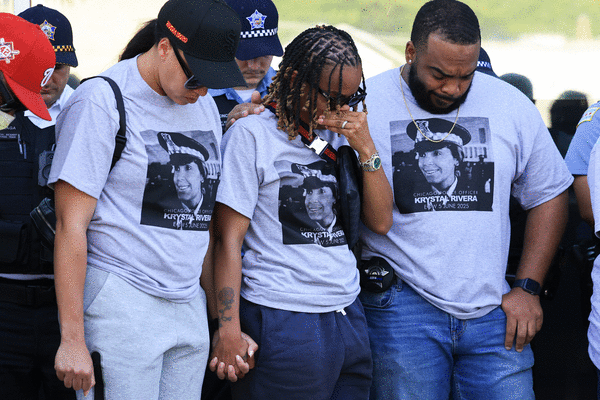
An Illinois appeals court may soon decide whether to undo a controversial order by a Cook County judge that kept video footage and other records sealed related to the slaying of Chicago police Officer Krystal Rivera, after media outlets and the state’s attorneys office asked for the ruling to be vacated.
Such a ruling from the court would not necessarily mean video footage is released, as agencies that keep the records could deny public records requests on other grounds. In its response, filed last week, the state’s attorney’s office made it clear that: “Vacating the order does not compel disclosure.”
But a decision in favor of undoing the order would remove at least one obstacle to public disclosure of information around the June 5 slaying of Rivera at the hands of her partner, Carlos Baker.
Rivera’s family, which is suing the Police Department, has raised questions about the shooting and called on officials to release body camera footage.
“From this moment forward, my purpose is simple: that those responsible for her death must be held accountable,” her mother, Yolanda Rivera, said in a news conference last year.
Baker has been stripped of his police powers, but is not facing any criminal charges.
The criminal cases at the center of the judge’s order to bar disclosure are against two men, Adrian Rucker and Jaylin Arnold, facing charges of armed violence and other felonies in connection with the underlying events around Rivera’s shooting.
Last year, Cook County prosecutors first asked that video footage be barred from disclosure via Freedom of Information Act laws, which was then granted by Judge Deidre Dyer.
Later, the Chicago Sun-Times, the Better Government Association, NBC Chicago and Jamie Kalven, founder of the Invisible Institute, filed a motion in court to intervene in the case, arguing that the state provided no “legal or factual justification” to deviate from public records laws.
Prosecutors then asked that Dyer’s order be vacated, and attorneys for Arnold and Rucker did not object.
In a surprise move though, Judge Barbara Dawkins denied the request and kept in place the order sealing the records, despite no parties continuing to ask for it.
The media outlets appealed the decision, arguing that Dawkins improperly denied the request, relying on “two different doctrines that apply in two very different contexts.”
“A court’s ability to control discovery does not grant it wide-ranging powers to impose secrecy on parties not before the court by prohibiting the release of their public records,” the media outlets argued in a brief to the appeals court.
In a response brief, the state’s attorney’s office did not stake out a position in opposition.
“Whatever authority the circuit court has to manage discovery and protect fair-trial interests, the continuation of a broad, injunction-like restraint on third-party agencies’ independent disclosure decisions is more extensive than necessary,” the office said in its briefing, “and should be vacated while still allowing the trial court to issue appropriately tailored protective orders concerning discovery in this criminal case.”
Still, it made clear that its position does not necessarily pave the way for the materials to be released.
“Vacating the order does not compel disclosure; it simply removes a blanket court-imposed prohibition so that any requests are handled in the ordinary course, with exemptions and privileges available to the custodians,” it said.
According to a briefing schedule, the appeals court has given the defendants in the case until Feb. 10 to file any response, if they would like to.
_____
©2026 Chicago Tribune. Visit chicagotribune.com. Distributed by Tribune Content Agency, LLC.





Comments