Minnesota sheriffs group, border czar Tom Homan negotiating blueprint for federal drawdown
Published in News & Features
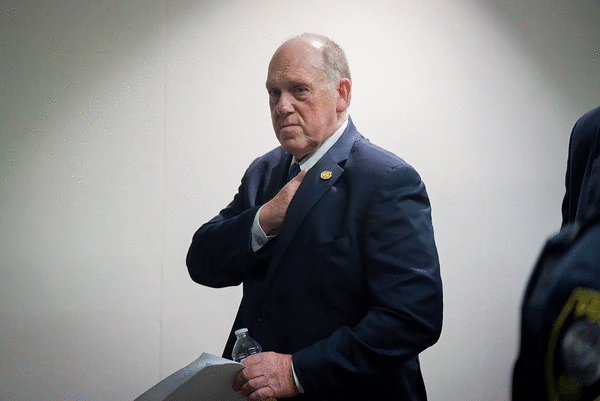
The head of the Minnesota Sheriffs’ Association and border czar Tom Homan are negotiating a deal for county jails to cooperate with federal immigration officials, a move that could lead to the drawdown of federal agents in the state, the Minnesota Star Tribune has learned.
The Minnesota Sheriffs’ Association, the Minnesota County Attorneys Association and Homan met on Monday, Feb. 1, to discuss a legal framework that would allow county jails to hold immigration enforcement targets for up to 48 hours after their scheduled releases from state custody.
James Stuart, the executive director of the Minnesota Sheriffs’ Association, confirmed the conversations and said his group sees it as a path to a reduction of federal agents in Minnesota.
“I will confirm that what you’re talking about is spot-on,” Stuart said. “We do think that it is a very viable solution to close some of the gaps. If we can find individuals who have committed crimes, if we’re able to have a secure and safe custody transfer rather than doing it on the streets, to us it seems like common sense.”
Homan has previously said that greater access to county jails would serve as a direct precursor to a drawdown of federal agents deployed to Minnesota for Operation Metro Surge.
Documents obtained by the Star Tribune show the general terms and conditions of what is known as a Basic Ordering Agreement, or BOA. It states that county jails would provide ICE with “reasonable access to all detainees or inmates” for the purpose of interviews related to immigration enforcement.
That wording might seem innocuous, but it would undercut what has been the state’s practice during the second Trump administration. And it’s certain to alarm activists and attorneys opposed to the immigration crackdown.
Access to county jails and state prisons for immigration enforcement was the thrust of Homan’s message at his news conference last week after arriving in Minnesota to take over Operation Metro Surge after the departure of Greg Bovino, the U.S. Border Patrol commander at large.
Homan’s arrival came with a more diplomatic tenor after the shooting deaths of Renee Good and Alex Pretti by federal law enforcement agents. He said his goal was better communication between the federal government and state and local leaders after the deployment of 3,000 federal agents by the Department of Homeland Security led to massive protests and confrontations between the public and federal agents across Minnesota.
Homan said if the state grew more cooperative with the federal government, agents could leave the state.
“As we see that cooperation happen,” Homan said at the news conference, “the redeployment will happen.”
Requests for comment from Homan on the BOA proposal were not returned. He is scheduled to address the media Wednesday morning, Feb. 4.
Stuart is a former Anoka County Sheriff who is awaiting Senate confirmation as President Donald Trump’s nominee as U.S. Marshal for Minnesota. He said the Sheriffs’ Association has been “trying to work with all of the stakeholders” involved in immigration enforcement.
“If there is a desire for a drawdown, honestly, I would be perplexed as to why anyone would be objecting to us trying to find a solution,” Stuart said. “I think this is a very workable solution.”
It is unclear if every county sheriff would participate in the agreement. That includes Hennepin and Ramsey, the two most populous counties in the state and the epicenter of Operation Metro Surge.
The BOA would seemingly operate as a legal workaround to an opinion issued by Minnesota Attorney General Keith Ellison in February of last year concluding that “Minnesota law prohibits state and local law enforcement agencies from holding someone based on an immigration detainer if the person would otherwise be released from custody.”
In the footnotes of that opinion, which was issued as a result of concerns raised by Ramsey County Attorney John Choi about the legal ramifications of holding people on immigration detainers, Ellison noted that there is a legal gray area in state law around “written agreements with local law enforcement agencies to enforce immigration laws.”
The BOA, which is a written agreement, could potentially include a clause that would stipulate the federal government pay damages or legal fees that sheriffs might incur if they were sued for breaking state law — a situation that has happened several times in Minnesota.
Still, the legal murkiness of the agreement led the Minnesota County Attorneys Association to get involved. Robert Small, the association’s executive director, said Tuesday that his office had sent the BOA to its members to request feedback on its legality.
While access to the jails has become a talking point of the Trump administration, state officials have questioned the notion that access to county jails is somehow stopping ICE from carrying out immigration enforcement or that it necessitated the deployment of 3,000 agents to Minnesota.
Last week, Dakota County Sheriff Joe Leko said he’s worked closely with federal partners in the past, but when the surge began, that communication seemed to break down. He said that if someone has been charged with a violent crime, then local law enforcement can and does arrest them.
Leko believes the “rapist murderers” the federal government has highlighted as the reason for Operation Metro Surge were already convicted and had done their time in prison but are being picked up for deportation, which is not the role of local police.
“It’s not people that we’re ignoring,” Leko said. “(ICE) might be taking them off the street, but we took them off the street first, and they already did their time in prison. So that’s a misconception that goes out there that can just inflame the whole thing, that we are just allowing murderers and rapists walking our streets.”
Homan said last week that access to the jails would create “commonsense cooperation that lets us draw down on the number of people here.”
_____
©2026 The Minnesota Star Tribune. Visit startribune.com. Distributed by Tribune Content Agency, LLC





Comments