Healey signs new offshore wind agreement with leaders of Nova Scotia as grid relies on fossil fuels
Published in News & Features
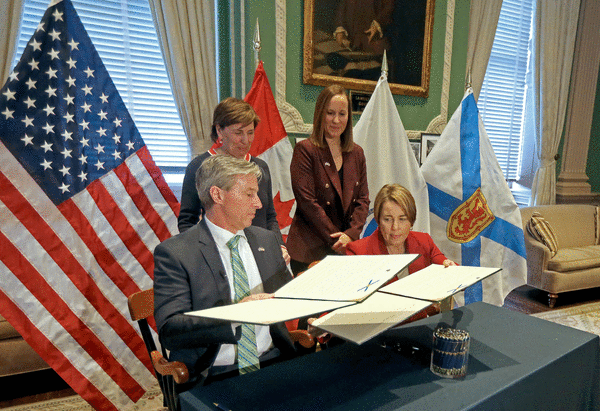
Gov. Maura Healey and Nova Scotia Premier Tim Houston signed an agreement to strengthen collaboration between the two jurisdictions on offshore wind development in the North Atlantic as the region’s electrical grid has been powered by fossil fuels during the cold winter weather.
“This memorandum of understanding today that Massachusetts sides with Nova Scotia is going to advance and strengthen offshore wind power in the Atlantic. It will benefit Nova Scotians, it will benefit people in Massachusetts and this region,” Healey said in a press conference announcing the agreement. “I’m really proud to take this step to strengthen the relationship between Massachusetts and Nova Scotia, and look with anticipation and excitement for what that means for our communities.”
The MOU identifies several areas of coordination between Massachusetts and Nova Scotia, including workforce development and job creation, transmission planning and grid integration, stakeholder engagement and public education, and investments in ports and supply chain development to advance the industry.
But critics say the high costs that come with industrial-scale offshore wind farms paired with the reliability of the technology makes it not worth pursuing.
“When the wind does not blow and imports do not arrive, Massachusetts still needs power. That is not a hypothetical. It is already happening right now,” said Fiscal Alliance Foundation Executive Director Paul Craney.
He noted the lack of reliability of wind power in the recent cold snap as well as a recent independent study that found New England ratepayers would save hundreds of billions of dollars through 2050 if the region ditched renewable energy mandates for natural gas and nuclear power.
“This is exactly what happens when ideology replaces affordability and engineering reality. Massachusetts has abundant access to clean domestic natural gas and proven nuclear technology, yet state leaders continue to chase the most expensive and unreliable options available,” he said.
The agreement comes as the data from the Independent System Operator New England (ISO-New England) shows offshore wind, as well as all other renewable energy sources combined, provided less than 10% of power to the grid servicing the region during last week’s cold snap that saw temperatures plunge into the single-digits.
Oil-fired plants provided the vast majority of power to the grid throughout the cold snap, with the energy source providing up to 43% of energy during peak demand. Oil, followed by natural gas and nuclear power, provided the vast amount of electricity to the region during the cold spell. Renewable sources combined to provide just 8% of the grid’s electricity during peak demand.
When asked by the Herald if offshore wind is a lost cause based on the recent shortcomings of wind power during the past couple of bitter cold weeks, Healey pointed to job creation, investment in infrastructure and anticipated regional energy supply as reasons why it is not.
“Heck no. You talk to anybody in the workforce, I mean, it’s been hundreds, if not thousands of jobs, the billions of investment in port infrastructure, and importantly, what it means for energy supply into the region. And obviously, more supply means lower costs,” said Healey.
“Around the world, countries are just moving fast on wind, on battery storage. And they understand that we need energy. And so we’re here today to try to do just that. We need all forms of energy. And certainly, offshore wind has been a great resource in any number of places. It’s not the only resource, right? We’re leaning hard into all energy sources, but it’s certainly something that is important,” she said.
Energy and Environmental Affairs (EEA) Secretary Rebecca Tepper also chimed in, praising what she calls the “success” of Vineyard Wind during the winter months.
“We were pleased to see that Vineyard Wind performed very well this winter, and indeed if we would have had like three more Vineyard Winds we would have had much lower prices and we would’ve had better reliability,” Tepper said. “So again, as the governor says, we’re really looking at all possibilities, all infrastructure, so that we can deal with a winter like this with varied energy resources.”
The governor’s office says the MOU calls on Massachusetts and Nova Scotia to initiate staff-level discussions to advance collaboration, with a focus on “practical next steps, including information sharing, coordination with relevant grid and transmission planners, and engagement with industry and other stakeholders, as appropriate.”
The MOU states that energy offices from both jurisdictions will report regularly to the heads of their agencies on progress and opportunities to deepen cooperation.
________
©2026 MediaNews Group, Inc. Visit at bostonherald.com. Distributed by Tribune Content Agency, LLC.






Comments