Jury deadlocked in Stanford felony vandalism trial
Published in News & Features
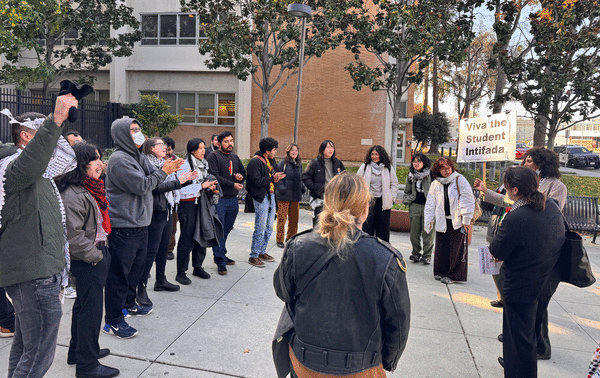
SAN JOSE, Calif. — Facing a possible mistrial, jurors in the felony vandalism case against five Stanford activists appeared deadlocked Thursday on a conspiracy charge, bringing prosecutors and defense attorneys back to court in one of the most serious prosecutions of pro-Palestinian supporters in the country.
Attorneys were first notified of the deadlock Wednesday afternoon and asked to appear in court Thursday for a status update. Judge Hanley Chew said the jury was split 8–4 on the conspiracy charge, though he did not disclose whether they favored conviction or acquittal. Chew instructed jurors to continue deliberating.
It remained unclear whether the split applied to one, some or all of the defendants. Although the five activists are being tried individually, jurors could reach the same outcome for all or decide differently for each.
As of press time, the jury had not returned a verdict on the conspiracy charge.
On Thursday afternoon, jurors also had begun deliberating on the felony vandalism charge, which carries a potential prison sentence of up to three years and possible restitution. If convicted on both charges, their sentences would run concurrently.
A continued deadlock on either the conspiracy or vandalism counts could result in a total or partial mistrial, leaving the door open for the prosecution to retry the case.
The trial centers on five of the 13 individuals initially arrested in connection with damage to Stanford’s executive offices during a June 2024 protest urging the university to divest from Israel-linked companies.
The five — German Gonzalez, Maya Burke, Taylor McCann, Hunter Taylor Black and Amy Zhai — are all Stanford students or alumni. The others initially arrested either accepted plea deals or were granted diversion programs.
The case stands out from other campus protests nationwide, where similar charges have largely been dropped.
Charges against most protesters arrested during a 2024 demonstration at Columbia University were dismissed, felony cases involving University of Michigan protesters were later dropped, and after arrests at a University of California, Los Angeles Gaza encampment, the Los Angeles city attorney declined to file criminal charges, though many students faced campus discipline.
At the trial, Santa Clara County Deputy District Attorney Rob Baker urged jurors to set aside politics, while defense attorneys framed the case as protected expression and argued there was insufficient evidence of intent to damage the buildings.
“Free speech is irrelevant to this case,” Baker said. “You don’t get to use free speech to commit crimes.”
Baker portrayed the defendants as a highly organized student group that planned the action in advance, stayed inside the building “as leverage” to push the university on divestment, and vandalized the office.
According to prosecutors, demonstrators caused more than $300,000 in damage to Building 10 by breaking a window to gain entry. Security footage shown at trial was presented by Baker, who pointed out that the defendants covered cameras with various materials and stacked bulky objects and furniture to block doors.
Santa Clara County Deputy Public Defender Avi Singh, who represents Gonzalez, argued the students wore protective gear and barricaded offices not to cause damage, but out of fear of being injured by police or campus security. To support that claim, Singh played security footage in which a voice can be heard saying, “Don’t get arrested, b****,” which the defense said came from a law enforcement officer.
Defense attorneys also argued the protesters said they would exit the building voluntarily, which they said showed that the intent of the demonstration was peaceful.
Other witnesses included fellow protester John Richardson, who entered a deferred judgment program last year, and Stanford facilities director Mitch Bousson, who testified about the extent of the damage. The defendants did not testify.
Throughout the trial, attorneys sparred over whether political expression could be considered in evaluating the defendants’ actions.
As early as jury selection, Baker argued that publicly discussing jurors’ views on Israel and Palestine could “poison” the jury pool. Defense attorney Leah Gillis countered that limiting such discussions would chill candor and undermine the goal of an impartial jury.
In closing arguments, Singh responded to the prosecution’s refrain that “dissent is American, vandalism is criminal,” telling jurors the government does not get to decide “what’s American and un-American, dissent and not dissent.”
“You decide whether their dissent is criminal,” he said.
©2026 MediaNews Group, Inc. Visit at mercurynews.com. Distributed by Tribune Content Agency, LLC.





Comments